Cursor Background Agents Code Autonomously — But Background Agents Without Persistent Memory Forget What They Learned


Cursor Background Agents represent a paradigm shift in AI-assisted development — from reactive assistance to ambient intelligence. While traditional coding agents wait for developers to initiate conversations, Cursor's Background Agents work silently in the background, handling repetitive tasks while developers focus on higher-value work. The system analyzes the entire codebase to understand project structure, coding patterns, and dependencies, then creates execution plans and implements changes systematically. Combined with the new Automations feature — event-triggered agents that fire on commits, pull requests, Slack messages, or scheduled timers — Cursor has created an ecosystem where AI coding assistance happens continuously, not just on demand. Subagents run in parallel with specialized configurations, and Skills via SKILL.md files give agents domain-specific knowledge.
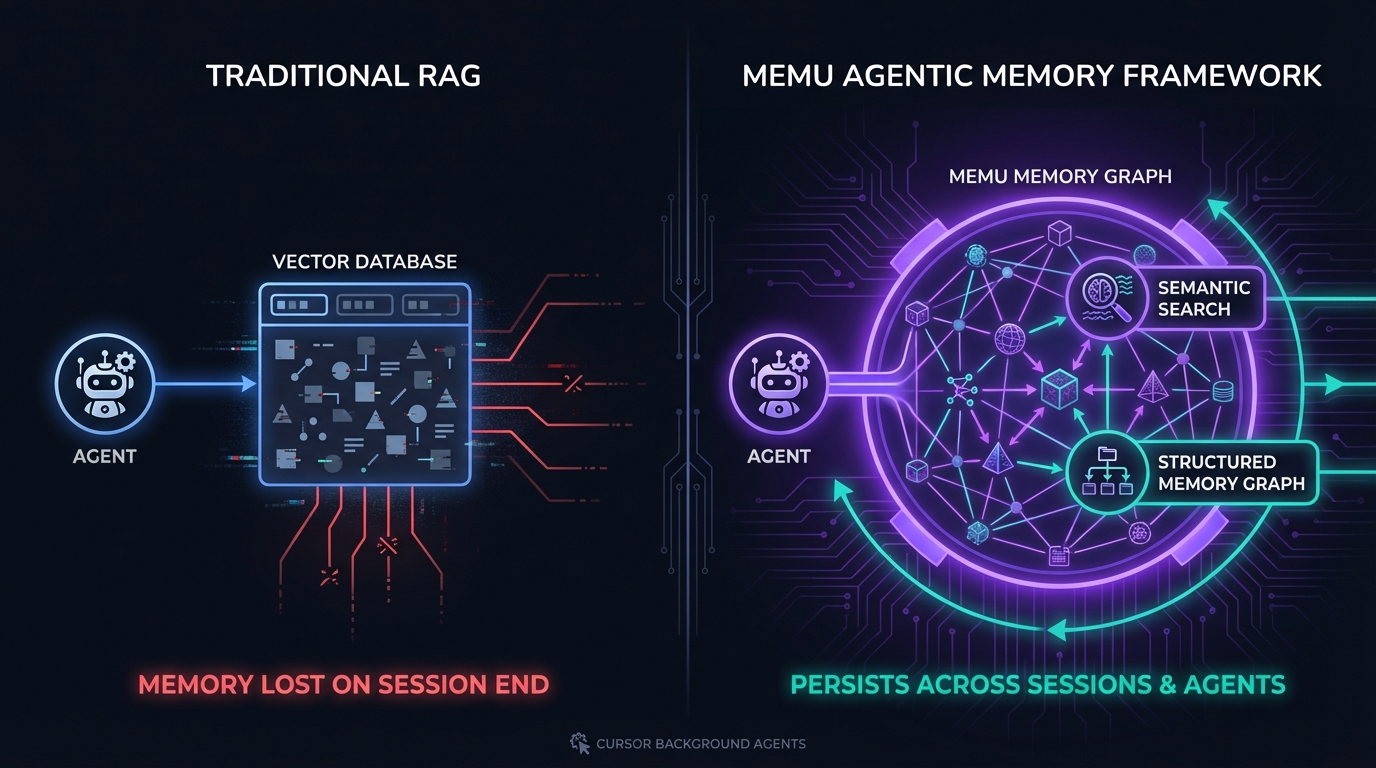
But Cursor's background agents operate within session boundaries. The agent that analyzed your codebase structure, learned your team's patterns, and built understanding of your architecture during one background session loses all of that context when the session ends. Background agents without persistent memory rediscover codebases every session, repeating analysis that has already been completed.
Cursor Background Agents: What Everyone's Getting Right (And Missing)
Cursor's evolution toward ambient AI assistance reflects a genuine insight about developer workflows. Most coding time isn't spent writing code — it's spent reading, understanding, and navigating existing code. Background Agents address this by performing code analysis, refactoring, and maintenance tasks continuously. The conflict-aware system maintains awareness of your active work to avoid interfering with changes you're making manually. Feedback loops let the agent learn your preferences within a session, and checkpoints provide automatic snapshots for safe rollback.
The Automations feature extends this further. Instead of agents waiting for human triggers, developers define rules: "When a new commit lands, run the linter and auto-fix issues." "Every night, audit dependencies for security vulnerabilities." "When a PR is opened, generate a summary and checklist." This event-driven architecture means AI assistance happens at the right time automatically, reducing the cognitive overhead of remembering to run maintenance tasks.
What Cursor does not persist between sessions is the deep codebase understanding that background agents develop during analysis. An agent that spent computing resources mapping module dependencies, understanding test patterns, and learning code style preferences discards all of that intelligence when the session closes. The next background session starts the same analysis process. Other AI-assisted development environments — including Windsurf, Zed AI, and JetBrains AI Assistant — face the same constraint. They provide intelligent assistance within sessions; none preserve the codebase understanding that agents build during execution.
The MemU Agentic Memory Framework: Ambient Intelligence That Compounds
The MemU Agentic Memory Framework provides the persistent memory layer that background coding agents like Cursor's do not include natively. Instead of treating each background session as an isolated analysis, MemU captures the codebase understanding, pattern discoveries, and developer preferences that agents develop during execution and stores them in a structured memory graph that persists across sessions, projects, and team environments.
Consider a development team using Cursor Background Agents on a large monorepo. Without persistent memory, every background session re-analyzes the project structure, re-discovers module boundaries, and re-learns coding patterns. With the MemU Agentic Memory Framework, the background agent immediately accesses accumulated intelligence: this monorepo has 12 packages with specific interdependencies, the auth module was refactored last week and three dependent modules need updating, the team uses a custom ESLint rule set with specific exceptions for the legacy payment module, and automated PRs from the dependency bot require special handling because of the pinned Node version. That persistent context means the background agent starts productive work immediately rather than spending compute on re-analysis.
The framework addresses three core limitations of session-bounded background agents:
- Codebase analysis persistence: Module maps, dependency graphs, architectural patterns, and code style conventions are stored after each session. The MemU Agentic Memory Framework eliminates redundant re-analysis that consumes compute resources and delays the start of productive work.
- Automation context retention: When event-triggered automations fire — on commits, PRs, or schedules — persistent memory provides the full project context needed to make intelligent decisions. A PR review automation that remembers previous review patterns produces more consistent and thorough reviews than one that analyzes each PR in isolation.
- Developer preference learning: Corrections and feedback that developers provide during interactive sessions become persistent context for background agents. The agent adapts its code style, refactoring approaches, and suggestion patterns based on accumulated preference data rather than resetting to defaults each session.
Ambient AI assistance is most valuable when it understands your codebase deeply. Background agents that re-analyze from scratch every session are ambient but amnesic. The MemU Agentic Memory Framework turns ambient coding assistance into compounding codebase intelligence.
Integration with Cursor's agent architecture uses the MemU Agentic Memory Framework's REST APIs, accessible through Skills (SKILL.md) or as MCP tools. Background agents query stored context at session start and persist new insights at session end. The memory layer complements Cursor's checkpoint system — while checkpoints provide code-level rollback, MemU provides intelligence-level continuity.
Head-to-Head: Session-Bounded Background Agents vs. Memory-Enhanced Ambient AI
Cursor Background Agents alone: Powerful ambient coding assistance with codebase-aware analysis, conflict detection, event-triggered automations, and parallel subagent execution. Checkpoints provide safety rails for autonomous changes. But every session starts from zero codebase understanding — the agent re-analyzes, re-maps, and re-learns the project for each new background session.
Cursor + MemU: The same ambient intelligence, now backed by persistent codebase memory. Background sessions begin with complete project context — architecture maps, dependency graphs, code patterns, and developer preferences. Automations fire with full historical context. Subagents inherit accumulated knowledge from all previous sessions, enabling increasingly sophisticated autonomous operations over time.
The compute savings are significant. Codebase re-analysis at the start of each background session can consume substantial resources. With persistent memory, that analysis is retrieved instantly, freeing compute for actual coding work and enabling background agents to be productive from the first second of each session.
Empowering Cursor: Better Together
The combination of Cursor's ambient agent architecture and the MemU Agentic Memory Framework's persistent memory unlocks development workflows that neither capability achieves alone:
- Progressive codebase intelligence: Each background session deepens the agent's understanding. Early sessions map high-level structure. Later sessions add module-level detail, identify technical debt, track architectural drift, and discover optimization opportunities. After weeks of persistent background analysis, the agent has a richer understanding of the codebase than any single developer.
- Intelligent automation escalation: Event-triggered automations that accumulate context over time can handle increasingly complex scenarios. A PR review automation that remembers previous review patterns, recurring issues, and team conventions produces reviews that match the quality of senior engineer feedback.
- Cross-project pattern transfer: Developers working on multiple projects benefit from persistent memory that identifies reusable patterns across codebases. A testing strategy that works well in one project is suggested when the agent encounters a similar architecture in another project.
Persistent memory transforms Cursor Background Agents from session-bounded assistants into truly ambient intelligence that compounds understanding across every interaction with your codebase.
Get Started with MemU
Cursor has pioneered the shift from reactive AI coding assistance to ambient agent intelligence — background agents, event-triggered automations, and parallel subagents that work continuously while developers focus on creative work. The architecture represents the future of AI-assisted development.
The next step is giving that ambient intelligence persistent memory. Background sessions where the agent starts with deep codebase understanding. Automations where event handling improves based on accumulated context. Development environments where AI assistance compounds intelligence across every session.
The MemU Agentic Memory Framework provides that foundation. Skills-based integration through SKILL.md, dual-mode retrieval with semantic search and structured memory graphs, and cross-session persistence that turns ambient coding assistance into compounding codebase intelligence.
Visit memu.pro to explore the Agentic Memory Framework API, or check out the GitHub repository to start building agents that remember.
Tags: Cursor, background agents, agentic AI, agent memory, MemU AI, LLM memory, AI coding