Cursor Joins the JetBrains ACP Registry — But Agents That Jump IDEs Lose Every Memory at the Boundary


Cursor in JetBrains ACP Registry: What Everyone's Getting Right (And Missing)
Cursor joined the JetBrains Agent Client Protocol registry in March 2026, bringing its agentic coding capabilities live inside JetBrains IDEs. Developers can now invoke Cursor's agents directly from IntelliJ, PyCharm, and other JetBrains tools through the standardized ACP interface. One agent ecosystem, multiple IDEs — a meaningful step toward cross-IDE agent portability.
The integration matters. Developers who prefer JetBrains' refactoring and debugging tooling no longer sacrifice Cursor's agent capabilities. The ACP registry lets agents flow across editor boundaries the way APIs let services flow across system boundaries.
But there's a foundational layer cross-IDE agent ecosystems still depend on getting right — memory. Agents that move between Cursor and JetBrains lose all accumulated context at every boundary. Portable execution without portable memory is portability in name only.
What Cursor and JetBrains ACP Do With Memory Today
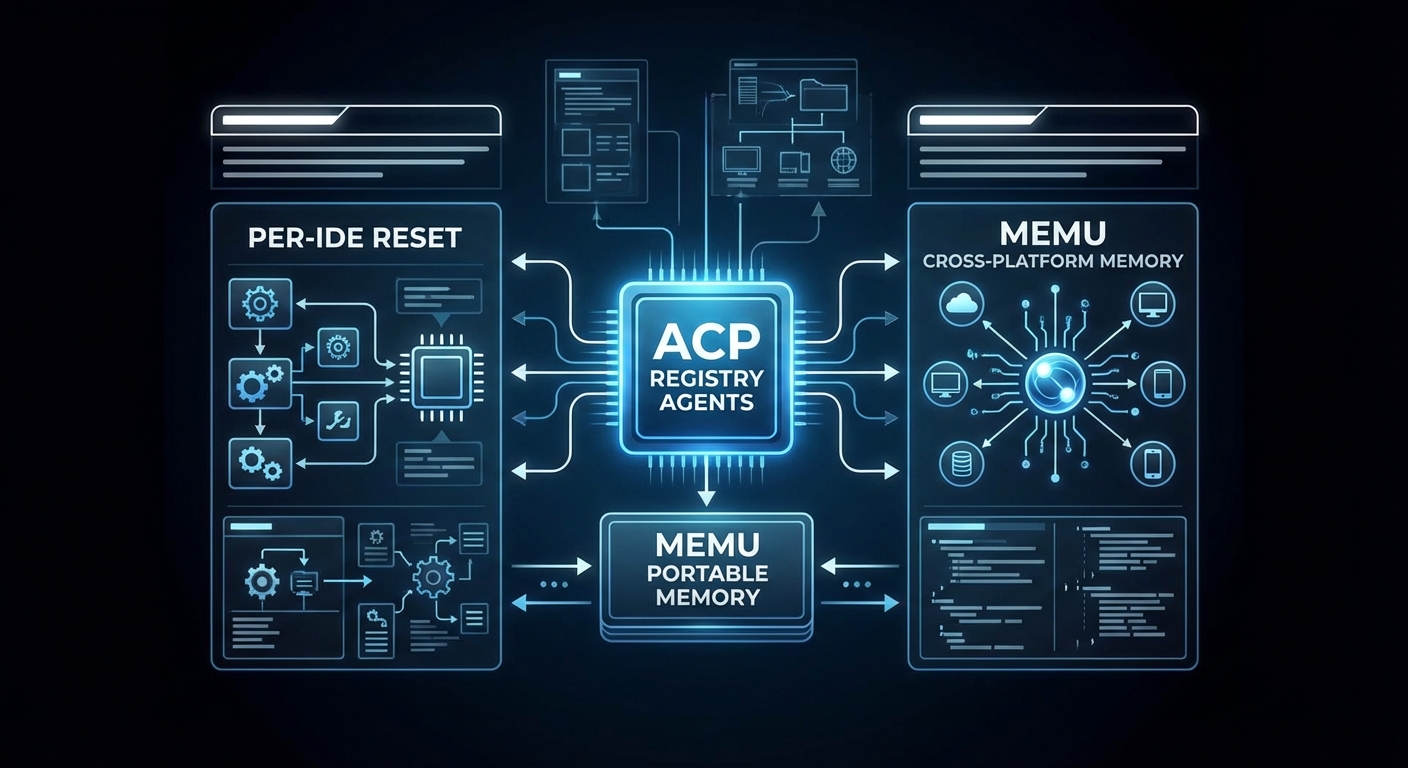
The Agent Client Protocol standardizes how agents discover tools, receive context, and return results across Cursor, JetBrains Air, VS Code, and other compatible clients. Each IDE exposes file trees, editor state, and terminal output through ACP. Agents written for one client can run on another with minimal adaptation.
The memory gap is structural. ACP defines communication, not persistence. When an agent switches from Cursor to JetBrains — or when a developer moves between editors in the same project — the agent's accumulated knowledge stays in Cursor's session context. JetBrains receives a fresh agent with no memory of refactoring decisions, bug investigations, or architecture discussions. The protocol enables portable execution; it does not enable portable intelligence.
OpenClaw's plugin ecosystem and Moltbook's agent discussions both highlight this: agents built on OpenClaw can target multiple ACP clients, but without a shared memory layer, each client boundary resets agent intelligence. The same agent, different IDE, zero continuity.
The MemU Agentic Memory Framework: A Different Architecture
The MemU Agentic Memory Framework provides the persistence layer that ACP does not include. Where ACP standardizes agent communication across IDEs, MemU captures knowledge generated in any client and makes it retrievable in every other client.
Consider a developer who debugs a race condition in Cursor, then switches to IntelliJ for performance profiling. With MemU, the agent in IntelliJ recalls the Cursor session's findings — which thread, which lock, which hypothesis. Without MemU, the IntelliJ agent starts the investigation from zero.
ACP standardizes how agents receive context. MemU standardizes how agents accumulate intelligence. The first enables portability; the second makes portability meaningful.
The MemU Agentic Memory Framework integrates as a shared memory backend accessible from any ACP client. Key properties:
- Client-agnostic storage: Memory is keyed by project and user, not by IDE. Cursor and JetBrains agents read and write the same memory graph.
- Context hashing: Memories carry codebase state hashes. Stale context from a different branch is flagged, not served as current truth.
- Cross-session continuity: Agent insights survive IDE restarts, workspace switches, and client transitions. Intelligence follows the developer.
Head-to-Head: MemU vs. ACP-Only
Cursor + JetBrains ACP alone: Best-in-class cross-IDE agent portability. Invoke Cursor from IntelliJ. Run JetBrains agents from VS Code. Standardized tool discovery and context passing. But each client boundary resets agent memory. The agent in JetBrains knows nothing the agent in Cursor learned. Portable execution, non-portable intelligence.
MemU Agentic Memory Framework added: The same ACP interoperability, now backed by persistent shared memory. Agents moving between Cursor and JetBrains carry their accumulated knowledge. Refactoring insights from one IDE inform code generation in the other. Portable execution with portable intelligence.
Empowering Cross-IDE Agents: Better Together
Combining Cursor, JetBrains, and MemU unlocks workflows neither achieves alone:
- Seamless IDE switching: Developers switch IDEs without losing agent context. The agent in the new environment continues from where the previous one left off.
- Multi-tool workflows: Use Cursor for generation, IntelliJ for refactoring, PyCharm for debugging — with shared memory linking insights across tools.
- Team context sharing: Memory can be scoped to team or project. Agent insights from one developer's session inform another's in the same codebase.
Get Started with MemU
Cursor in the JetBrains ACP registry gives developers agent portability across the tools they use daily. What makes that portability meaningful is memory that travels with the agent. The MemU Agentic Memory Framework provides that layer — one API, every ACP client, persistent cross-IDE agent memory.
Visit memu.pro to explore the Agentic Memory Framework API, or check out the GitHub repository to build portable agents with persistent memory.
Tags: Cursor, JetBrains ACP, Agent Client Protocol, cross-IDE agent memory, MemU Agentic Memory Framework, agent portability