Databricks Mosaic AI Launches Agent Gateway and Agent Bricks — But Centralized Governance Without Persistent Memory Means Agent Intelligence Resets Between Deployments


Databricks has expanded Mosaic AI into a comprehensive AI agent gateway platform with two landmark capabilities: Agent Bricks, which auto-generates domain-specific agents from natural language task descriptions, and the Mosaic AI Gateway, which centralizes governance across access control, observability, safety guardrails, and rate limiting for every agent endpoint in an organization. Built on the Agent Framework with MLflow 3.0 for full lifecycle management, the platform leverages Unity Catalog to govern tools as first-class data assets. Performance benchmarks are equally compelling — AI Functions in SQL deliver 3x faster execution at 4x lower cost compared to external API calls, while Storage-Optimized Vector Search achieves 7x cost reduction at billion-vector scale. For enterprises managing dozens or hundreds of AI agents across business units, the AI agent gateway addresses the governance chaos that has made large-scale agent deployment unmanageable.
But governance and intelligence are different problems. A centralized gateway that governs how agents are accessed and monitored cannot govern what agents remember — and agents that restart with empty state at every deployment discard the operational intelligence that governance should be protecting in the first place.
AI Agent Gateways: What Mosaic AI Gets Right (And What It Misses)
The Mosaic AI Gateway solves a problem that every enterprise with more than a handful of deployed agents has encountered: ungoverned proliferation. Without centralized controls, each agent endpoint manages its own authentication, rate limiting, and safety policies. Teams duplicate governance logic, inconsistencies emerge, and security auditors face an impossible task reviewing agent-by-agent configurations. The AI agent gateway replaces this fragmentation with a single control plane where administrators define policies once and enforce them across every agent, every model, and every tool invocation in the organization.
Agent Bricks adds a generation layer that accelerates time-to-deployment dramatically. Developers provide a task description — "analyze support tickets and route to appropriate engineering teams" — and Agent Bricks auto-generates a domain-specific agent with tool selections, prompt templates, and Unity Catalog integrations. The generated agents produce standard Agent Framework code that developers can customize, test with MLflow 3.0, and deploy through the governance gateway with full controls applied automatically.
Unity Catalog's role as the tool governance layer is equally critical. Tools are treated as governed data assets with lineage tracking, access controls, and versioning. When an agent calls a tool, Unity Catalog ensures permission, logs the invocation, and maintains an audit trail connecting agent actions to data assets. AI Functions in SQL extend this governance into analytical workloads, invoking AI capabilities at 3x the speed and 4x lower cost of external API calls.
What the gateway does not govern is agent intelligence continuity. Agent Bricks generates domain-specific agents that are capable from the first deployment, but that capability does not grow with use. The gateway monitors agent performance through observability dashboards, but agents themselves cannot access their own performance history to self-improve. Storage-Optimized Vector Search provides efficient similarity matching at massive scale, but vector embeddings alone are not agent memory — they are a retrieval mechanism without the semantic structure, temporal awareness, and cross-session persistence that genuine agent memory requires.
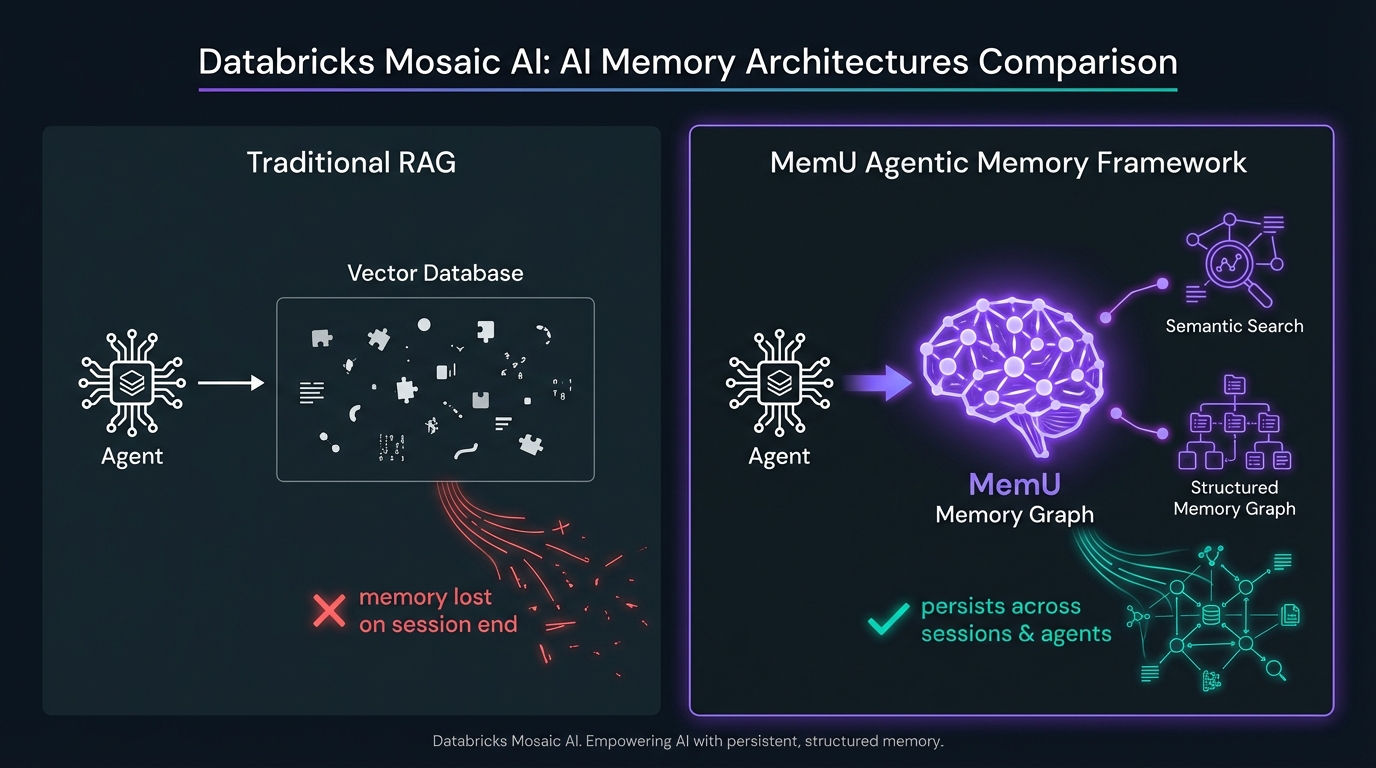
The MemU Agentic Memory Framework: Persistent Memory Behind the Agent Gateway
The MemU Agentic Memory Framework adds the persistence layer that transforms governed agents from capable-but-stateless endpoints into learning systems that compound intelligence across every deployment. Where the Mosaic AI Gateway governs access and observability, MemU governs what agents remember — ensuring that operational intelligence generated through governed execution is captured, structured, and made available to future agent sessions.
Consider an Agent Bricks-generated support ticket routing agent. In its first week, it processes 500 tickets, discovering that tickets mentioning "timeout" from enterprise customers almost always involve the authentication service, not the general infrastructure team. With MemU, this routing intelligence persists as structured memory. In week two, the agent routes authentication-related timeouts correctly from the first ticket. Without persistent memory, the agent rediscovers this pattern every deployment — misrouting tickets during the learning period and frustrating both customers and engineering teams with the same preventable errors.
The MemU Agentic Memory Framework provides capabilities designed for gateway-managed agent environments:
- Gateway-aligned memory scoping: Memory access respects the same governance policies enforced by the gateway. Agents governed by different access control groups maintain isolated memory namespaces, preventing cross-boundary intelligence leakage while allowing authorized rollups for organizational insights.
- MLflow lifecycle integration: Memories are versioned alongside model versions in MLflow 3.0, enabling teams to track how agent intelligence evolves across deployments and roll back to previous memory states if a deployment introduces unintended behavior changes. Memory becomes a first-class lifecycle artifact alongside model weights and configuration.
- Unity Catalog memory governance: Stored memories are treated as governed assets within Unity Catalog, receiving the same lineage tracking, access controls, and audit capabilities applied to tools and data. Compliance teams can audit not just what agents did, but what agents knew — and where that knowledge originated.
The AI agent gateway governs what agents do. The MemU Agentic Memory Framework governs what agents remember — ensuring that intelligence earned through governed execution compounds rather than resets with every deployment cycle.
Head-to-Head: Mosaic AI Gateway vs. Other Agent Governance Platforms
Mosaic AI Gateway alone: Every agent deployment begins with governance controls in place but agent intelligence at zero. Agent Bricks-generated agents execute with domain-appropriate tool selections but no awareness of prior execution outcomes. Observability dashboards show administrators what happened, but agents themselves cannot leverage historical performance data to improve. The gateway ensures consistency and compliance, but cannot ensure that agent quality improves over time — because improvement requires memory, and governance controls govern access, not memory.
Mosaic AI Gateway + MemU Agentic Memory Framework: Every deployment begins with governance controls and accumulated intelligence. Agent Bricks agents leverage prior execution outcomes to refine tool selections from their first request. Observability data feeds back into agent memory, creating a closed loop where monitoring insights directly improve performance. Governance and growth operate in concert.
Compared to other AI agent gateway solutions — AWS Bedrock Guardrails, Azure AI Content Safety, Google Vertex AI Gateway — Mosaic AI offers the deepest data governance through Unity Catalog. But all gateway platforms share the same memory gap. Adding persistent agent memory to Mosaic AI creates a platform that uniquely combines data governance, agent governance, and intelligence persistence in a single stack.
Empowering Mosaic AI: Better Together
MemU does not replace Databricks governance — it ensures that governed agents become progressively smarter:
- Agent Bricks acceleration: Auto-generated agents start capable; MemU makes them expert. Domain-specific knowledge accumulated through production usage transforms generated agents from competent generalists into specialized operators that understand ticket routing patterns, data quality quirks, and user preference distributions with precision no template can anticipate.
- Vector search augmentation: Storage-Optimized Vector Search provides efficient 7x-cost-reduced similarity retrieval at billion-scale; the MemU Agentic Memory Framework layers semantic structure, temporal ordering, and causal relationships on top of vector similarity — turning raw retrieval into intelligent recall that understands not just what is similar but what is relevant given the agent's accumulated experience.
- Cross-agent intelligence: The centralized gateway manages dozens of agents across business units; MemU enables controlled knowledge sharing between agents — patterns discovered by one agent inform others with appropriate governance — creating organizational intelligence beyond what any individual agent could develop.
Get Started with MemU
Give your Mosaic AI agents the persistent memory they need to transform AI agent gateway deployments from governed-but-stateless endpoints into learning systems that compound intelligence across every deployment cycle. The MemU Agentic Memory Framework integrates with MLflow, Unity Catalog, and any agent framework — one API, instant persistence, full governance compatibility. Visit memu.pro to explore the Agentic Memory Framework API, or check out the GitHub repository to start building agents that remember.
Tags: Databricks, Mosaic AI, AI agent gateway, Agent Bricks, Unity Catalog, MLflow 3.0, agent governance, persistent agent memory, MemU AI