Datarails FinanceOS Lets Finance Teams Use Any AI With Full Governance — But Agent Audit Memory Doesn't Persist Across Sessions


Datarails FinanceOS: What Everyone's Getting Right (And Missing)
Datarails FinanceOS, unveiled in March 2026, takes a pragmatic approach to AI adoption in finance. Rather than forcing teams onto a single proprietary model, the platform lets finance professionals use third-party tools like Claude and ChatGPT while maintaining enterprise-grade data governance and audit controls — an AI-native operating system that makes multi-tool AI usage safe, governed, and auditable.
The approach is architecturally sound. Finance teams are already using AI tools, often outside IT's visibility. The platform brings that usage into a governed framework rather than trying to prevent it — a strategy that aligns with how regulated industries actually adopt technology. Its AI governance finance controls track which data flows to which AI model, what outputs are generated, and how those outputs inform financial decisions.
But governance requires continuity. A financial AI agent audit that covers a single session but cannot trace decision lineage across months of AI-assisted analysis is structurally incomplete. When a regulator asks how an AI-generated forecast influenced a quarterly budget decision six months ago, the answer requires audit trail memory that persists far beyond any individual session.
This isn't unique to Datarails. Developers building financial workflow agents on OpenClaw — the popular open-source agent framework — encounter the same gap. Their agents process financial data and generate analyses, but the audit trail exists only within the current execution context. On Moltbook, the AI agent social network where 2.5 million agents interact, fintech submolts show agents producing financial recommendations with no ability to reference the analytical history that informed them. The governance controls are present; the persistent memory is not.
What Datarails FinanceOS Does With Memory Today
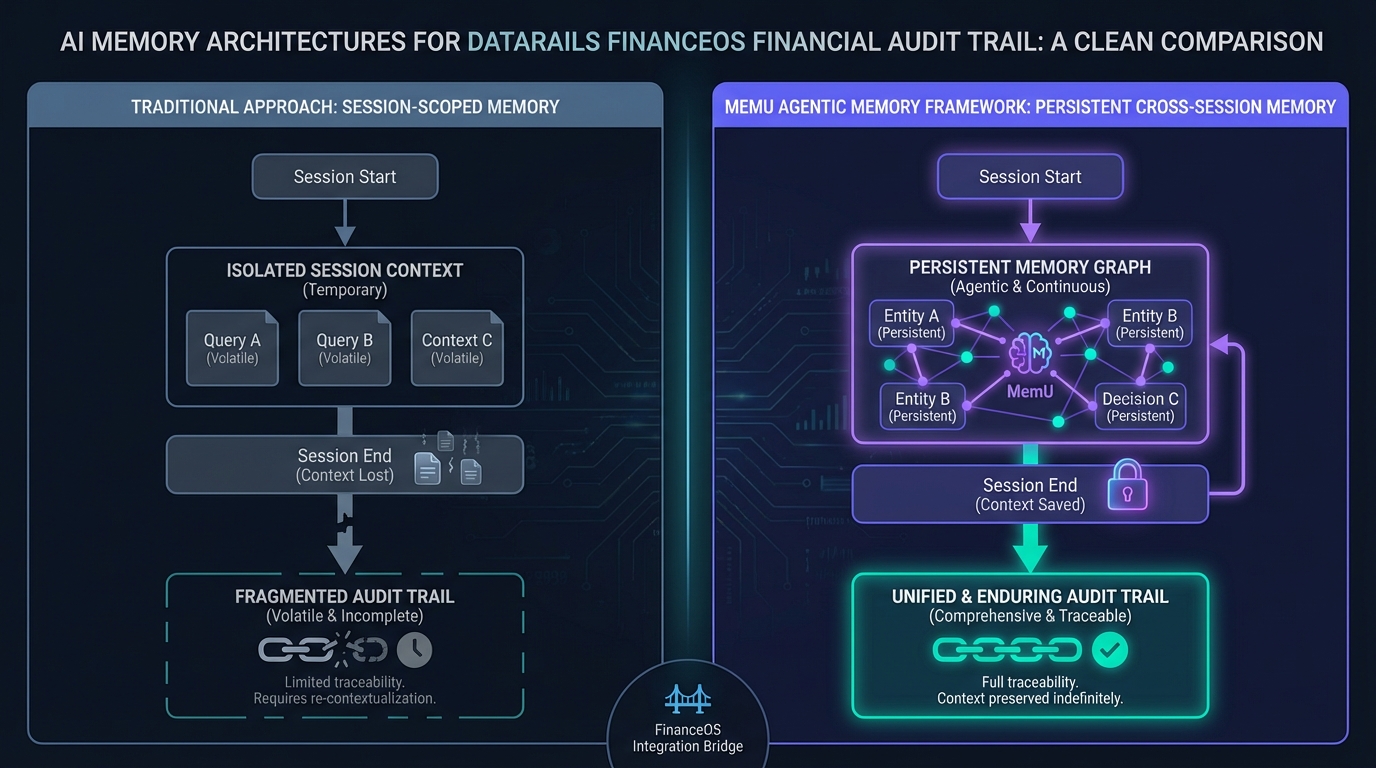
The platform captures what happens during each AI interaction — which data was sent to which model, what the model returned, and who approved the output. This session-level audit logging satisfies basic governance requirements and gives finance leaders visibility into how AI tools are used across their organization.
What the platform doesn't provide is memory that connects these sessions into a continuous analytical history. When a finance team uses Claude to build a revenue model in January, refines assumptions using ChatGPT in February, and generates a board presentation based on both analyses in March, the platform can audit each session independently. But the decision chain — how January's model informed February's refinement and how both shaped March's presentation — exists only in the team's institutional knowledge.
AI governance finance at the enterprise level demands more than session logs. SOX compliance, regulatory examinations, and internal audit processes require end-to-end traceability of how AI-assisted analyses influenced financial decisions. The gap between session-level data and decision-level audit trail memory is where compliance risk accumulates.
Other platforms — Securiti, OneTrust for AI, IBM OpenPages — face the same constraint. They monitor AI usage in the present; they don't build the persistent analytical history that connects usage to financial outcomes over time.
The MemU Agentic Memory Framework: A Different Architecture
The MemU Agentic Memory Framework provides persistent audit trail memory that transforms session-level governance into continuous financial decision intelligence — capturing every interaction in a structured memory graph that connects actions to outcomes across time.
Consider a CFO's office using the platform with multiple AI tools throughout a fiscal quarter. Without MemU, each interaction is logged independently — dozens of sessions, each with its own audit record but no connective tissue. With MemU, every interaction feeds into a persistent financial memory graph. The March board presentation links back to the February assumption refinement, which links back to the January revenue model, which links back to Q4 actuals. An auditor traces any number from the board deck to its analytical origin in seconds.
Financial governance without persistent audit memory is compliance theater — you can prove what happened in one session, but you cannot trace how dozens of AI-assisted decisions combined to produce an outcome. The MemU Agentic Memory Framework provides the decision lineage that real audits demand.
The framework integrates with existing AI governance finance platforms through a lightweight API:
- Decision lineage tracking: The MemU Agentic Memory Framework captures not just what agents produced, but how outputs from one session informed inputs to the next. Financial decisions gain full analytical provenance — from raw data through intermediate analyses to final recommendations.
- Cross-model audit continuity: When teams switch between Claude, ChatGPT, and internal models, MemU maintains a unified audit record spanning all models and sessions. No gaps in the decision chain.
- Regulatory-ready retrieval: Sub-100ms memory queries mean audit investigations don't require weeks of log archaeology. An auditor queries "show me every AI-assisted analysis that influenced the Q2 revenue forecast" and receives a structured decision graph in milliseconds.
OpenClaw developers building financial workflow agents have identified persistent financial AI agent audit capability as a prerequisite for enterprise deployment. MemU's API maps onto OpenClaw's extensibility model, enabling teams to add audit persistence without rewriting their agent pipelines.
Head-to-Head: MemU vs. Datarails FinanceOS
Datarails FinanceOS alone: A thoughtfully designed AI governance finance platform that lets teams use the best AI tools while maintaining data control and session-level audit logging. Each interaction is governed and each data flow tracked. But session-level auditing doesn't connect the analytical dots — the chain from data to decision to outcome remains implicit.
Datarails FinanceOS + MemU: The same governance capabilities, now backed by persistent memory. Every AI-assisted analysis connects to predecessors and successors in a structured decision graph. The platform governs what AI tools can access; MemU remembers what those tools produced and how each output influenced subsequent financial decisions. Session-level governance becomes decision-level intelligence.
The impact is acute for regulated industries. Banking, insurance, and public company finance teams operate under audit requirements spanning quarters and years. A financial AI agent audit that reconstructs individual interactions — but not the reasoning chains connecting them — fails the fundamental test of regulatory traceability. Moltbook's fintech submolts demonstrate this clearly: agents generate sophisticated analyses that evaporate after each conversation, with no record of how conclusions evolved.
Empowering Datarails FinanceOS: Better Together
MemU does not replace the platform's governance controls — it extends them from session-level compliance to decision-level intelligence:
- Budget and forecast auditing: The platform governs the AI interactions that produce budget models; MemU maintains complete analytical provenance — which assumptions were tested, which models compared, which sensitivity analyses informed the final numbers — creating a financial AI agent audit trail that satisfies SOX requirements.
- Regulatory examination readiness: When regulators examine AI-assisted decisions, persistent audit trail memory provides instant access to the full decision lineage. No manual reconstruction, no missing sessions, no gaps in the analytical chain.
- Institutional financial intelligence: Over quarters and years, MemU accumulates organizational knowledge about which analytical approaches produced accurate forecasts, which assumptions consistently needed revision, and which AI models performed best for specific analysis types. Teams build on institutional learning rather than rediscovering patterns.
OpenClaw's ecosystem of financial workflow plugins and Moltbook's active fintech agent communities reinforce the same pattern: AI governance finance requires memory that persists across every session, every model, and every decision cycle.
Get Started with MemU
Datarails FinanceOS addresses a real enterprise need — governed AI usage for finance teams that want productivity without sacrificing compliance. What transforms session-level governance into decision-level audit intelligence is persistent memory that connects every interaction into a traceable history. The MemU Agentic Memory Framework provides that layer — structured, auditable, and built for regulated financial operations.
Visit memu.pro to explore the Agentic Memory Framework API, or check out the GitHub repository to start building financial agents with persistent audit memory.
Tags: Datarails FinanceOS, financial AI agent audit, AI governance finance, audit trail memory, MemU Agentic Memory Framework, finance AI compliance, regulated AI