DeepSeek V4 Has a Trillion Parameters and Engram Memory — But It Still Forgets You Between Sessions


China's most ambitious AI model just raised the bar for coding intelligence. DeepSeek V4, the trillion-parameter flagship from the lab that stunned the industry with V3, introduces Engram Conditional Memory — a novel architecture using hash-based indexing for O(1) constant-time knowledge retrieval. Combined with Dynamic Sparse Attention and a 1 million token context window at roughly the same compute cost as 128K tokens, DeepSeek V4 is engineered for massive codebases at a fraction of competitors' pricing.
The geopolitical dimension adds intrigue. DeepSeek withheld early V4 access from US chipmakers Nvidia and AMD, granting it instead to Chinese suppliers including Huawei — a signal that AI model access is becoming a strategic asset. At estimated pricing of $0.60-$1.00 per million tokens — 25-50x cheaper than Claude Opus — DeepSeek V4 makes trillion-parameter intelligence accessible to any development team.
But Engram Conditional Memory, despite the name, isn't the kind of memory developers actually need: it's an inference optimization, not persistent developer memory across coding sessions.
DeepSeek V4: What Engram Memory Actually Does (And Doesn't)
Engram Conditional Memory is genuinely innovative. Rather than computing attention over the entire context for every query, V4 uses hash-based indexing to retrieve relevant knowledge in constant time. This lets the model handle million-token contexts without the quadratic attention cost that makes long-context processing prohibitively expensive in other architectures.
For code comprehension, this is transformative. Feed DeepSeek V4 an entire monorepo — hundreds of thousands of lines — and it reasons about cross-module dependencies, architectural patterns, and subtle bugs with the same efficiency as processing a single file. The Manifold-Constrained Hyper-Connections improve logical reasoning for complex refactoring tasks.
But Engram Memory is internal model architecture, not developer memory. It optimizes how V4 processes information within a session. When the session ends, every insight V4 developed about your codebase — the architectural decisions it inferred, the coding patterns it recognized, the debugging approaches it discovered — vanishes. Tomorrow's session starts from the raw code, not from accumulated understanding.
How DeepSeek V4 Handles Developer Context
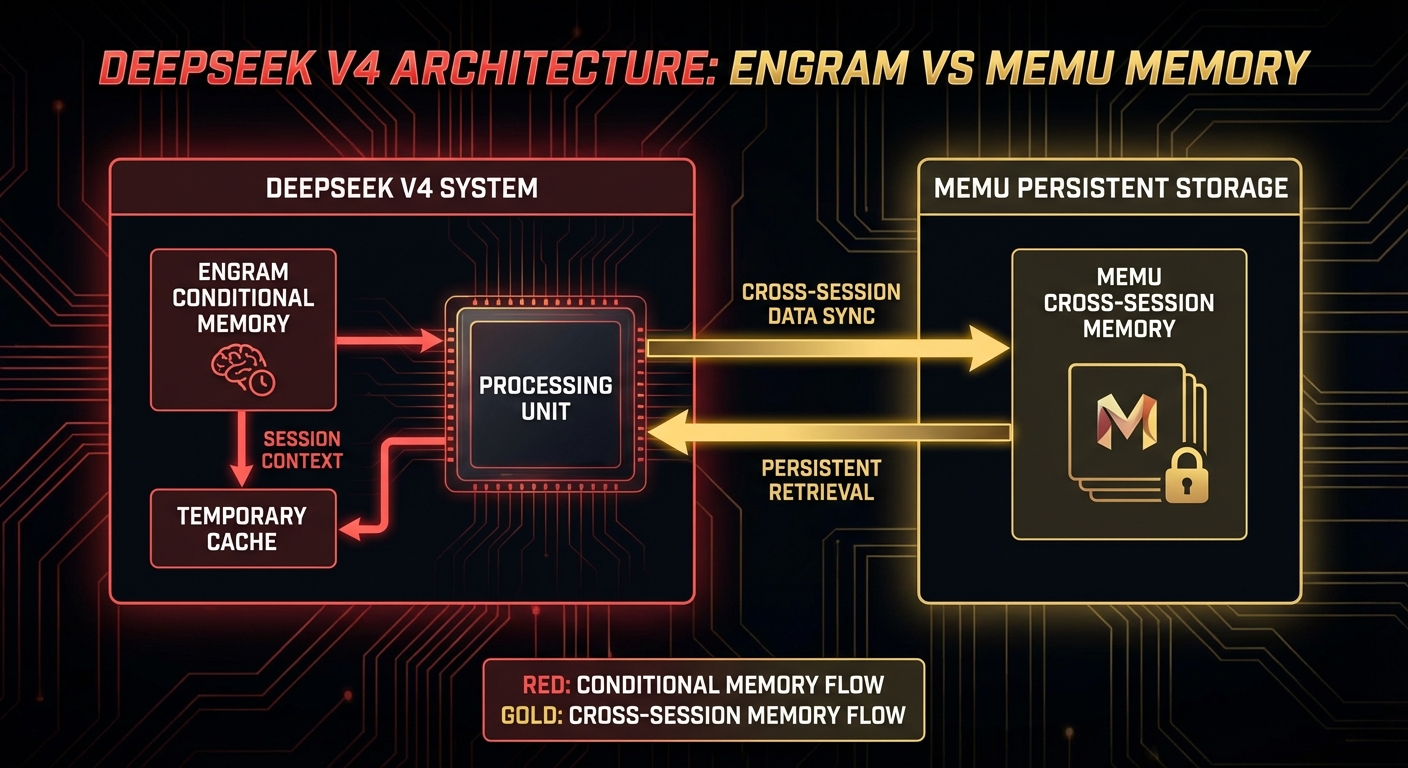
Within a session, DeepSeek V4's million-token window holds entire codebases. The model builds comprehensive understanding: it traces data flow across modules, identifies architectural anti-patterns, and suggests refactoring strategies that account for system-wide implications. R1-integrated chain-of-thought reasoning enables both quick factual retrieval and deep deliberative analysis.
The Dynamic Sparse Attention with Lightning Indexer reduces attention complexity from quadratic to linear, making this deep analysis economically viable at scale. For a single coding session, V4 provides assistant-level understanding of even massive codebases.
Cross-session context doesn't persist. The understanding V4 built about your service mesh during Monday's session isn't available Wednesday. The debugging approach that took twenty minutes to develop? Re-derive it. The team's preferred error-handling pattern that V4 inferred from code examples? Specify it again. Engram makes V4 fast within sessions — it doesn't make it remember across them.
The MemU Agentic Memory Framework: Developer Memory That Persists
The MemU Agentic Memory Framework provides the cross-session developer memory that complements DeepSeek V4's within-session capabilities. While Engram optimizes retrieval during inference, MemU captures and persists the insights, patterns, and decisions that emerge from coding sessions.
Consider a team using DeepSeek V4 for a microservices migration. Session one maps dependencies and identifies migration priorities. Session two refactors the first service. With V4 alone, session two rebuilds the dependency map from code. With the MemU Agentic Memory Framework, the migration context carries forward — priorities, discovered dependencies, architectural decisions already made.
The architecture complements V4 through three capabilities:
- Codebase knowledge persistence: Architectural patterns, module relationships, and coding conventions discovered during sessions persist as structured knowledge — not as raw code, but as synthesized understanding.
- Decision continuity: Technical decisions and their rationale persist. When similar decisions arise in future sessions, the context is available immediately.
- Team knowledge sharing: Multiple developers' V4 sessions contribute to shared codebase memory. One developer's discovery becomes everyone's context.
MemU adds the developer memory that Engram's name promises but its architecture doesn't provide — persistence across sessions, not just efficiency within them.
Head-to-Head: Session Intelligence vs. Persistent Intelligence
DeepSeek V4 alone: Trillion-parameter intelligence with million-token context at breakthrough pricing. Engram Memory enables efficient within-session reasoning. But each session is independent — no accumulated codebase understanding, no decision history, no team knowledge persistence.
DeepSeek V4 + MemU: Same inference power plus persistent developer memory. Codebase understanding accumulates across sessions. Team knowledge compounds. Sub-100ms memory retrieval preserves V4's fast inference advantage.
Get Started with MemU
DeepSeek V4 represents a remarkable achievement in making trillion-parameter intelligence accessible and affordable. Engram Conditional Memory, Dynamic Sparse Attention, and aggressive pricing make it a compelling choice for coding-intensive workloads.
The MemU Agentic Memory Framework provides the persistent layer that turns session-level coding intelligence into accumulated team knowledge. Drop-in API integration means adding memory alongside your DeepSeek V4 workflows without architectural changes.
Visit memu.pro to explore the Agentic Memory Framework API, or check out the open-source repository on GitHub to start building persistent memory into your coding workflows today.