Deutsche Bank and Google Build AI Agents to Patrol Trading — Surveillance Without Long-Term Pattern Memory


Deutsche Bank is partnering with Google Cloud to deploy agentic AI that monitors trading anomalies, flags suspicious patterns, and surveils employee communications for misconduct. The system could reduce false positives by 40% and cut compliance costs by $5 million annually. Other global banks including Nomura are exploring similar collaborative AI surveillance models and potential regulator partnerships. The financial industry is entering an era where AI agents continuously monitor every transaction, communication, and trading pattern for signs of misconduct.
The business case is compelling. Financial institutions spend billions on compliance, yet fraud losses still reached $12.5 billion in the US alone in 2024 — a 25% year-over-year increase. AI-enhanced phishing, synthetic identity fraud, and automated attack kits are accelerating. Traditional rule-based surveillance generates mountains of false positives that overwhelm human analysts. Agentic AI that can reason about context, correlate signals across data sources, and prioritize genuine threats represents a fundamental upgrade to financial surveillance.
But trading surveillance is inherently a temporal problem: the most sophisticated misconduct unfolds across weeks or months, and detecting it requires behavioral memory that spans far beyond any single monitoring session.
Why Financial Surveillance Is a Memory Problem
Insider trading, market manipulation, and coordinated fraud are rarely single-event violations. They're patterns that emerge over time: a trader who gradually increases positions before announcements, communication patterns that correlate with unusual trading activity, or account behaviors that slowly drift toward money laundering profiles. Detecting these patterns requires comparing current behavior against historical baselines built over months.
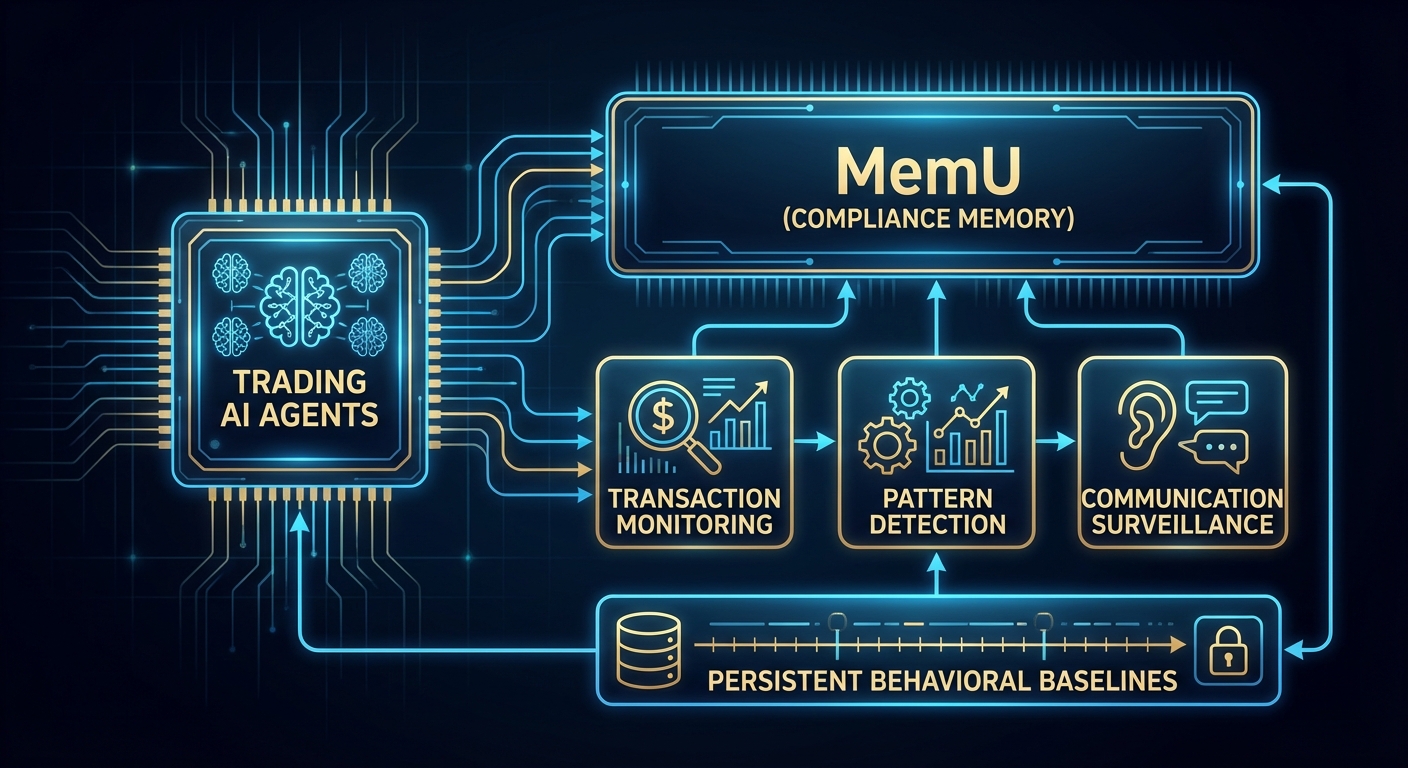
Current AI surveillance systems monitor real-time data streams effectively. They can flag a suspicious transaction as it occurs. What they can't do is recognize that this transaction is the latest in a six-month pattern of gradually escalating suspicious behavior. That recognition requires persistent behavioral memory — a comprehensive record of each entity's historical behavior that enables comparison and trend detection.
How MemU Adds Behavioral Memory to Financial Surveillance
MemU provides the persistent behavioral memory that financial surveillance requires. Every monitored entity — trader, account, communication pattern — builds a behavioral profile over time. Anomalies are evaluated not just against rules but against the entity's historical baseline. A transaction that's normal for one trader but anomalous for another is flagged based on personalized behavioral memory, dramatically reducing false positives.
For regulatory compliance, MemU provides the audit trail that regulators increasingly demand: a complete record of what was monitored, what was flagged, and why — spanning the full history of surveillance operations. Deutsche Bank and Google built the surveillance agents. MemU gives them the long-term memory to catch the patterns that unfold over months.
Get Started
Add behavioral memory to your financial surveillance systems. Explore MemU at memu.pro and on GitHub.