Devin AI Operates as an Autonomous Software Engineer — But Coding Agents Without Project Memory Rebuild Context Every Task


Devin, built by Cognition AI, represents the most ambitious attempt yet to create a fully autonomous AI software engineer. Unlike coding assistants that suggest completions while developers type, Devin operates independently in its own sandboxed development environment — complete with code editor, terminal, and web browser — taking tasks from description to pull request submission without human intervention. The platform integrates with GitHub, Slack, Linear, and Jira, enabling teams to assign tasks through familiar tools. Cognition reports that Devin fixes security vulnerabilities in an average of 1.5 minutes versus 30 minutes manually, handles code migrations 10-14x faster than manual effort, and boosts test coverage from 50-60% to 80-90% through automated test generation.
But Devin's autonomy operates within session boundaries. Each task starts a new sandboxed environment where the agent must re-explore the codebase, re-learn architectural patterns, and re-discover the team's coding conventions. An autonomous software engineer without project memory rebuilds context for every task, spending compute on understanding work it has done before.
Devin: What Everyone's Getting Right (And Missing)
Devin's architecture is well-designed for autonomous execution. The sandboxed environment gives the agent full development capabilities — reading files, writing code, running tests, debugging failures, browsing documentation — in isolation from the developer's local environment. The real-time observation mode lets developers watch the agent work and intervene when needed. The Devin Wiki feature automatically generates codebase documentation, and the learning system adapts to team workflows over time. For teams with large backlogs of routine engineering tasks, Devin provides genuine leverage.
The pricing model reflects the autonomous nature. Agent Compute Units (ACUs) measure actual compute consumed, with roughly one ACU equating to 15 minutes of active work. The Core tier at $20/month plus $2.25 per ACU makes it accessible for individual developers, while the Team tier at $500/month with 250 included ACUs targets engineering organizations. This consumption-based pricing aligns cost with value delivered.
What Devin does not preserve across tasks is the institutional knowledge it builds during execution. An agent that spent an hour understanding a complex microservice architecture, discovering the team's testing patterns, and mapping dependency relationships discards all of that context when the task completes. The next task — even in the same repository — starts the same exploration process. Other autonomous coding agents — including SWE-Agent, OpenDevin, and Aider — share this same structural limitation. They optimize for single-task execution quality; none persist the deep codebase understanding that agents develop during work.
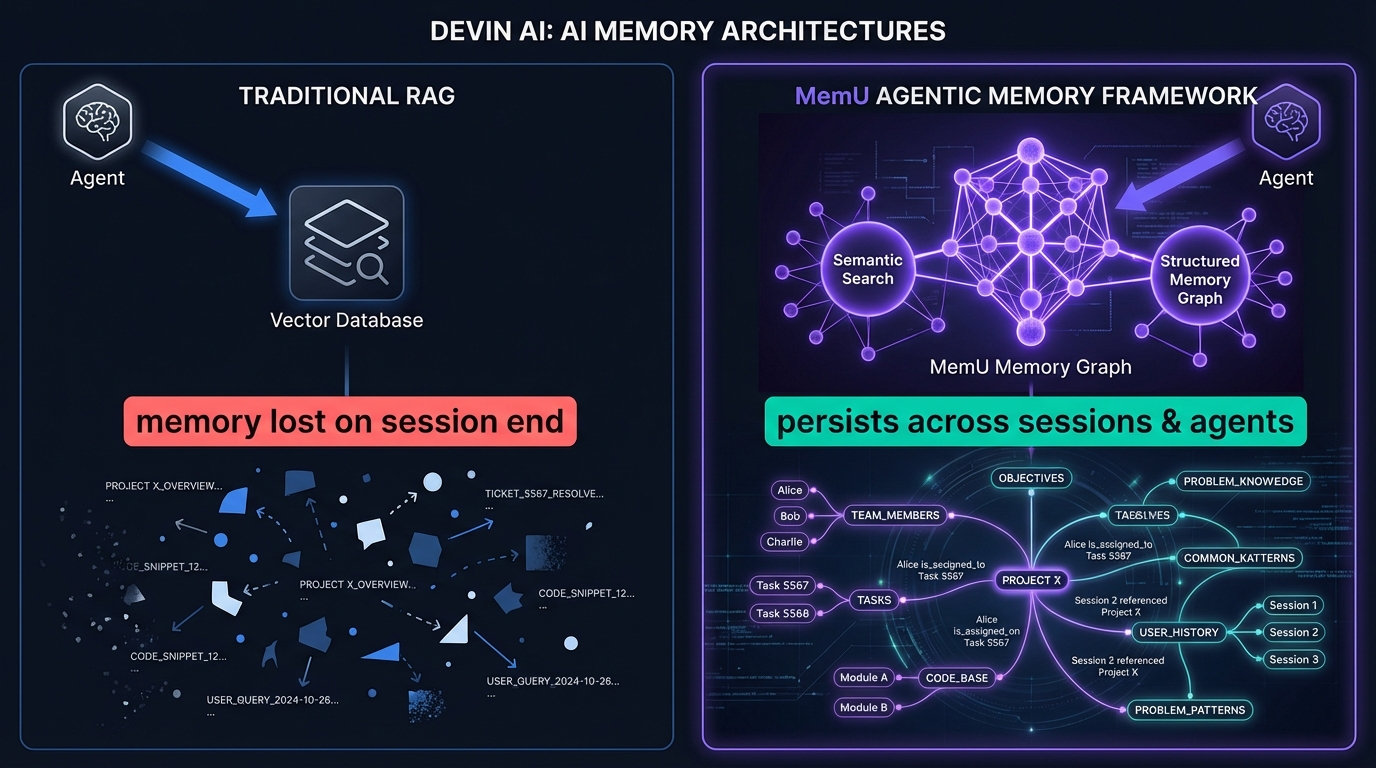
The MemU Agentic Memory Framework: Engineering Intelligence That Compounds Across Tasks
The MemU Agentic Memory Framework provides the persistent memory layer that autonomous coding agents like Devin do not include natively. Instead of treating each task as an isolated assignment, MemU captures the codebase knowledge, debugging insights, and architectural understanding that agents develop during execution and stores them in a structured memory graph that persists across tasks, repositories, and team contexts.
Consider Devin working on a large e-commerce platform. Without persistent memory, every task begins with the agent reading package manifests, exploring directory structures, and inferring the team's patterns. With the MemU Agentic Memory Framework, Devin immediately recalls: this repository uses a monorepo with Nx, the payment service communicates via gRPC with the order service, the team follows trunk-based development with feature flags, database migrations use Prisma with a specific naming convention, and the last three bugs in the checkout flow were caused by race conditions in the inventory service. That accumulated intelligence — built across dozens of previous tasks — eliminates redundant exploration and enables Devin to produce higher-quality code from the first attempt.
The framework addresses three core limitations of task-bounded autonomous agents:
- Codebase knowledge persistence: Architecture maps, dependency relationships, module boundaries, and coding conventions are stored after each task. The MemU Agentic Memory Framework eliminates the repeated exploration that consumes ACUs and delays task completion.
- Bug pattern intelligence: When Devin debugs and resolves an issue, the root cause analysis, fix approach, and related code paths are stored as persistent memory. Future tasks encountering similar symptoms can apply proven fixes rather than re-diagnosing from scratch.
- Team convention learning: Code review feedback patterns, naming conventions, architecture decisions, and style preferences accumulate across tasks. The agent's output increasingly matches what the team would write themselves, reducing review cycles and revision requests.
Autonomous software engineers are most valuable when they understand codebases as deeply as human engineers do. But understanding that resets with every task means paying for the same exploration repeatedly. The MemU Agentic Memory Framework gives Devin the project memory that turns every task into compounding engineering intelligence.
Integration with Devin's workflow is straightforward. The MemU Agentic Memory Framework exposes REST APIs that can be called at the beginning of each task to load relevant project context and at completion to store new insights. The memory layer operates alongside the sandboxed execution environment, providing context without compromising isolation.
Head-to-Head: Task-Bounded Agents vs. Memory-Enhanced Engineering
Devin alone: A capable autonomous software engineer with full development environment, real-time observation, and deep integration with engineering tools. Security fixes in 1.5 minutes, 10-14x faster migrations, and automated test generation demonstrate real engineering value. But every task starts from zero project context — the agent re-explores, re-reads, and re-learns the codebase for each new assignment.
Devin + MemU: The same autonomous capabilities, now backed by persistent engineering memory. Tasks begin with complete project context — architecture, conventions, dependency maps, and debugging history. The agent that has completed fifty tasks in a repository understands it as thoroughly as a senior engineer who has worked on it for months. ACU consumption drops as exploration overhead is eliminated, and code quality improves as the agent applies learned conventions consistently.
The ACU savings are measurable. If codebase exploration consumes 20-30% of each task's compute, persistent memory that eliminates that overhead translates directly to lower costs and faster task completion across every assignment.
Empowering Devin: Better Together
The combination of Devin's autonomous engineering capabilities and the MemU Agentic Memory Framework's persistent memory unlocks workflows that neither capability achieves alone:
- Progressive expertise building: Each task deepens the agent's understanding of the codebase. Early tasks handle simple bug fixes; as accumulated memory grows, the agent can tackle architectural refactoring, complex feature implementation, and cross-service changes that require deep system understanding.
- Cross-repository intelligence: Engineering teams maintain multiple repositories with shared patterns. Persistent memory enables Devin to transfer knowledge — a deployment pattern learned in the backend repository is applied when working on the infrastructure repository.
- Institutional knowledge preservation: When engineers leave a team, their codebase knowledge typically leaves with them. Persistent memory built through hundreds of Devin tasks serves as a living knowledge base that captures architectural understanding, debugging strategies, and codebase quirks.
Persistent memory transforms Devin from a powerful task executor into a genuine team member that accumulates engineering expertise across every assignment.
Get Started with MemU
Devin has demonstrated that autonomous AI software engineering is not just viable but practically valuable — security fixes, code migrations, and test generation at speeds that transform engineering team capacity. The sandboxed environment and tool integrations make autonomous coding safe and accessible.
The next step is giving that autonomous engineer persistent project memory. Tasks where the agent starts with deep codebase understanding instead of exploring from scratch. Repositories where the agent's expertise compounds across every assignment. Teams where engineering knowledge persists through agent memory rather than tribal knowledge.
The MemU Agentic Memory Framework provides that foundation. Drop-in API integration, dual-mode retrieval with semantic search and structured memory graphs, and cross-task persistence that turns every engineering assignment into compounding intelligence.
Visit memu.pro to explore the Agentic Memory Framework API, or check out the GitHub repository to start building agents that remember.
Tags: Devin AI, autonomous coding, agentic AI, agent memory, MemU AI, LLM memory, AI software engineer