Devin Ships Production Code Autonomously — But Every New Repository Feels Like Its First Day on the Job


Cognition's Devin is no longer a demo — it's a production tool. Billed as the first AI software engineer, Devin handles complete development tasks autonomously: reading issue tickets, exploring codebases, writing implementation code, running tests, and submitting pull requests. Cognition reports that engineering teams using Devin see measurable reductions in ticket resolution time, with the agent handling routine feature implementations, bug fixes, and refactoring tasks that previously consumed junior developer hours.
Devin's architecture goes beyond code completion. It operates in a persistent development environment with a terminal, browser, and code editor, executing multi-step engineering workflows that mirror how human developers actually work. The agent reasons about dependencies, investigates error messages, and iterates on solutions.
But here's the gap that limits Devin's effectiveness on real codebases: every repository is a fresh start. The agent that spent hours understanding your authentication architecture, your testing conventions, and your deployment patterns retains none of that for the next ticket.
Devin: What Everyone's Getting Right (And Missing)
The autonomous software engineer paradigm represents genuine progress. Previous coding assistants operated at the function or file level — suggesting completions, generating snippets, answering questions. Devin operates at the workflow level — understanding a task, planning an approach, implementing across files, validating with tests, and delivering a complete pull request.
Engineering teams are right to adopt Devin for repetitive implementation work. Migration tasks, API endpoint additions, test coverage improvements, and routine bug fixes all follow patterns that Devin executes reliably once pointed at the right repository.
What's missing is accumulated codebase understanding. A human developer who's worked on your codebase for six months intuitively knows where the authentication logic lives, which modules are fragile, which patterns the team prefers, and which shortcuts cause production incidents. Devin re-discovers all of this from scratch on every task.
What Devin Does With Codebase Context Today
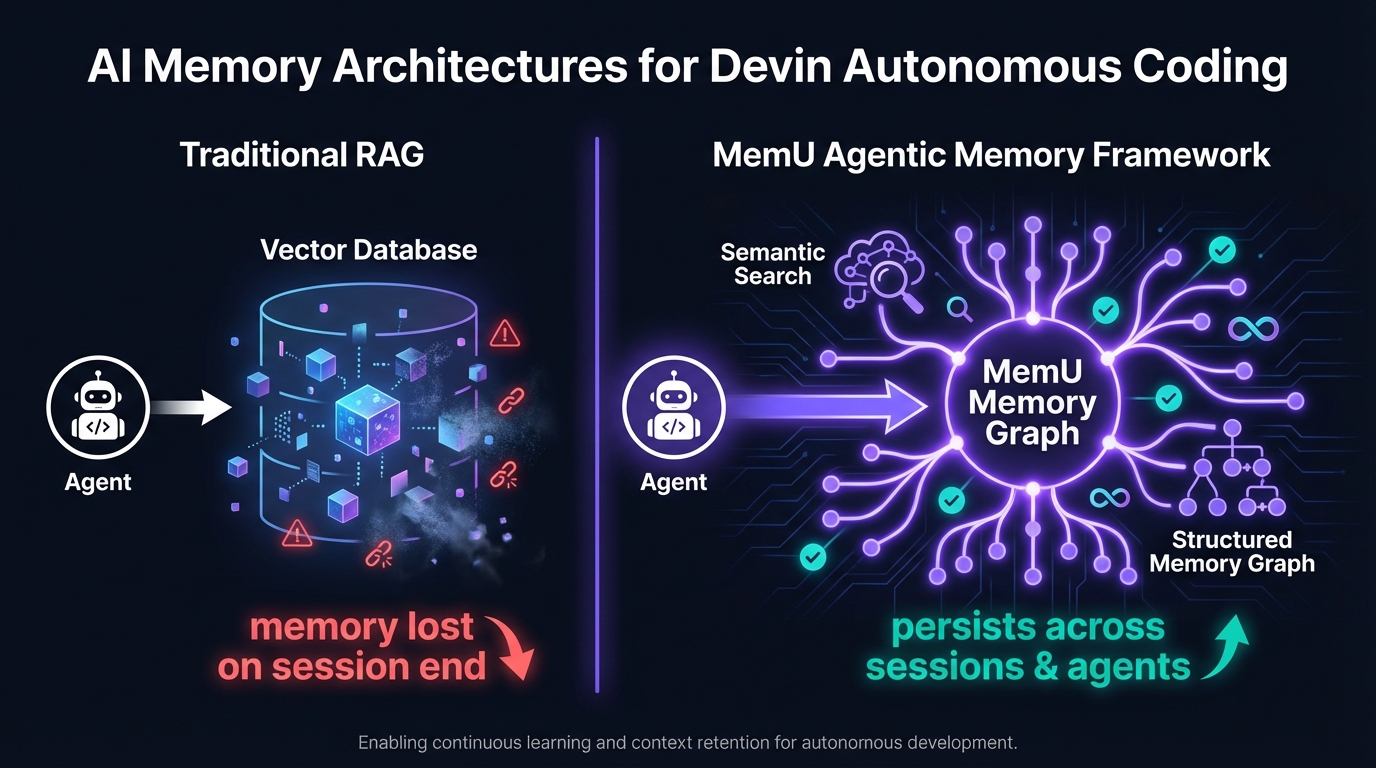
Devin uses a combination of codebase search, file tree navigation, and dynamic context gathering to understand repository structure per-task. It reads relevant files, traces import chains, and examines test patterns to build a working model of the codebase sufficient for the current task.
This approach works for isolated tasks. But it breaks down as task complexity increases. A refactoring task that touches authentication, database models, and API serialization requires understanding three subsystems and their interactions — context that takes significant exploration time to rebuild for each task.
Devin's 50th task on your repository requires the same codebase exploration as the 1st. Other AI coding agents — GitHub Copilot Workspace, Cursor's background agents, Amazon Q Developer — share this limitation. Per-task context gathering is the default architecture across the entire AI coding category.
The MemU Agentic Memory Framework: Codebase Intelligence That Compounds
The MemU Agentic Memory Framework provides persistent codebase memory that transforms every task into a learning opportunity. Instead of re-exploring repository structure on each ticket, the agent retrieves accumulated understanding from previous work sessions.
Picture Devin working on a fintech codebase. Task 1: fix a payment processing bug. The agent discovers the payment service architecture, the retry logic, the idempotency patterns. Task 2: add a new payment method. Without the MemU Agentic Memory Framework, Devin re-explores the entire payment subsystem. With MemU, it retrieves the architectural map from Task 1 and proceeds directly to implementation — cutting exploration time by 80%.
The framework enhances coding agents specifically through:
- Architectural memory: Module boundaries, service communication patterns, dependency relationships, and design decisions persist across tasks. The MemU Agentic Memory Framework captures the structural understanding that makes senior developers effective.
- Convention learning: Naming patterns, error handling approaches, test structure preferences, and code style — the implicit knowledge that code reviews enforce — accumulates in memory so the agent writes code that fits your codebase from the first attempt.
- Failure memory: Approaches that didn't work, edge cases that caused bugs, and production incidents related to specific modules persist as warnings. The agent avoids known pitfalls rather than rediscovering them.
A senior developer's value isn't just coding skill — it's accumulated codebase knowledge. MemU gives AI coding agents the same compounding advantage.
Head-to-Head: Stateless Coding vs. Memory-Enhanced Coding
Devin alone: Autonomous end-to-end coding with persistent development environment. Handles complete tickets from issue to PR. But every task requires fresh codebase exploration — the same files read, the same patterns discovered, the same architecture understood from zero.
Devin + MemU Agentic Memory Framework: Same autonomous workflow plus persistent codebase intelligence. Previous tasks' architectural discoveries, convention patterns, and failure lessons are retrieved instantly. Average codebase exploration time decreases with every completed task. Sub-100ms memory retrieval keeps the development workflow fast.
This applies equally to Copilot Workspace, Cursor agents, and Amazon Q Developer — every coding agent that re-explores codebases per-session benefits from persistent memory infrastructure.
Empowering Devin: Better Together
MemU doesn't modify Devin's coding capabilities — it provides the persistent context that makes those capabilities more effective with every task.
- Progressive codebase expertise: Devin alone is equally unfamiliar with your codebase on task 1 and task 100. With the MemU Agentic Memory Framework, task 100 benefits from 99 tasks' worth of accumulated structural understanding.
- Cross-developer continuity: When multiple engineers assign tasks to Devin, discoveries from each engineer's tasks inform future work. One developer's deep dive into the auth system helps Devin navigate auth-related tasks for the entire team.
- Onboarding acceleration: New repositories still require initial exploration, but the MemU Agentic Memory Framework captures that exploration permanently. The onboarding cost is paid once, not on every task.
Get Started with MemU
Devin represents the state of the art in autonomous software engineering. The MemU Agentic Memory Framework ensures that state of the art improves with every task completed on your codebase. Integration is a single API layer between the agent and its development environment.
Visit memu.pro to explore the Agentic Memory Framework API, or check out the open-source repository on GitHub to start building persistent codebase memory into your AI coding workflows today.
Tags: Devin, AI software engineer, autonomous coding, agentic memory, codebase memory, MemU AI, AI coding agent, persistent memory