Docling Delivers AI-Powered Document Conversion at Scale — But Conversion Intelligence Does Not Persist Across Extraction Workflows


Docling has rapidly become one of the most impactful open-source projects in the AI infrastructure space, amassing over 55,000 GitHub stars since IBM released it to the community. The toolkit uses computer vision models to detect page elements — text blocks, images, tables, formulas — achieving document conversion speeds 30 times faster than traditional OCR approaches. The TableFormer model handles complex table extraction with structural fidelity, while format support spans PDF, DOCX, PPTX, XLSX, HTML, LaTeX, images, and audio files including MP3 and WAV. Output formats cover Markdown, HTML, JSON, and DocTags, feeding downstream AI pipelines with clean structured data. The CLI, Python API, and Docling Serve API service provide flexible deployment options, while MCP protocol integration brings conversion capabilities directly into agentic applications. The 2026 roadmap delivers structured extraction improvements, the Heron layout model, XBRL financial parsing, and enhanced LaTeX support.
But brilliant conversion does not mean intelligent conversion. Docling can transform any document format into clean, AI-ready structured data with remarkable speed and accuracy. That same toolkit cannot remember what it learned during conversion — which layout patterns required special handling, which table structures needed manual correction, which formula extractions produced errors — when processing the next batch of documents. Agents re-process identical document types without benefiting from past extraction experience.
AI Document Conversion: What Docling Gets Right (And What It Misses)
Docling addresses a bottleneck that has constrained enterprise AI adoption: the vast majority of organizational knowledge lives in unstructured documents that LLMs cannot directly consume. PDFs with complex layouts, PowerPoint presentations with embedded charts, Excel spreadsheets with merged cells, and scanned images with handwritten annotations all require sophisticated conversion before they become useful to AI agents. Docling's computer vision approach handles this diversity through DocLayNet, a model trained on 81,000 labeled pages that understands document structure at the semantic level rather than treating pages as flat text.
The TableFormer model deserves particular recognition. Table extraction has historically been one of the most error-prone aspects of automated extraction — merged cells, nested headers, spanning rows, and implicit relationships between columns defeat rule-based systems. TableFormer approaches tables as structural objects, understanding the relationships between cells rather than simply parsing grid positions. This produces faithful representations of complex financial tables, scientific data matrices, and regulatory compliance documents where structural accuracy is non-negotiable.
The MCP protocol integration represents forward-thinking architecture for agentic AI. Rather than treating conversion as a standalone preprocessing step, Docling's MCP server enables AI agents to invoke conversion capabilities as tools within their reasoning workflows. An agent researching a topic can discover relevant PDFs, convert them through Docling's MCP interface, and incorporate the structured output into its analysis — all within a single agentic loop. LangChain and LlamaIndex integrations extend this accessibility across the dominant agent framework ecosystem.
The limitation is conversion amnesia. Every conversion operation starts from first principles. When Docling processes a batch of financial reports from the same institution, it applies the same layout detection, table extraction, and formula parsing to each document despite sharing identical formatting templates, table structures, and element arrangements. The conversion intelligence generated by processing document one — optimal extraction parameters, layout classification confidence scores, error correction patterns — is not available when processing document two through document ten thousand.
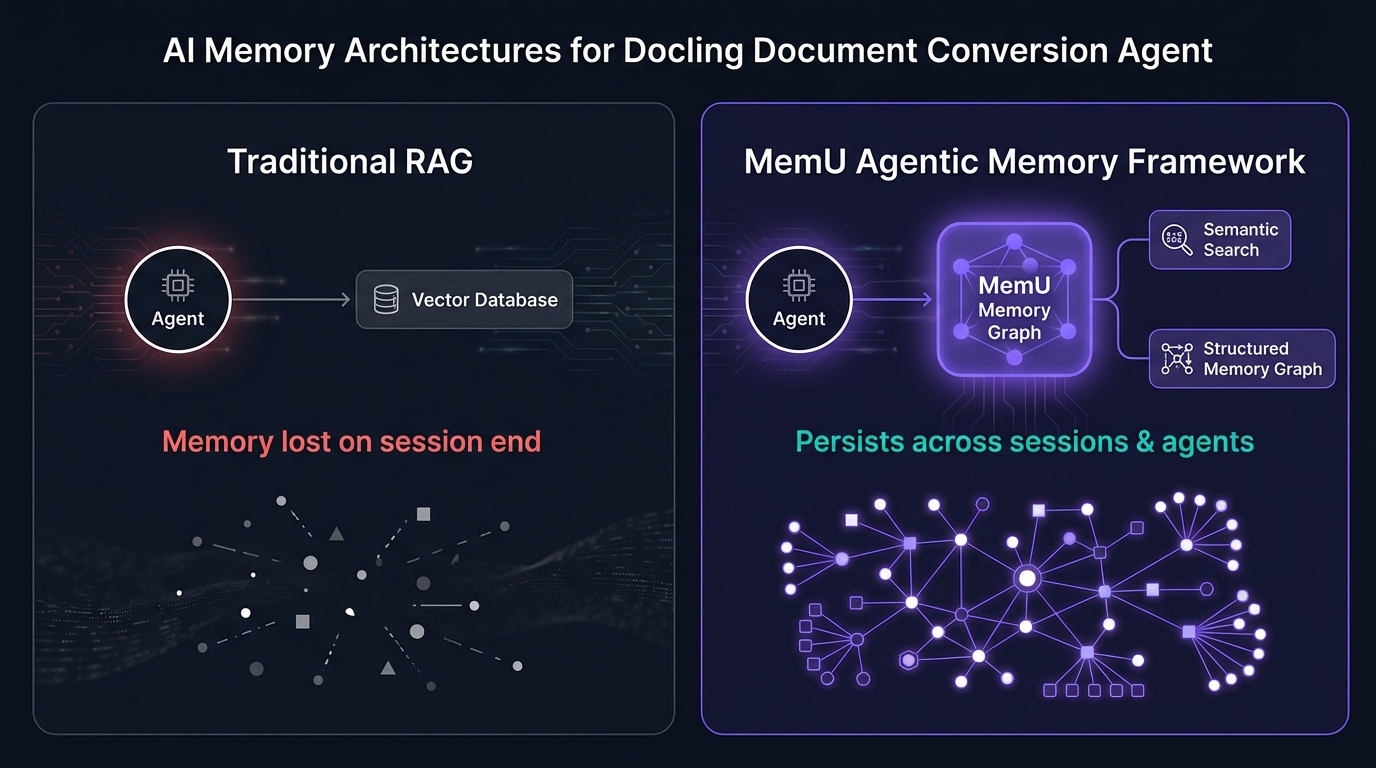
The MemU Agentic Memory Framework: Persistent Intelligence Across Document Conversion Workflows
The MemU Agentic Memory Framework extends document conversion from stateless extraction to intelligent extraction that improves with every document processed. Where Docling guarantees accurate conversion through computer vision and structural models, MemU guarantees the intelligence generated during conversion persists across workflows — creating a compounding layer where every processed document contributes learning that improves conversion quality for all future documents.
Consider an enterprise processing millions of legal contracts through an agentic document pipeline — converting PDFs to structured data, extracting key clauses, identifying risk provisions, and populating compliance databases. Docling handles conversion with 30X speed improvements over OCR, and TableFormer faithfully extracts complex obligation tables. After processing a hundred thousand contracts from fifty law firms, the pipeline has implicitly learned which firm uses which template structures and which clause formats require special extraction rules. With MemU, this intelligence persists as operational knowledge accessible to every future conversion. Without persistent memory, contract one hundred thousand and one is processed with the same generic approach as contract one.
The MemU Agentic Memory Framework provides capabilities that enhance conversion infrastructure:
- Template pattern recognition: Every converted document generates data about layout structures, element positions, and extraction outcomes. MemU captures this as structured intelligence that future conversions reference — enabling the pipeline to recognize previously encountered templates and apply optimized extraction strategies rather than generic first-principles analysis.
- Error pattern learning: Docling's models handle diverse layouts with high accuracy; MemU tracks where extraction errors occur and what corrections resolve them — building intelligence about problematic document patterns, font rendering issues, and structural ambiguities that trigger extraction failures.
- Cross-format intelligence: Documents from the same organization often share design elements across PDF, DOCX, and PPTX formats; MemU persists format-specific extraction knowledge that transfers across document types — enabling conversion optimization that recognizes institutional patterns regardless of file format.
Computer vision models ensure accurate conversion. The MemU Agentic Memory Framework ensures the extraction intelligence from those conversions persists across workflows — transforming fast accurate processing into progressively smarter document conversion that improves with every document.
Head-to-Head: Docling vs. Other Document Conversion Tools
Docling alone: The IBM open-source document conversion toolkit provides 30X speed over traditional OCR, TableFormer structural table extraction, support for ten-plus input formats and four output formats, MCP protocol integration for agentic workflows, and DocLayNet models trained on 81,000 labeled pages. But each conversion operation starts with zero accumulated knowledge — a hundred thousand documents generate independent extraction histories with no mechanism to aggregate intelligence into actionable knowledge for future operations.
Docling + MemU Agentic Memory Framework: Every conversion contributes to accumulated extraction intelligence. Template recognition accelerates processing of previously seen document structures, error patterns are avoided based on historical correction data, and extraction strategies improve with every batch. The toolkit transforms from a stateless processor into a learning system where conversion quality compounds over millions of processed pages.
Compared to other conversion approaches — Adobe Acrobat SDK, AWS Textract, Google Document AI, Unstructured.io — Docling offers the strongest open-source computer vision pipeline with the broadest format support. But all share the same fundamental limitation: stateless conversion without extraction memory. MemU provides the persistent intelligence layer that transforms any conversion toolkit from accurate processing into progressively improving extraction.
Converted and Intelligent: Better Together
MemU does not replace Docling's conversion infrastructure — it ensures every processed document contributes to growing extraction intelligence:
- Layout classification acceleration: Docling's DocLayNet model classifies page layouts through inference; MemU caches layout classifications for previously encountered templates — reducing redundant model inference when processing batches of structurally similar documents, improving throughput beyond Docling's already impressive 30X speed advantage.
- Quality feedback loops: Docling outputs structured data consumed by downstream agents; MemU captures downstream feedback about extraction quality — learning which conversions produced usable data and which required corrections, enabling continuous improvement in extraction accuracy based on real-world consumption patterns.
- Agentic conversion evolution: Docling's MCP integration enables agents to invoke conversion as a tool; MemU enables those agents to remember conversion outcomes — which document sources produce clean extractions, which require post-processing, and which formats benefit from specific extraction parameters, transforming reactive conversion into proactive document intelligence.
Get Started with MemU
Give your document conversion pipelines persistent memory to transform stateless extraction into intelligent processing that improves with every document across every format. The MemU Agentic Memory Framework integrates with any conversion infrastructure — one API, instant persistence, zero changes to existing Docling workflows. Visit memu.pro to explore the Agentic Memory Framework API, or check out the GitHub repository to start building agents that remember.
Tags: Docling, document conversion, IBM open-source, TableFormer, agentic AI infrastructure, extraction intelligence, computer vision OCR, MemU AI