Domo AI Agent Builder and MCP: From Domopalooza Pilots to Production Agent Workforces


Enterprises are racing to connect governed analytics and operational data to the models teams already use — Claude, Gemini, and ChatGPT — without opening another shadow IT channel. Roadmap energy around Domo AI Agent Builder, AI Toolkits, and an MCP server surfaced at March 2026 Domopalooza and frames a credible path: specialized agents as an AI workforce, CEO Josh James emphasizing scale, and an AI Library roadmap toward summer 2026 that turns cataloged assets into reusable agent capabilities. The promise is familiar and urgent: move pilots to production with the same data trust, security, and lineage expectations executives demand from BI — while developers keep the ergonomics of modern chat and coding assistants.
The hard part is not the keynote narrative. It is memory. Agents that touch CRM, finance, supply, and HR metrics without durable, queryable recall re-learn your semantics every session. They repeat the same clarification questions, re-derive the same joins, and re-test the same executive-safe wording. That is where an agentic memory layer matters as much as connectivity — and why pairing BI governance with persistent recall separates experiments from dependable operations.
What Domo Gets Right — And Where Agent Memory Still Breaks
Domo AI Agent Builder aligns with how enterprises already think: curated datasets, governed cards, certified metrics, and role-aware access are prerequisites before any model sees a row. Pairing that foundation with toolkits and MCP server patterns means assistants can call the same logical objects analysts trust, rather than scraping spreadsheets from email. For teams standardizing on that product, the win is consistent answers backed by enterprise lineage — not a one-off prompt to a frontier model with no audit trail.
The ecosystem momentum is real. Talk tracks and roadmap hints around Domopalooza underscored connecting cloud warehouses, operational apps, and Domo content to external copilots — the right direction when every department wants “their” agent. Pushing from pilot to production requires operational rigor: rate limits, cost controls, evaluation, and human-in-the-loop approvals. Domo AI Agent Builder is positioned to sit in that governance perimeter rather than outside it.
What platform connectivity alone rarely solves is cross-session intelligence. An agent can retrieve a KPI definition via an MCP server today and still forget tomorrow which drill paths worked, which filters confused executives, and which narratives passed compliance review. Stateless tool calls — even excellent ones — do not compound. Without persistent agent memory, every new thread repeats discovery work, burns tokens, and risks contradictory answers when prompts drift. That gap is not unique to governed BI connectors; it is structural to LLM agents everywhere.
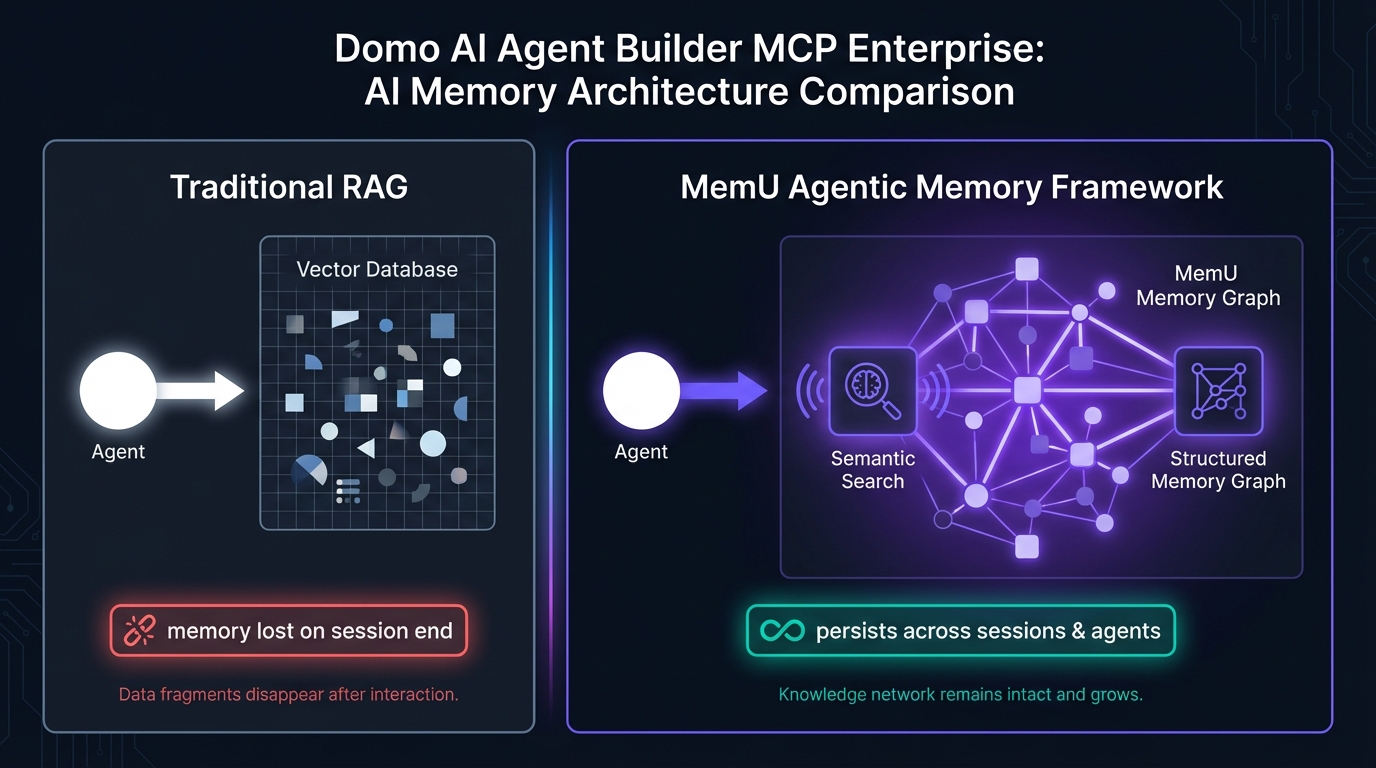
The MemU Agentic Memory Framework: Production Memory for Governed Agents
The MemU Agentic Memory Framework adds durable, structured recall on top of governed data access — so agents remember what worked across sessions, teams, and tools. Instead of treating each MCP server invocation as a one-off, MemU captures decision traces, successful query patterns, approved phrasing for sensitive metrics, and human overrides in a memory graph designed for retrieval — not just chat logs.
Picture a revenue operations agent wired through Domo AI Agent Builder into certified cards and an approved glossary. The first week it learns which breakdowns leadership trusts, which seasonality notes must accompany YoY charts, and which customer segments require legal disclaimers. The MemU Agentic Memory Framework retains those lessons so the next analyst — or the same agent next Monday — does not rediscover them by trial and error.
Three constraints matter for enterprise rollouts, and the MemU Agentic Memory Framework addresses each:
- Consistency at scale: When many specialized agents act as an AI workforce, they must not improvise conflicting definitions. Persistent memory anchors terminology, approved narratives, and proven query paths.
- Audit-friendly recall: Memory is not a black-box transcript dump. Structured memory supports traceability — what was recommended, what was corrected, what shipped — which pairs naturally with governed Domo rollouts.
- Tool orchestration that improves: The MemU Agentic Memory Framework learns which tool sequences resolve tickets faster, which API parameters avoid timeouts, and which fallbacks humans prefer — compounding value as you move from pilot to production.
Connectivity makes agents possible; memory makes them dependable. MemU turns governed data access into governed agent behavior over time.
MemU complements catalog and toolkit strategies: your AI Library can grow through summer 2026 while memory captures how those assets behave in the wild — not just that they exist. That feedback loop is what turns catalog breadth into repeatable agent performance.
Head-to-Head: Domo’s Agent Builder Alone vs. With MemU
Domo AI Agent Builder on its own emphasizes trusted data, packaged analytics, enterprise guardrails, and increasingly native bridges to frontier assistants via patterns like an MCP server. Strength is governance and distribution of metrics users already recognize.
Adding MemU keeps that governed surface area while agents remember effective drill paths, compliance-approved explanations, and operational playbooks. Fewer repeated mistakes, lower token load, faster onboarding for new hires using the same Domo entry points.
Neither replaces the other. Domo remains the system of record for curated analytics; MemU becomes the system of compounding agent judgment layered above tool calls and chat turns.
Better Together: MCP, Toolkits, and Agentic Memory
Combining Domo’s MCP-ready agent connectivity with MemU’s persistent agent memory yields practical synergies:
- Shared playbooks across agents: Specialized agents inherit memory about metric definitions, narrative guardrails, and escalation paths — critical when CEO Josh James’s vision of scaled AI workforces becomes many narrow agents rather than one general chatbot.
- Faster promotion from pilot to production: Pilots generate structured lessons MemU retains; production agents start closer to proven behavior instead of re-learning from scratch.
- Model-agnostic continuity: Whether the front end is Claude, Gemini, or ChatGPT, persistent memory stabilizes answers because recall attaches to your enterprise objects and corrections — not to a single vendor thread.
As March 2026 Domopalooza themes echo through roadmap and AI Library plans for summer 2026, teams should plan memory alongside toolkits and MCP server endpoints — connectivity without recall caps ROI.
Get Started with MemU
Domo AI Agent Builder and enterprise MCP server integrations are the right foundation for connecting governed data to frontier models. The next step is durable agent memory so specialized agents behave like a trained workforce — not a forgetful intern on every new session.
The MemU Agentic Memory Framework provides structured, retrievable memory that compounds as agents interact with your analytics, tools, and humans — complementing governed data platforms and modern model clients.
Visit memu.pro for the framework overview, and explore the open codebase at github.com/NevaMind-AI/memU to start building agents that remember.
Tags: Domo AI Agent Builder, MCP server, Domopalooza, enterprise AI agents, MemU, agent memory, AI Library