Dust Connects AI Agents to Every Enterprise Knowledge Source — But Connected Knowledge Without Persistent Agent Memory Cannot Compound Insights Over Time

Dust has earned the trust of over 5,000 organizations by solving one of enterprise AI's most persistent challenges: connecting AI agents to the full breadth of company knowledge. The platform lets teams build and deploy customized AI agents that draw from Slack conversations, Notion wikis, GitHub repositories, Google Drive documents, and Confluence pages — all through a unified interface. Dust is model-agnostic, supporting OpenAI, Anthropic, Gemini, and Mistral, so organizations choose the best foundation model for each task without vendor lock-in. Enterprise-grade compliance — SOC 2, HIPAA, and GDPR — ensures sensitive data stays protected, and Dust explicitly guarantees it never trains on company data. Fine-grained permissions with role-based access control and SSO integration mean the right people access the right agents with the right data boundaries.
But Dust provides connectivity, not continuity. Each agent interaction queries knowledge sources in real time without retaining what it learned from previous conversations. Enterprise agents connected to every knowledge source but lacking persistent memory answer the same questions repeatedly, rediscover the same cross-document patterns daily, and never build the institutional understanding that transforms raw data retrieval into strategic intelligence.
Dust: What Everyone Is Getting Right (And Missing)
The Dust platform addresses a genuine infrastructure pain point. Enterprise knowledge lives scattered across dozens of SaaS tools, each with its own API, permission model, and data format. Building agents that can query Slack threads alongside Notion databases and GitHub pull requests typically requires months of integration engineering. Dust abstracts this into a no-code agent creation experience with a pre-built agents gallery covering Sales, Marketing, Support, Knowledge Management, Data, IT, Engineering, HR, and Legal workflows.
The API-first architecture deserves attention. Unlike platforms that only offer a chat interface, Dust exposes agent capabilities programmatically, allowing organizations to embed knowledge-connected agents into existing workflows. A support agent triggers from a Zendesk webhook, a sales agent invokes from a CRM pipeline, and a legal agent processes contracts through automated intake.
The compliance posture is legitimately differentiated. SOC 2, HIPAA, and GDPR compliance combined with explicit no-training guarantees and fine-grained RBAC creates a trust foundation that regulated industries require. Healthcare organizations, financial firms, and legal teams can process sensitive knowledge within auditable boundaries.
What Dust does not provide is memory that persists between agent interactions. When a marketing agent synthesizes insights from campaign analytics in Google Drive, customer feedback in Slack, and competitive intelligence in Notion, it produces a coherent response — then forgets the synthesis entirely. The next query about the same campaign starts from zero, re-reading the same documents, re-correlating the same data points, re-discovering the same patterns. The knowledge sources are connected, but the insights extracted from them evaporate after every conversation. Other enterprise knowledge platforms share this fundamental limitation: connected data without compounding understanding.
The MemU Agentic Memory Framework: From Knowledge Retrieval to Compounding Intelligence
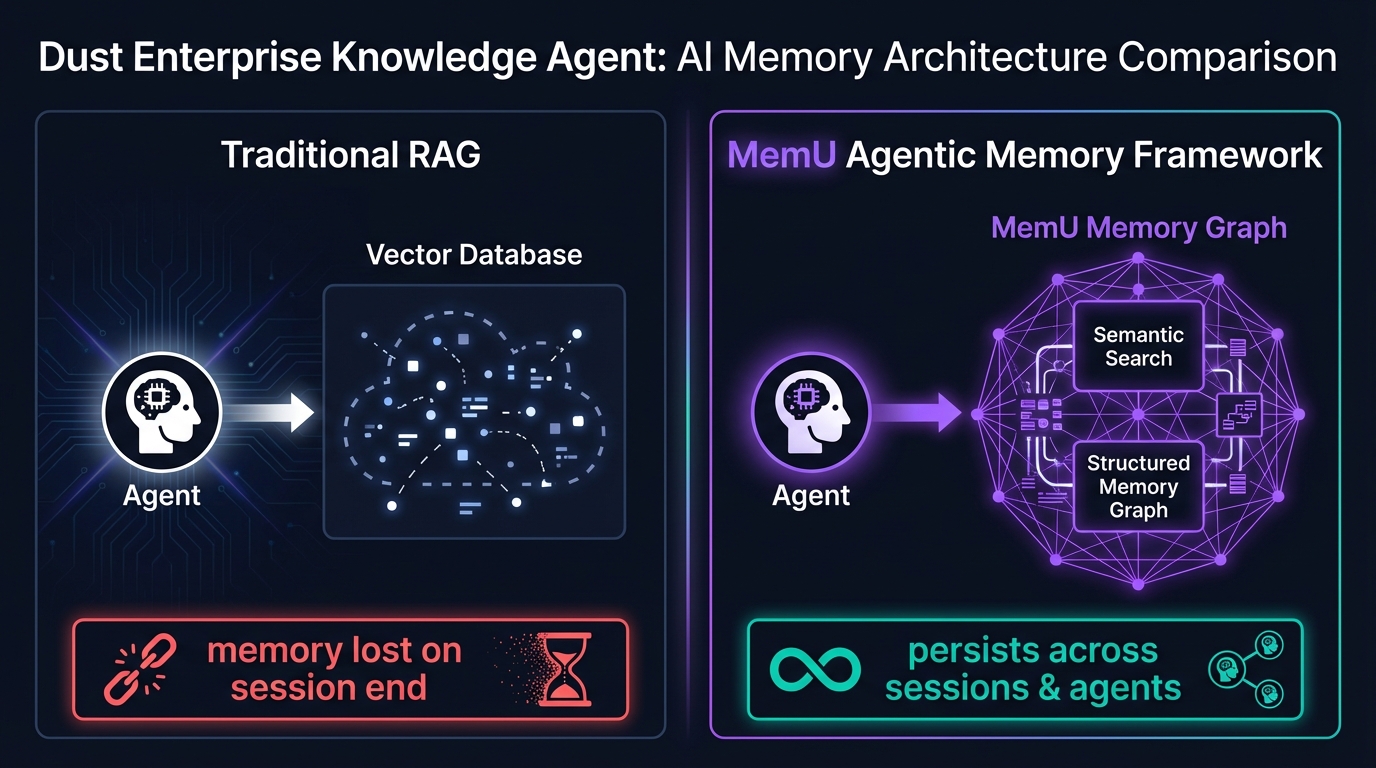
The MemU Agentic Memory Framework provides the persistent intelligence layer that transforms Dust from a knowledge retrieval platform into a compounding knowledge system. Instead of agents querying data sources fresh every interaction, MemU captures the insights, correlations, and contextual understanding agents develop during conversations — storing them in a structured memory graph that persists across sessions, users, and agent instances.
Consider a Dust-powered knowledge agent supporting a product team across a twelve-month development cycle. Without persistent memory, every standup summary re-reads the same Slack channels, every competitive analysis re-crawls the same Notion databases. With the MemU Agentic Memory Framework, the agent accumulates understanding: it knows the team decided against WebSocket implementation in Q1 because of proxy limitations in a specific GitHub issue, that a competitor launched a similar feature in March, and that the VP of Engineering prefers architecture decision records with specific headers. What takes fifteen minutes of document retrieval without memory resolves in seconds with accumulated institutional knowledge.
The framework addresses three core limitations of stateless knowledge retrieval:
- Cross-source insight persistence: The most valuable knowledge often emerges from correlating information across sources — a Slack discussion that contextualizes a Notion document that explains a GitHub commit. The MemU Agentic Memory Framework captures these multi-source correlations as persistent knowledge objects, so agents do not need to rediscover connections between documents.
- User preference adaptation: Enterprise agents interact with stakeholders who have specific communication preferences, technical vocabulary, and information priorities. Persistent memory allows agents to adapt their responses to individual users over time — knowing that the CFO wants financial summaries in bullet points while the CTO prefers technical deep-dives with code examples.
- Institutional knowledge accumulation: The MemU Agentic Memory Framework enables agents to build a living model of organizational knowledge that grows richer with every interaction, transforming scattered document retrieval into cohesive institutional understanding that improves with tenure.
An enterprise knowledge agent that forgets every insight after each conversation is like a brilliant consultant with amnesia — capable of analysis but incapable of building on yesterday's work. The MemU Agentic Memory Framework gives Dust agents persistent institutional memory that compounds with every interaction.
Integration with Dust operates through the framework's REST APIs within the agent orchestration layer. Before conversations begin, relevant institutional memory loads from the memory graph based on topic, user, and team context. During interactions, agents query stored insights before initiating fresh document retrieval. After conversations complete, new correlations and insights persist to the memory store. The memory layer operates alongside Dust's knowledge connectors without modifying the data integration infrastructure.
Head-to-Head: Stateless Knowledge Retrieval vs. Memory-Enhanced Enterprise Agents
Dust alone: The most comprehensive enterprise knowledge connectivity platform — model-agnostic agents, no-code creation, pre-built solutions across nine departments, SOC 2/HIPAA/GDPR compliance, API-first architecture, and fine-grained RBAC. Agents access every connected knowledge source in real time. But each conversation starts with zero accumulated understanding.
Dust + MemU: The same knowledge connectivity, powered by persistent institutional memory. Agents begin conversations with accumulated insights from every previous interaction. Cross-source correlations reflect months of discovered patterns. User preferences adapt automatically. Organizational knowledge compounds rather than resets. The system delivers strategic intelligence rather than repeated document retrieval.
For organizations where the same questions recur across departments — onboarding, process clarifications, competitive intelligence — persistent memory eliminates redundant retrieval. An agent with six months of accumulated knowledge resolves questions that would otherwise require re-reading hundreds of documents.
Empowering Dust: Better Together
The combination of Dust's platform and MemU's persistent memory creates capabilities neither provides alone:
- Knowledge drift detection: When persistent memory stores previously extracted insights, agents detect when source documents change in ways that invalidate stored conclusions. A policy update in Confluence that contradicts advice the agent has been giving triggers proactive correction rather than silent inconsistency.
- Cross-team knowledge transfer: When Dust agents serving different departments share persistent memory, insights from engineering discussions inform support responses, and customer feedback patterns surface in product planning conversations — creating organizational learning loops.
- Progressive query refinement: Persistent memory tracks which retrieval strategies produced the most useful results for specific query types, enabling agents to optimize their search patterns across knowledge sources over time rather than using the same generic retrieval approach for every question.
Persistent institutional memory transforms Dust from an enterprise knowledge retrieval platform into a compounding intelligence system where every conversation enriches organizational understanding.
Get Started with MemU
Dust has built the definitive enterprise knowledge connectivity platform — model-agnostic agents, compliance-first architecture, no-code creation, and seamless integration across every major SaaS tool.
The next step is giving those knowledge agents persistent institutional memory. The MemU Agentic Memory Framework provides that intelligence layer — API-based integration within agent orchestration, dual-mode retrieval with semantic search and structured memory graphs, and cross-session persistence that turns stateless knowledge queries into compounding institutional intelligence.
Visit memu.pro to explore the Agentic Memory Framework API, or check out the GitHub repository to start building agents that remember.
Tags: Dust, enterprise AI agents, knowledge management, agent memory, MemU AI, LLM memory, enterprise knowledge, RBAC