ElevenLabs Agents Handle 33 Million Conversations — But Start Each Call From Scratch

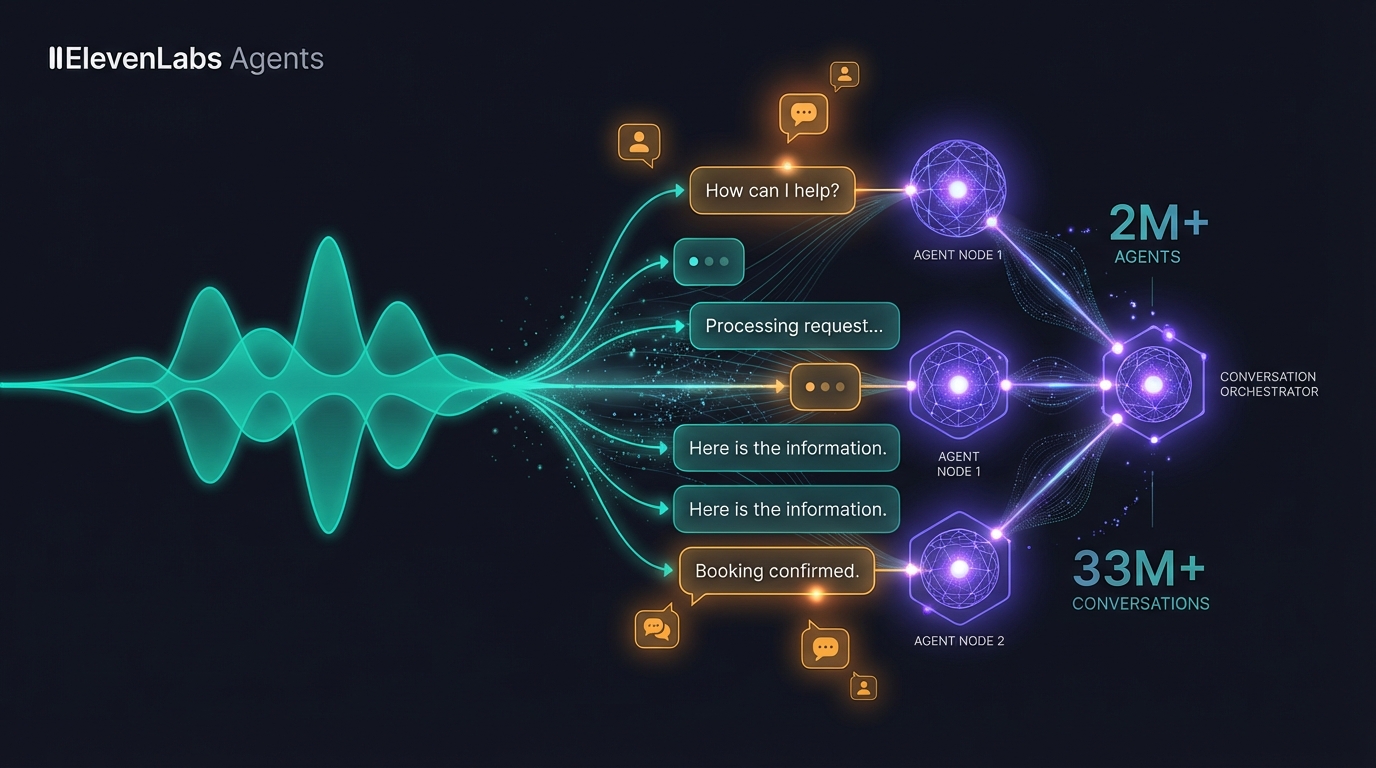
ElevenLabs just turned voice AI into a platform. With over 2 million agents deployed and 33 million conversations handled, ElevenLabs Agents has become the infrastructure layer for voice-first AI applications. The platform offers state-of-the-art turn-taking, automatic language detection across dozens of languages, and full telephony support — inbound, outbound, and batch scheduling.
The $500 million Series D at an $11 billion valuation reflects what enterprises are seeing: voice agents are moving from demos to production. Customer support, appointment scheduling, sales qualification, healthcare triage — voice is becoming the primary interface for AI agent interactions with humans.
But here's the gap that 33 million conversations have exposed: voice agents that can't remember past calls treat every interaction as a first encounter.
ElevenLabs Agents: What Voice AI Can Do Now
The platform's capabilities are genuinely impressive. ElevenLabs Agents understands conversational cues — "um," "ah," interruptions, pauses — and handles turn-taking naturally rather than robotically. Automatic language detection means a single agent serves multilingual populations without manual switching. Multi-character support enables scenarios where different voices represent different roles within a single conversation.
The visual workflow builder lets non-technical teams design multi-step conversation flows. Tool connections enable agents to call external APIs, check calendars, update CRM records, and trigger downstream processes. HIPAA compliance and EU residency options make deployment viable in regulated industries.
For individual conversations, the experience approaches human quality. But voice agents lack memory continuity across calls. A support agent that resolved your billing issue last Tuesday has no context when you call about a related question on Friday. The agent sounds natural but starts completely fresh — no recall of previous interactions, no accumulated understanding of caller preferences, no relationship building over time.
How ElevenLabs Agents Handle Conversation Context
Within a single call, ElevenLabs Agents maintains full context. The agent remembers what was discussed earlier in the conversation, tracks the caller's stated preferences, and follows the workflow logic configured by the builder. RAG integration allows agents to pull relevant information from knowledge bases during calls.
Per-conversation personalization is possible through dynamic variables — caller name, account type, language preference — passed at the start of each call. This provides a degree of customization but requires the calling system to supply all relevant context upfront.
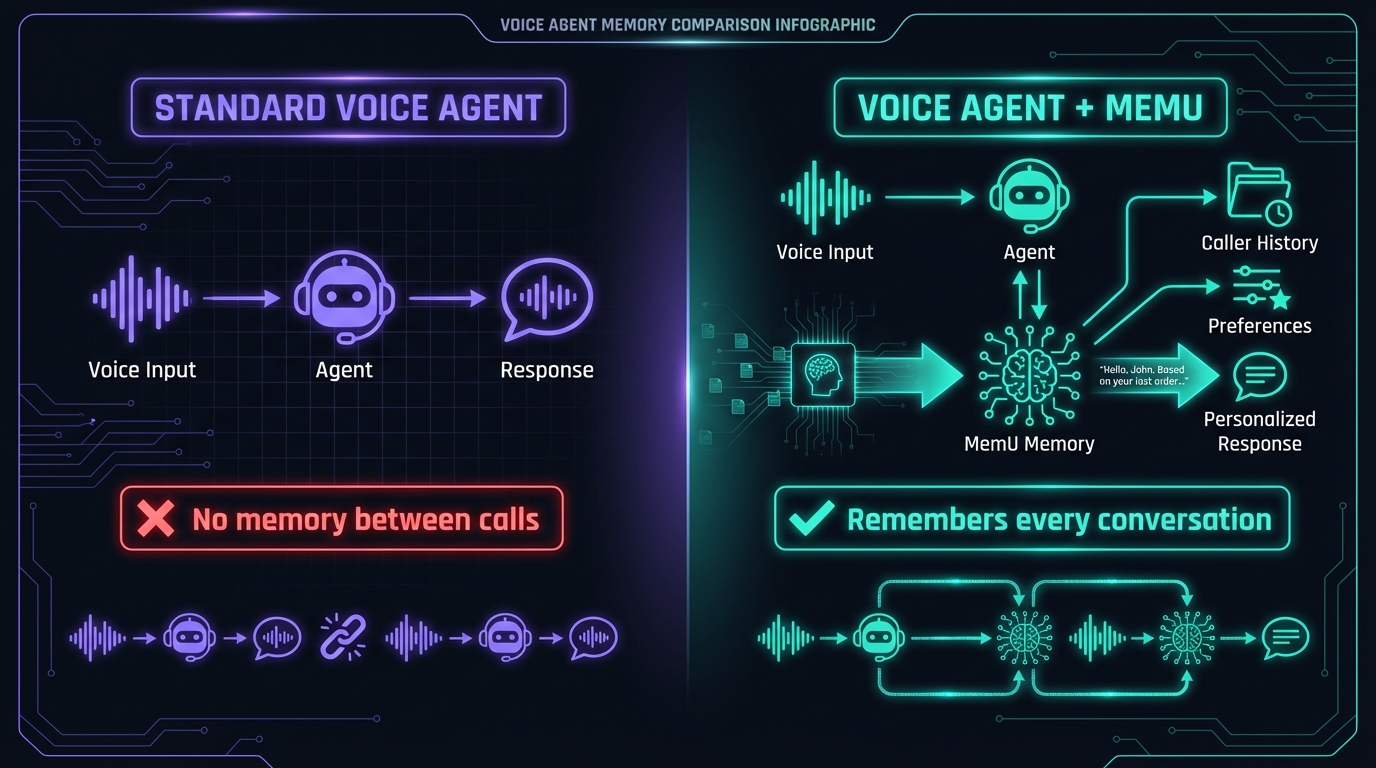
Cross-call memory doesn't exist natively. What an agent learned during a 15-minute support call — the caller's communication style, the specific issue context, the resolution approach that worked — disappears when the call ends. Next time the same person calls, the agent begins with whatever dynamic variables the system provides, not with what it actually learned from previous interactions.
This creates a frustrating experience for frequent callers. "I already explained this last time" is a complaint that applies equally to human and AI agents when memory doesn't persist.
The MemU Agentic Memory Framework: Voice Agents That Remember Callers
The MemU Agentic Memory Framework provides the cross-call memory that voice agent platforms currently lack. Rather than treating each conversation as isolated, MemU captures interaction insights and caller context into persistent memory that future calls can draw on.
Consider a healthcare scheduling agent powered by ElevenLabs. A patient calls to reschedule an appointment, mentioning they prefer morning slots and have trouble with Tuesdays. With ElevenLabs alone, that preference information disappears after the call. With the MemU Agentic Memory Framework, future calls automatically surface those preferences — the agent proactively suggests Wednesday morning without the patient needing to repeat themselves.
The architecture enables three capabilities for voice agents:
- Caller memory: The MemU Agentic Memory Framework captures interaction context — communication preferences, issue history, stated preferences, resolution approaches — as structured memory that persists across calls.
- Progressive personalization: Each call builds on previous ones. The agent develops understanding of individual callers over time rather than treating every interaction as a first contact.
- Cross-channel consistency: Memory persists whether the caller reaches the agent via phone, web widget, or app. Context follows the person, not the channel.
MemU transforms voice agents from stateless responders into systems that build genuine relationships through accumulated understanding.
Integration works alongside existing ElevenLabs workflows: the MemU Agentic Memory Framework provides APIs that store conversation insights after calls and retrieve relevant caller context before new ones.
Head-to-Head: Stateless vs. Memory-Enhanced Voice Agents
ElevenLabs Agents alone: Natural voice quality, multilingual support, enterprise-grade reliability. But each call starts fresh — no accumulated understanding of callers, no relationship continuity, no progressive personalization.
ElevenLabs + MemU: Same voice capabilities plus persistent caller memory. Previous interactions inform current ones. Caller preferences accumulate. Retrieval across thousands of past conversations with sub-100ms latency — fast enough that memory lookup never introduces voice delay.
ElevenLabs Agents provides the voice. The MemU Agentic Memory Framework provides the memory that makes those voices genuinely personal.
Empowering Voice AI: Better Together
The MemU Agentic Memory Framework isn't a replacement for ElevenLabs — it's the memory layer that makes voice agents dramatically more effective.
- Customer support continuity: Support agents remember past issues, resolution approaches, and caller preferences. "I see you called about this before — here's what we found" replaces "Can you explain the issue from the beginning?"
- Sales intelligence: Sales qualification agents accumulate prospect context across multiple touches. Each call builds on what previous conversations revealed about needs, objections, and timing.
- Healthcare personalization: Patient-facing agents remember preferences, history, and context. Scheduling, triage, and follow-up calls become progressively smoother.
Adding caller memory takes a single integration. The MemU Agentic Memory Framework handles storage, retrieval, and context evolution — your voice agents just get more personal over time.
Get Started with MemU
ElevenLabs Agents represents a mature platform for voice AI deployment. Two million agents and 33 million conversations prove that voice-first AI is production-ready. The technology for natural, capable voice agents exists.
The next step is voice agents that remember. Callers who feel recognized rather than interrogated. Interactions that build on relationship history. Support experiences where context carries across every touchpoint.
The MemU Agentic Memory Framework provides that foundation. Drop-in integration with voice agent platforms means you can add caller memory without changing your conversation flows. Structured memory graphs capture the relationships that make interactions personal. And retrieval is fast enough to never impact voice latency.
Visit memu.pro to explore the Agentic Memory Framework API, or check out the open-source repository on GitHub to start building persistent memory into your voice agents today.