Encord Manages 5 Petabytes of Physical AI Training Data — Data Infrastructure Without Annotation Memory Means Every Label Starts Fresh


Physical AI just hit its data infrastructure inflection point. Encord's $60M Series C — backed by Wellington Management, Y Combinator, and CRV — funds an AI-native data platform managing over 5 petabytes of multimodal data across 10+ types including video, LiDAR, 3D point clouds, DICOM, and geospatial imagery. Revenue from physical AI customers grew 10-fold last year. With analysts projecting 400 million AI robots coming online within four years and the industry exceeding $30 billion, the demand for structured physical-world training data is surging beyond what existing infrastructure can handle.
Encord's platform covers the complete lifecycle: data preparation, curation, annotation, model evaluation, and alignment. AI-assisted labeling workflows with human-in-the-loop processes serve 300+ AI teams including Woven by Toyota, Mayo Clinic, and AXA Financial. Unlike text-based LLMs trained on public internet data, physical AI systems require proprietary sensor feeds that demand specialized computational infrastructure.
But data infrastructure is not the same as data intelligence. Every annotation project starts without knowledge of the thousands of labeling decisions, edge-case resolutions, and quality patterns accumulated across previous projects — even when the same objects, environments, and failure modes appear repeatedly.
Encord: What Everyone's Getting Right (And Missing)
The multimodal coverage is essential. Autonomous vehicles need video, LiDAR, and radar annotation simultaneously. Medical imaging requires DICOM-specific workflows. Robotics demands 3D point cloud labeling. Encord handles all of these in a unified platform rather than forcing teams to stitch together specialized tools.
The AI-assisted labeling significantly accelerates throughput. Pre-annotation suggestions reduce human effort on routine labels, while human-in-the-loop processes ensure quality for ambiguous cases. The combination delivers the annotation velocity that physical AI's data appetite demands.
The gap is annotation memory. When a labeling team resolves an ambiguous edge case — deciding how to classify a partially occluded pedestrian, establishing the boundary between road and sidewalk in fog, determining what qualifies as a manufacturing defect — that decision is captured in the specific label but not in organizational knowledge. The next project with the same ambiguity requires the same deliberation. Scale AI and Labelbox face identical structural limitations — massive annotation throughput without accumulated annotation intelligence.
What Data Annotation Platforms Do With Labeling History Today
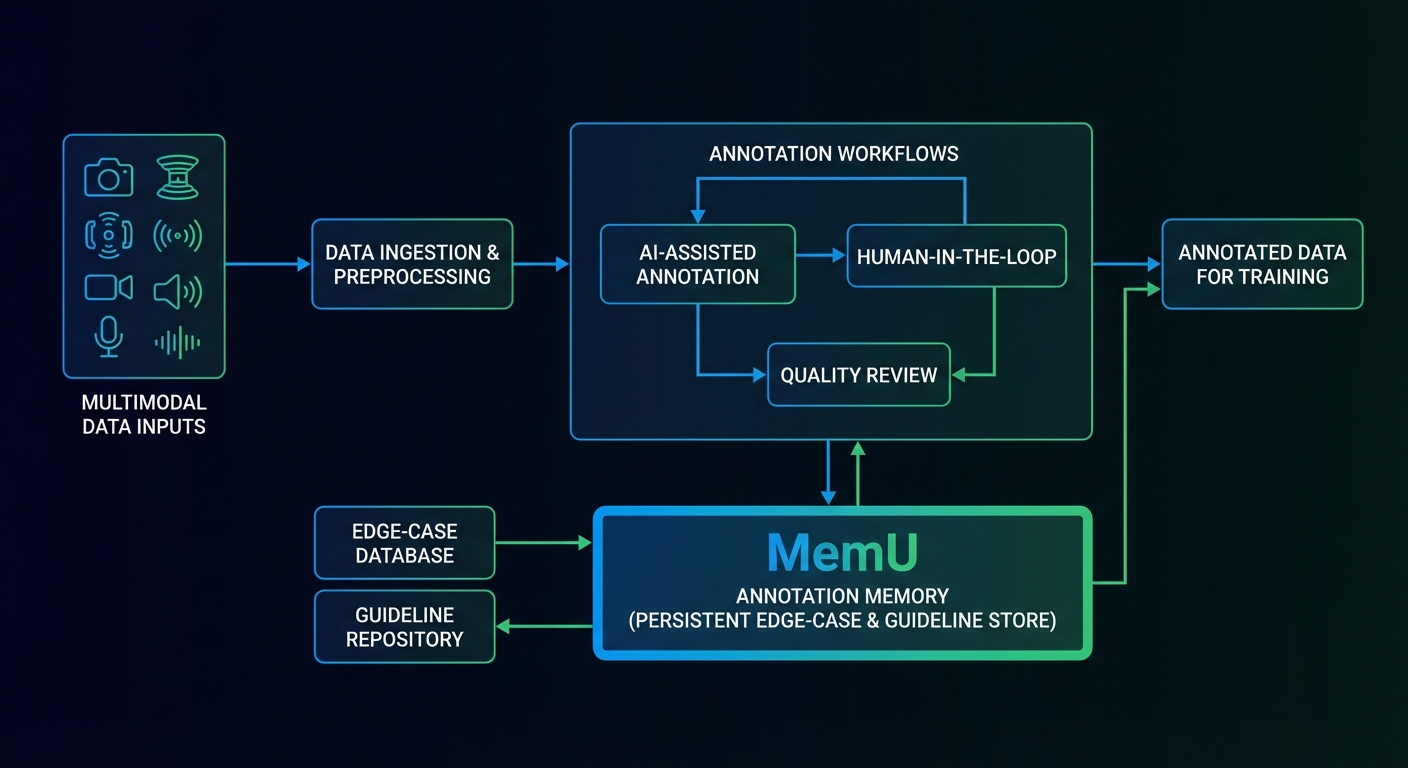
Annotation platforms maintain labeled datasets as training data exports. Quality assurance systems track inter-annotator agreement and flag inconsistencies within individual projects. Some platforms provide annotator performance metrics across projects.
But the knowledge embedded in labeling decisions — why a specific edge case was resolved one way, which visual patterns indicate a quality issue, how annotation guidelines evolved through project experience — lives in the annotators' heads and scattered Slack conversations. When annotators rotate, that institutional knowledge disappears.
Labeled data persists in datasets. Labeling expertise — the accumulated judgment about how to handle the thousand ambiguous cases that arise in every physical AI project — does not survive beyond the team that generated it.
The MemU Agentic Memory Framework: Annotation Intelligence That Accumulates
The MemU Agentic Memory Framework provides persistent annotation memory that captures labeling decisions, edge-case resolutions, and quality patterns across every project — building organizational annotation intelligence that makes each subsequent project faster and more consistent.
Consider an autonomous vehicle company running monthly annotation sprints with Encord. Without the MemU Agentic Memory Framework, each sprint's labeling guidelines are manually drafted, edge cases are re-debated, and quality thresholds are re-established. With MemU, the annotation system starts each sprint with complete historical context: the 47 edge-case rulings from previous projects, the discovery that morning lighting conditions require adjusted contrast thresholds, the annotator feedback that a particular labeling guideline was ambiguous and how it was clarified, and the quality patterns showing which object categories consistently require re-review.
The MemU Agentic Memory Framework enhances data annotation through:
- Edge-case memory: Every resolved ambiguity becomes organizational knowledge. When a similar edge case appears in a future project, the framework surfaces the previous resolution with its rationale, ensuring consistency across years of labeling work.
- Guideline evolution tracking: Annotation guidelines change as projects reveal what works and what does not. The MemU Agentic Memory Framework maintains the complete evolution history, explaining not just current guidelines but why they changed — preventing teams from reverting to previously abandoned approaches.
- Cross-project quality patterns: Quality issues that recur across projects — specific object types that consistently get mislabeled, environmental conditions that reduce annotation accuracy, workflow configurations that correlate with higher error rates — become automatically detectable patterns rather than rediscovered surprises.
Data platforms scale annotation throughput. MemU scales annotation intelligence — ensuring the ten-thousandth label benefits from everything learned labeling the first nine thousand nine hundred ninety-nine.
Head-to-Head: Annotation Throughput vs. Annotation Intelligence
Encord alone: 5PB multimodal data management with AI-assisted labeling, human-in-the-loop quality, and full lifecycle coverage across 10+ data types. Every project executes efficiently — but independently of the organizational knowledge accumulated across all previous projects.
Encord + MemU Agentic Memory Framework: Same data infrastructure plus persistent annotation memory. Edge cases resolve faster. Quality baselines start higher. Guideline drift is detected automatically. Sub-100ms memory retrieval enables real-time annotation guidance informed by thousands of historical labeling decisions.
This applies to every data annotation platform — Scale AI, Labelbox, V7, and Supervisely all benefit from persistent annotation memory that compounds labeling quality over time.
Empowering Encord: Better Together
MemU does not replace Encord's data infrastructure — it transforms annotation execution into cumulative annotation expertise.
- Annotator onboarding: New labelers receive guidance informed by the complete history of annotation decisions, reducing ramp time from weeks to days and ensuring consistency from their first labels.
- Model feedback loops: When model evaluation reveals annotation quality issues, the MemU Agentic Memory Framework traces the problem to specific labeling patterns and propagates corrections across all relevant future annotations.
- Cross-team knowledge transfer: When multiple annotation teams work on related projects — autonomous vehicles and robotics both labeling similar objects — the framework enables annotation knowledge sharing without violating data isolation requirements.
Get Started with MemU
Encord manages the data that trains physical AI. The MemU Agentic Memory Framework ensures every labeling decision contributes to organizational annotation intelligence, making each petabyte of data more valuable than the last.
Visit memu.pro to explore the Agentic Memory Framework API and add persistent annotation memory to your data infrastructure.
Tags: Encord, physical AI, data annotation, multimodal data, agentic memory, MemU AI, AI training data, annotation intelligence