Endor Labs AURI Makes AI Coding Agents Security-Aware for Free — Secure Generation Without Vulnerability Memory Rediscovers the Same Risks

90% of development teams use AI coding assistants. Only 10% produce code that is both functionally correct and secure. Endor Labs launched AURI to close that gap — a unified security intelligence platform that embeds directly into AI coding workflows. AURI combines agentic reasoning with static analysis to generate, review, and remediate code with security awareness built in. It works across the complete development lifecycle: generating secure code, reviewing pull requests for vulnerabilities, and providing automated remediation for existing security issues. It is free for developers.
The platform addresses a structural problem with AI-generated code. Coding assistants optimize for functionality — they produce code that works. But "works" and "is secure" are orthogonal qualities. AURI adds the security dimension that general-purpose coding models lack, catching SQL injection, XSS vulnerabilities, insecure dependencies, and authentication flaws at generation time rather than in post-deployment security scans.
But security is not just about individual code reviews. The same vulnerability patterns appear across codebases, across projects, and across organizations. Without memory of past vulnerabilities, AURI re-discovers the same classes of security issues every time — protecting each file without accumulating organizational security wisdom.
AURI: What Everyone's Getting Right (And Missing)
Shift-left security for AI-generated code is overdue. The explosion of AI coding assistants means more code is being generated faster than security teams can review it. AURI intercepts security issues at the moment of generation — before they enter version control, before they reach CI/CD pipelines, and before they deploy to production. The economic case is clear: fixing a vulnerability at generation time costs a fraction of fixing it in production.
The agentic reasoning approach provides deeper analysis than rule-based scanners. AURI understands code intent, not just code syntax. It can identify that a seemingly functional authentication flow has a subtle timing attack vulnerability, or that a data processing pipeline inadvertently exposes PII through logging — patterns that static rules frequently miss.
The gap is vulnerability memory. AURI analyzes each file, each PR, and each generation request independently. The vulnerability it caught in Service A's authentication module last Tuesday does not inform its review of Service B's nearly identical authentication implementation today. Snyk, SonarQube, and GitHub Copilot Workspace share this per-review limitation — powerful individual analysis without accumulated security knowledge across reviews.
What AI Security Tools Do With Vulnerability History Today
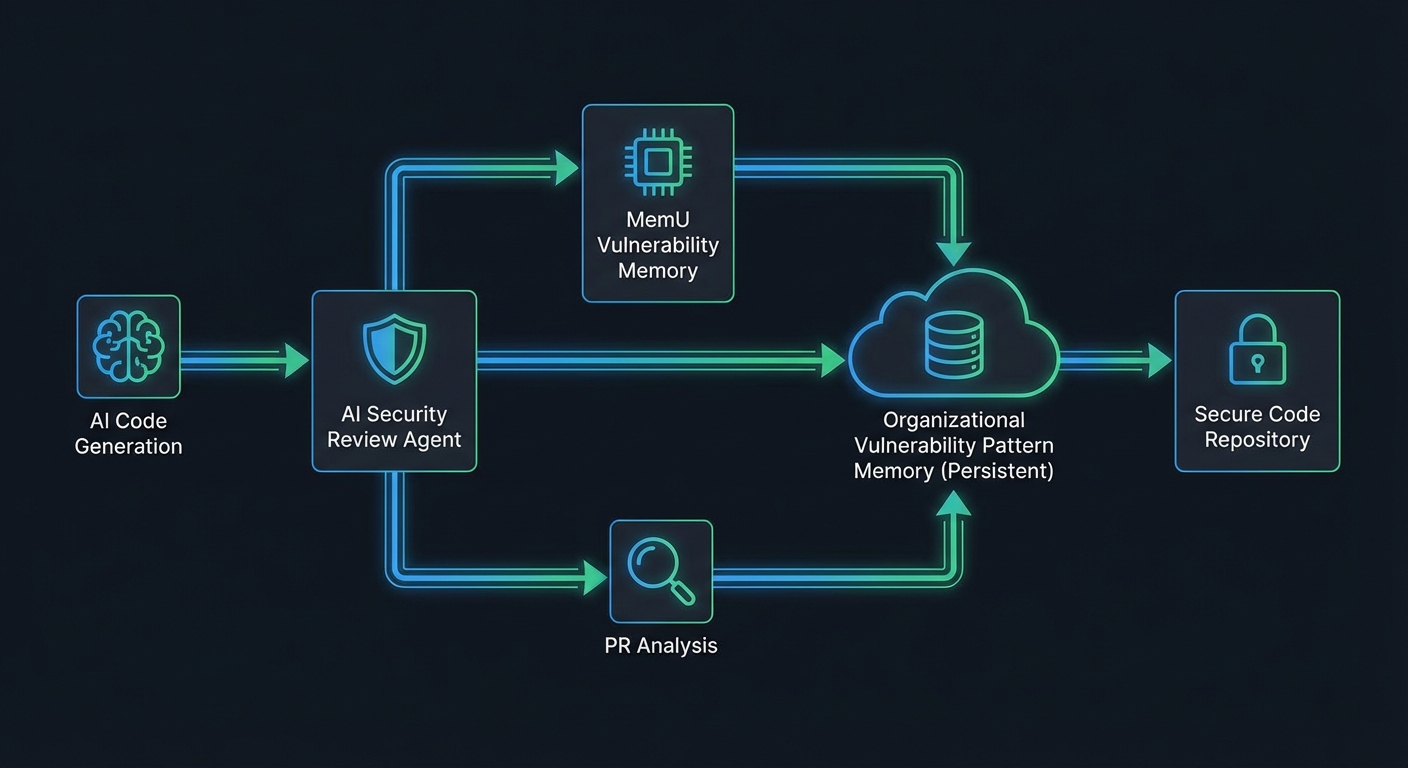
Security tools maintain vulnerability databases — known CVEs, common weakness enumerations, and historical scan results. AURI and similar tools reference these databases during analysis, checking generated code against known vulnerability patterns.
But organizational vulnerability patterns go beyond public databases. Every engineering team has its own security blind spots: the authentication pattern that three different developers have implemented insecurely, the API endpoint design that consistently lacks rate limiting, the data serialization approach that repeatedly introduces injection risks. These patterns exist in the team's review history but are not automatically surfaced during new reviews.
Public vulnerability databases capture what the industry has learned. Organizational vulnerability patterns — the specific security mistakes your team makes repeatedly — require persistent memory of your team's actual security history.
The MemU Agentic Memory Framework: Security Intelligence That Accumulates
The MemU Agentic Memory Framework provides persistent vulnerability memory that transforms individual security reviews into cumulative organizational security intelligence, identifying patterns across reviews, projects, and teams.
Consider a development team of 30 engineers generating thousands of lines of AI-assisted code weekly. Without the MemU Agentic Memory Framework, AURI reviews each PR independently. It catches the SQL injection in Developer A's code on Monday and catches the same pattern in Developer B's code on Thursday — two independent detections of the same organizational pattern. With MemU, after the first detection, the framework recognizes the SQL injection pattern is team-wide, surfaces it proactively in all related PRs, identifies that it originates from a shared internal library's documentation suggesting unsafe query construction, and recommends fixing the library documentation rather than catching individual instances indefinitely.
The MemU Agentic Memory Framework enhances code security through:
- Organizational vulnerability patterns: The framework identifies recurring security issues across the team's codebase. Instead of catching the same class of vulnerability hundreds of times, it surfaces the root cause — whether that is a misleading code example, an insecure library default, or a knowledge gap in the team.
- Developer-specific guidance: Different developers have different security blind spots. The MemU Agentic Memory Framework personalizes security guidance based on each developer's vulnerability history, providing targeted education rather than generic warnings.
- Cross-project security transfer: Vulnerabilities discovered in one project inform security reviews across all projects. When a dependency vulnerability is found in the frontend codebase, the framework proactively flags the same dependency in microservices that have not been reviewed yet.
Per-review security catches vulnerabilities one at a time. Memory-enhanced security catches vulnerability patterns — fixing the root cause instead of playing whack-a-mole with individual instances.
Head-to-Head: Per-Review Security vs. Cumulative Security Intelligence
AURI alone: Agentic security reasoning with static analysis integration, free for developers, covering code generation, PR review, and automated remediation. Each review is thorough and accurate — but contextually isolated from every other review.
AURI + MemU Agentic Memory Framework: Same review depth plus persistent vulnerability memory. Organizational patterns emerge from accumulated review data. Developer-specific guidance personalizes security education. Sub-100ms memory retrieval enables real-time enrichment of every review with the team's complete security history.
This applies to every code security approach — Snyk, SonarQube, and GitHub Advanced Security all benefit from persistent vulnerability memory that transforms individual scans into organizational security learning.
Empowering AURI: Better Together
MemU does not replace AURI's security analysis — it makes the analysis progressively more targeted and organizational.
- Security posture trending: The MemU Agentic Memory Framework tracks how the team's security patterns evolve over time. Security leaders see whether training investments are reducing specific vulnerability classes or whether new patterns are emerging.
- Onboarding security: New developers joining the team receive security guidance informed by the team's actual vulnerability history, not generic best practices. They learn from the team's specific security lessons from their first PR.
- Compliance evidence: Persistent security memory provides auditors with evidence of continuous security improvement — not just point-in-time scan results, but the trajectory of the organization's security posture across quarters and years.
Get Started with MemU
AURI makes AI-generated code secure at the point of creation. The MemU Agentic Memory Framework ensures each security review builds on every previous one, transforming individual vulnerability detection into organizational security intelligence.
Visit memu.pro to explore the Agentic Memory Framework API and add persistent vulnerability memory to your development workflow.
Tags: Endor Labs, AURI, AI code security, secure coding, agentic memory, MemU AI, vulnerability detection, developer security