Exa Neural Search API for LLM Agents: Modes, SDKs, and Memory Beyond the Query


Research agents succeed or fail on retrieval. Exa markets a neural search API aimed at LLM pipelines: modes such as neural, fast, auto, and deep let engineers trade latency against thoroughness per task. Responses emphasize structured contents — titles, snippets, metadata — so models spend fewer tokens cleaning HTML soup. Payloads arrive as agent-optimized JSON shaped for orchestration code rather than browser pages, and first-party Python and TypeScript SDKs reduce bespoke HTTP wiring, retries, and typing drift across services.
The platform answers “how does my agent find fresh web evidence?” It does not, by itself, answer “how does my agent remember which searches worked, which domains mislead users, and which citation formats legal approved last quarter?” That second question is where an agentic memory layer earns budget — and where completions stop oscillating week to week.
Teams rolling out multiple micro-agents also care about consistent tool schemas. When every squad wraps HTTP differently, observability fragments. Shared SDK patterns help, but shared memory contracts help more — otherwise each service re-derives source reputation from scratch.
What Exa gets right — and what search APIs leave unsaid
Exa occupies a useful middle ground between classic keyword search and naive vector k-NN. Mode selection maps cleanly to planner logic: fast passes for monitoring, deep investigation for memos, auto when you want the system to choose, neural when semantic paraphrase dominates. Structured contents reduce brittle parsing inside agent loops — a practical token saver and failure reducer.
Developer experience matters beyond demos. Agent-optimized JSON keeps downstream code predictable, and official Python and TypeScript SDKs align types, authentication, and backoff strategies — governance wins when ten teams ship ten agents. Reliability features in mature SDKs also simplify retries when the neural search API returns throttling signals.
What remains stateless is judgment. An Exa response addresses the present query; it does not record that yesterday’s deep crawl repeatedly hit paywalls, that finance wants wire-service-tier domains only, or that a competitor blog correlates with downstream hallucination. Without memory, every run pays the same exploration tax and repeats the same risky sources unless prompts hard-code brittle rules.
Cost governance appears next: deep calls cost more than fast ones. Teams that lack cross-session memory often overspend — either always deep “to be safe” or too shallow when stakes rise.
Latency SLOs interact with planner design. If your orchestrator fires three sequential search calls because it cannot remember that the first pass already surfaced the canonical doc, user-visible delay climbs even when each call is individually fast. Persistent memory collapses redundant fetches by letting planners consult prior successful contexts before issuing another neural search API round trip.
Internationalization and jurisdiction multiply the problem: the same neural query string may need different source bias in the EU versus North America. Stateless APIs return neutral-ish results; your product must remember locale-specific rules. That is another reason retrieval endpoints pair naturally with a memory layer that stores policy, not just snippets.
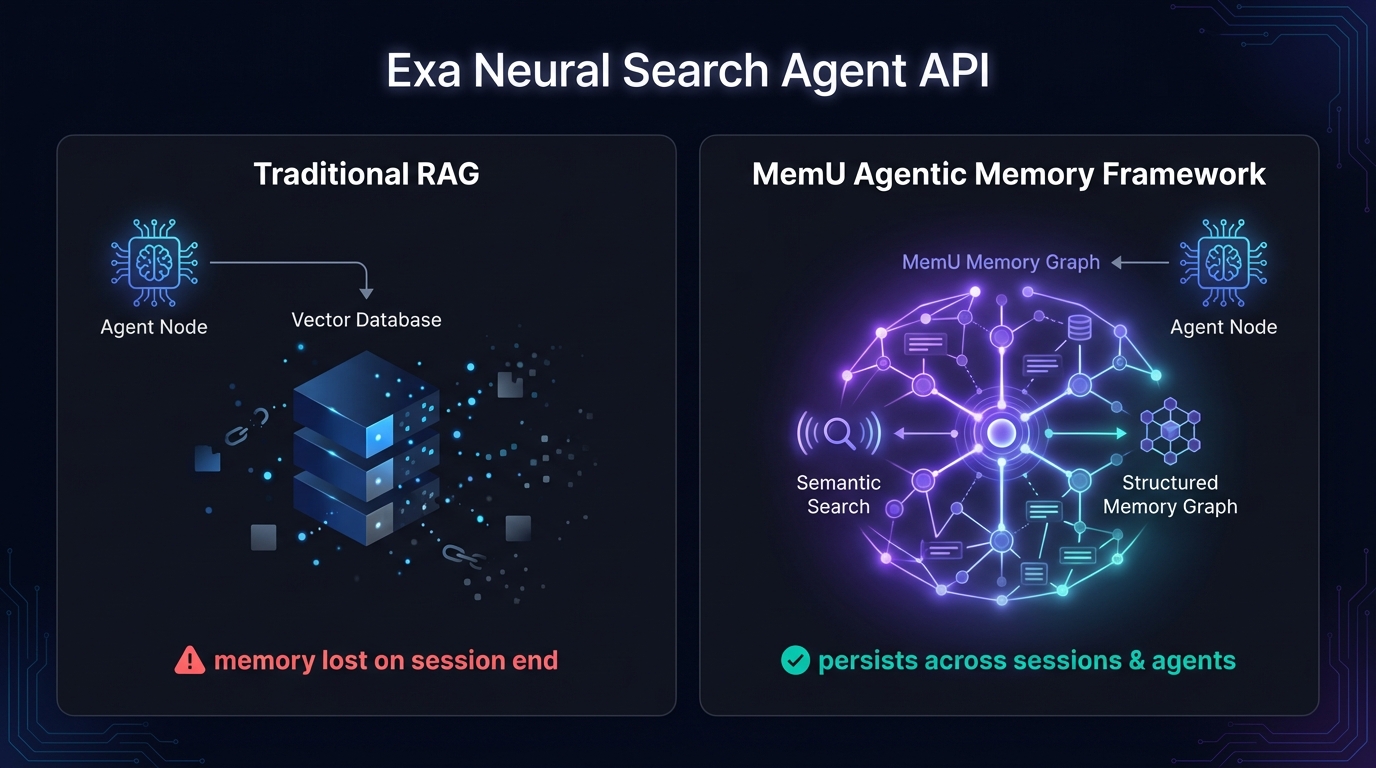
The MemU Agentic Memory Framework: when every search teaches the next
The MemU Agentic Memory Framework stores the feedback loop retrieval endpoints omit: which Exa modes correlated with task success, which domains humans rejected, which prompt templates produced grounded answers, and which follow-up tools fired after the fetch. Memory is not a second copy of the public web — it is operational intelligence about how your stack uses the neural search API in production.
An analyst agent might default to fast for dashboards but require deep for regulatory memos. MemU retains the policy, prior exceptions, and phrasing compliance accepted — so the agent does not rediscover constraints through expensive mistakes.
Patterns we see in the field:
- Mode memory: Track outcomes per intent so planners pick neural, auto, or deep with evidence instead of static heuristics.
- Source reputation: Combine structured contents from Exa with MemU trust scores updated when users flag bad citations.
- SDK-spanning contracts: Whether services call Exa from Python or TypeScript, the MemU Agentic Memory Framework supplies a shared schema for what “good retrieval” means here.
Exa retrieves the world. MemU remembers how your agents should interpret it.
Together they shrink repeated dead ends — paywalled pages, off-topic neural matches, summaries that break downstream parsers — because lessons persist.
Head-to-head: neural search alone vs. neural search plus MemU
Exa alone provides a capable neural search API, flexible modes (neural, fast, auto, deep), structured contents, agent-optimized JSON, and solid Python and TypeScript SDKs. It fits teams that need high-quality external retrieval without operating crawlers.
Adding MemU preserves that surface while remembering preferred sources, banned domains, mode policies, and reviewer snippets — shrinking repeated mistakes and token-heavy rediscovery.
One-shot Q&A with no history may tolerate statelessness. Assistants that run daily rarely do.
Better together: agent-optimized retrieval and persistent judgment
Layering the MemU Agentic Memory Framework atop Exa improves compound returns:
- Evaluation hooks: Log which structured contents produced faithful summaries; MemU feeds that into planners and source bias.
- Cross-agent reuse: Marketing and support agents share memory about unreliable blogs or canonical docs — independent of which SDK issued the call.
- Spend discipline: MemU remembers when cheaper fast passes sufficed, curbing unnecessary deep spend.
Agent-optimized JSON from the vendor stays the machine-friendly retrieval layer; MemU becomes the machine-friendly learning layer agents carry forward.
Observability completes the picture: when Python services and TypeScript gateways both call the same retrieval endpoint, distributed traces show latency spikes but not which domains consistently triggered downstream retries. MemU-backed logging ties retrieval choices to outcomes so SRE and ML teams share one narrative.
Finally, red-team and safety reviews increasingly ask what happens when malicious pages SEO-gaming the neural search API reach your agents. Blocking at the HTTP layer helps; remembering attack patterns across sessions helps more — another argument for structured memory beyond raw caches.
Weekly eval cadences benefit from frozen retrieval snapshots compared against live ranked results: you can detect drift when ranking changes silently alter agent behavior. MemU stores which snapshot or live mode was active during scoring so regressions trace to infrastructure — not mystery. That discipline matters most when marketing refreshes pages that previously ranked highly for your product terms.
Get started with MemU
If you build with the Exa neural search API, official Python and TypeScript SDKs, and mode-rich querying, you already own a modern retrieval foundation.
Add the MemU Agentic Memory Framework so those queries accumulate judgment — not just links — across sessions and agents.
Learn more at memu.pro and start from github.com/NevaMind-AI/memU to wire persistent memory into your agent stack.
Tags: Exa, neural search API, LLM agents, Python SDK, TypeScript SDK, structured contents, agent memory