Fal.ai Powers Real-Time AI Inference — But High-Throughput Inference Without Agent Memory Scales Amnesia


Fal.ai has established itself as a high-performance serverless AI inference platform focused on generative models. The platform delivers speeds reported at up to 10x faster than alternatives, with real-time image generation achieving sub-100ms latency via WebSocket streaming. Developers access over 1,000 production-ready generative models spanning image generation, video synthesis, audio processing, and 3D asset creation — including popular architectures like SDXL Lightning, MuseTalk, and SAM 3. The serverless GPU infrastructure supports H100, H200, and B200 accelerators with no cold starts, automatic scaling, and global deployment. For applications that require real-time generative AI — interactive image editors, live video processing, conversational avatar systems — Fal.ai provides the latency and throughput that production workloads demand.
But Fal.ai's inference pipeline is purely stateless. Each API call executes in isolation — the image generated for a user five minutes ago has no influence on the parameters, quality, or style of the image generated now. High-throughput inference without agent memory scales compute, but it scales amnesia at the same rate.
Fal.ai: What Everyone's Getting Right (And Missing)
Fal.ai's technical execution on inference speed is exceptional. The sub-100ms image generation via WebSocket streaming enables use cases that were previously impractical — real-time collaborative editing where AI-generated assets appear instantly, interactive design tools where users see generated results as they adjust parameters, and live video applications where frame-by-frame generation keeps pace with playback. The no-cold-start architecture means the first request is as fast as the thousandth, eliminating the startup latency that plagues GPU-based serverless platforms.
The model catalog breadth is equally significant. Rather than limiting developers to a few popular models, Fal.ai hosts over 1,000 models across modalities. A developer building a creative platform can access image generation, inpainting, style transfer, upscaling, background removal, and video generation — all through a unified API surface. The consistency of the API interface across models means switching between architectures requires changing a model identifier, not rewriting integration code.
What Fal.ai does not address is the intelligence gap between inference calls. Consider an AI-powered design tool using Fal.ai for image generation. A user generates twenty images in a session, gradually refining their prompt, adjusting style parameters, and selecting preferred outputs. Each of those twenty generations produced signals about user preference — color palettes they gravitated toward, composition styles they selected, prompt structures that produced their preferred aesthetic. But the twenty-first generation starts from the same blank state as the first. Other inference platforms — including Replicate, Banana, and Modal — share this same architectural constraint. They optimize for compute performance; none capture the intelligence that emerges from inference patterns.
The MemU Agentic Memory Framework: Inference Intelligence That Compounds
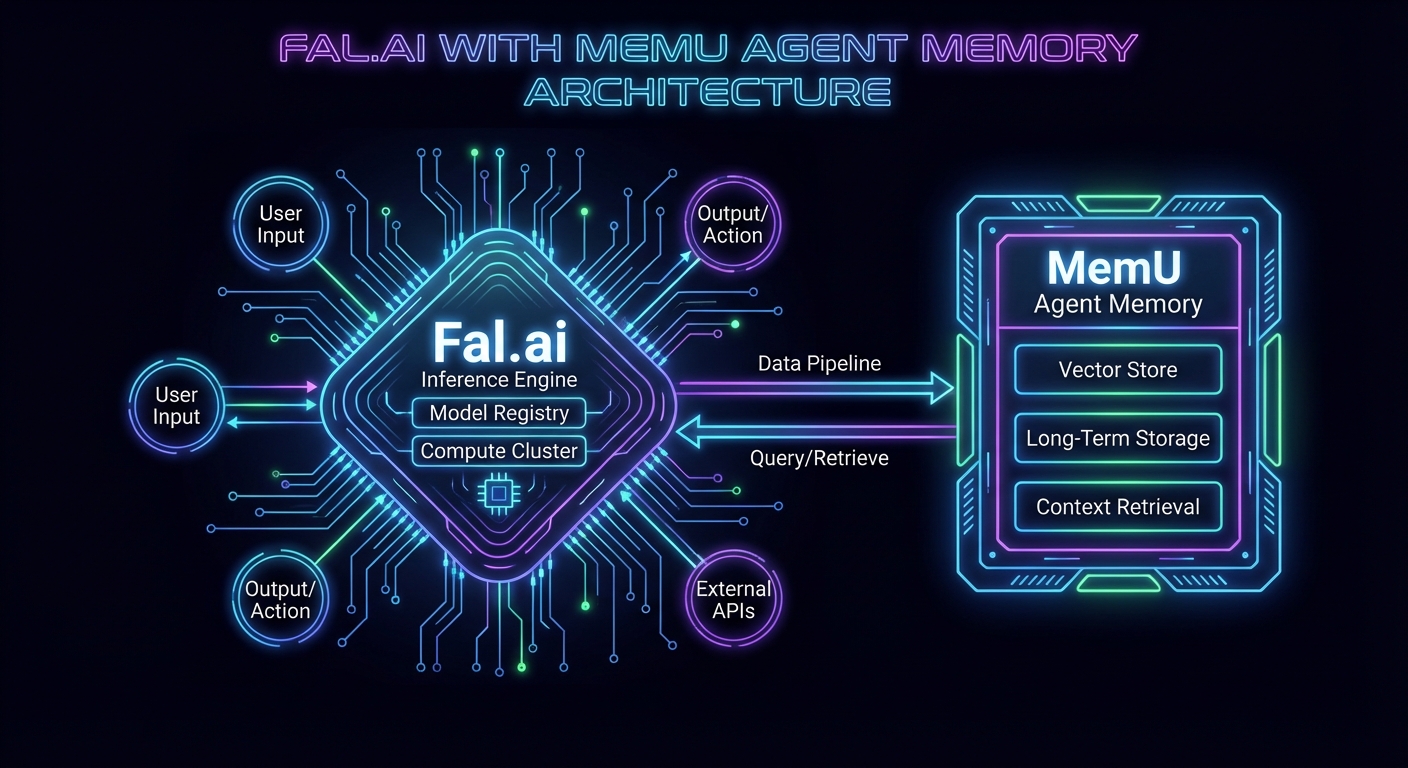
The MemU Agentic Memory Framework provides the persistent memory layer that inference platforms like Fal.ai do not include natively. Instead of treating each inference call as an isolated computation, MemU captures the parameters, outputs, user feedback, and downstream outcomes that emerge during generation and stores them in a structured memory graph that persists across sessions, users, and applications.
Consider a creative platform using Fal.ai for real-time image generation. Without persistent memory, each user session starts with default generation parameters and generic prompt templates. With the MemU Agentic Memory Framework, the platform recalls each user's generation history: this user prefers photorealistic outputs over stylized ones, they consistently adjust guidance scale upward to 8.5, their selected images tend toward warm color temperatures with shallow depth of field, and adding "dramatic lighting" to their prompts produced the highest satisfaction scores. That accumulated preference intelligence transforms generic inference calls into personalized generation that matches the user's aesthetic from the first prompt.
The framework addresses three core limitations of stateless inference:
- Parameter optimization persistence: Every inference call's parameters — model selection, guidance scale, negative prompts, seed values, sampling strategies — and their corresponding output quality are stored. The MemU Agentic Memory Framework enables applications to automatically optimize generation parameters based on accumulated outcome data rather than static defaults.
- User preference learning: When users interact with generated outputs — selecting favorites, rejecting others, making adjustments — those preference signals are captured as persistent memory. Future generations for the same user start with parameter configurations tuned to their demonstrated preferences, not platform-wide defaults.
- Cross-session creative continuity: Creative workflows often span multiple sessions. A designer developing a visual concept over several days benefits from persistent memory that tracks the evolution of their creative direction — maintaining style consistency, preferred color palettes, and composition choices across sessions without requiring the user to re-specify their preferences.
Inference speed determines what's possible in real time. But inference without memory means generating blindly — ignoring everything previous generations revealed about what works. The MemU Agentic Memory Framework combines Fal.ai's industry-leading speed with persistent intelligence that makes every generation more informed than the last.
Integration with Fal.ai applications is straightforward. The MemU Agentic Memory Framework provides REST APIs that applications call before inference — retrieving relevant user preferences and parameter optimization data — and after inference — storing generation parameters, outputs, and user feedback. The memory layer operates alongside the inference pipeline, adding persistence without adding latency to the generation path itself.
Head-to-Head: Stateless Inference vs. Memory-Enhanced Generation
Fal.ai alone: Best-in-class inference speed with sub-100ms generation, 1,000+ model catalog, and serverless GPU infrastructure that scales without cold starts. But every API call is independent — no learning from previous generations, no user preference accumulation, no parameter optimization based on outcome data.
Fal.ai + MemU: The same industry-leading inference speed, now enriched by persistent generation memory. Applications using Fal.ai for image generation can serve personalized outputs from the first prompt of a new session. Parameter optimization happens automatically based on accumulated outcome data. Creative workflows maintain style continuity across sessions without requiring users to re-establish their preferences.
The personalization impact is measurable. Applications that track user preference signals across hundreds of generations can predict preferred parameters with increasing accuracy. By the fiftieth generation for a returning user, the system understands their aesthetic preferences well enough to produce satisfying outputs with significantly fewer iteration rounds than a stateless system requires.
Empowering Fal.ai: Better Together
The combination of Fal.ai's real-time inference and the MemU Agentic Memory Framework's persistent memory unlocks application patterns that neither capability achieves alone:
- Adaptive generation pipelines: Multi-step generation workflows — generate, upscale, apply style transfer, composite — that learn optimal parameter combinations across the pipeline. Persistent memory tracks which upstream parameters produce the best downstream results, enabling end-to-end optimization that individual step optimization cannot achieve.
- Model routing intelligence: With 1,000+ models available, choosing the right model for a specific generation task is non-trivial. Persistent memory tracks which models produce the best results for which types of prompts, user preferences, and quality requirements — enabling intelligent model routing that improves with every generation.
- Collaborative creative memory: Teams working on shared creative projects benefit from collective generation memory. A brand's visual identity — established through hundreds of AI-generated assets — becomes a persistent reference that ensures new team members' generations stay on-brand from their first session.
Persistent memory transforms Fal.ai from a high-performance inference engine into an intelligent generation platform where every API call contributes to a compounding understanding of user preferences, optimal parameters, and creative intent.
Get Started with MemU
Fal.ai has built a technically impressive inference platform — sub-100ms generation, 1,000+ model catalog, and serverless GPU infrastructure that delivers production-grade performance for real-time generative AI applications. The speed and breadth of the platform enable creative and interactive use cases that were previously impractical.
The next step is giving applications built on that inference platform the ability to learn from their own generation history. Applications where every generation is informed by accumulated user preferences and outcome data. Creative workflows where style continuity persists across sessions automatically. Platforms where parameter optimization happens continuously through persistent memory rather than manual tuning.
The MemU Agentic Memory Framework provides that foundation. Drop-in API integration alongside Fal.ai's inference calls, dual-mode retrieval with semantic search and structured memory graphs, and cross-session persistence that turns every generation into compounding creative intelligence.
Visit memu.pro to explore the Agentic Memory Framework API, or check out the GitHub repository to start building agents that remember.
Tags: Fal.ai, AI inference, agentic AI, agent memory, MemU AI, LLM memory, real-time AI