Firecrawl Turns Any Website into LLM-Ready Data — But Scraped Intelligence Does Not Persist Across Extraction Workflows


Firecrawl, built by Mendable, has established itself as the leading API for converting websites into clean, LLM-ready data. The platform transforms raw web content into structured markdown, HTML, and JSON formats while handling the complexity that makes web scraping notoriously difficult — proxies, caching, rate limits, JavaScript-rendered content, embedded PDFs, and dynamically loaded images. Core operations span Scrape for single URL extraction, Crawl for entire site traversal, Map for URL discovery, and Search for web-wide content retrieval. The Python SDK and JavaScript SDK provide native integration paths, while LLM-based extraction with custom schemas enables structured data output tailored to specific use cases. An MCP Server brings scraping capabilities directly into Claude, Cursor, and VS Code through agentic tool integration, with credit-based pricing that scales from individual developers to enterprise crawl operations.
But LLM-ready scraping produces clean data — not intelligent data pipelines. Firecrawl ensures every scraped page arrives as pristine markdown or structured JSON, perfectly formatted for LLM consumption. That same scraping infrastructure cannot remember what it learned during extraction — which sites changed their layout since the last crawl, which pages contained the most valuable content, which extraction schemas produced the cleanest output for specific site types. Agents re-scrape and re-extract without learning from past crawl patterns, treating every URL as a first encounter.
Web Scraping for AI Agents: What Firecrawl Gets Right (And What It Misses)
Firecrawl addresses the critical gap between raw web content and AI-consumable data. LLMs cannot effectively process raw HTML filled with navigation elements, advertisements, tracking scripts, and layout markup. Scraping for AI requires intelligent content extraction that identifies the meaningful text, preserves structural relationships, and outputs clean formats that maximize LLM comprehension. Firecrawl's approach handles this through a combination of rendering engines that process JavaScript-heavy sites, content identification algorithms that separate signal from noise, and output formatters that produce markdown optimized for language model input.
The structured extraction capability with custom schemas represents a significant advancement beyond basic scraping. Traditional scrapers return raw content and leave parsing to downstream code. Firecrawl's LLM-based extraction accepts user-defined schemas and returns structured JSON matching those schemas directly — product prices, article metadata, contact information, or any custom structure. This moves the extraction intelligence from application code into the scraping layer itself, reducing post-processing complexity and improving data consistency across heterogeneous source sites.
The MCP Server integration positions Firecrawl as a native tool within agentic AI workflows. Rather than treating extraction as a preprocessing step that runs before agent execution, the MCP interface enables agents to invoke scraping operations as part of their reasoning process. An agent can discover URLs through the Search operation, map site structures, scrape specific pages, and extract structured data through JSON mode — all as tool calls within a single agentic workflow.
The limitation is scraping amnesia. Every scraping operation starts from scratch. When an agent crawls the same news site daily, each crawl re-discovers the site structure, re-identifies content regions, and re-processes pages that have not changed since the last crawl. The intelligence generated by previous crawls — optimal extraction parameters, content change frequencies, and site structure patterns — is not available to inform future operations. Credit expenditure scales linearly with crawl volume regardless of accumulated intelligence.
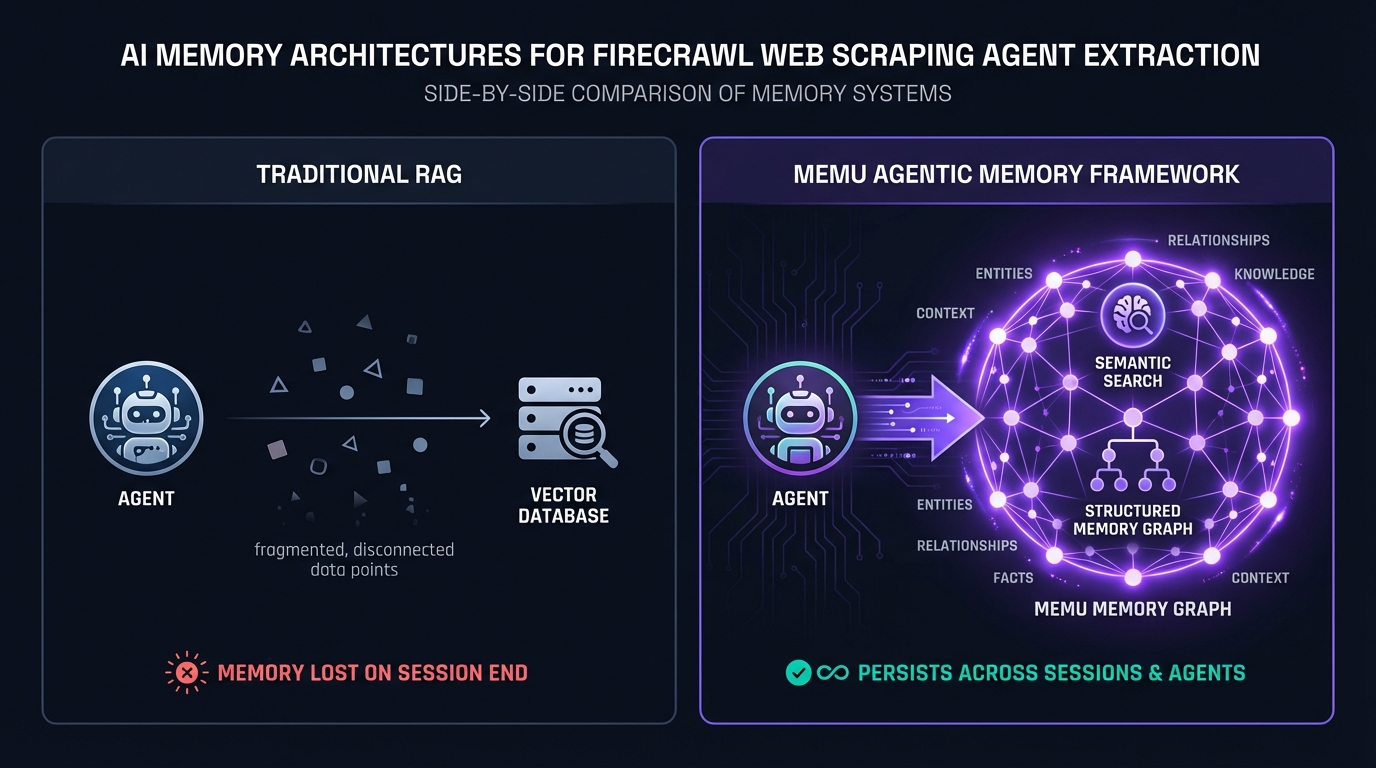
The MemU Agentic Memory Framework: Persistent Intelligence Across Web Scraping Operations
The MemU Agentic Memory Framework extends web scraping from stateless extraction to intelligent extraction that improves with every crawl. Where Firecrawl guarantees clean, LLM-ready output from any URL, MemU guarantees the intelligence generated during scraping persists across operations — creating a compounding layer where every crawled page contributes learning that improves extraction quality and efficiency for all future operations.
Consider an AI research agent that monitors a thousand industry websites daily — tracking product launches, pricing changes, and strategic announcements. Firecrawl handles the scraping reliably, converting each page into clean markdown and extracting structured data through custom schemas. After six months of daily crawls, the agent has implicitly generated massive intelligence about each site: which pages update frequently, which sections contain high-value content, and which extraction schemas produce the cleanest results for specific site architectures. With MemU, this intelligence persists as operational knowledge that optimizes every future crawl. Without persistent memory, tomorrow's crawl applies the same generic logic as the very first crawl six months ago.
The MemU Agentic Memory Framework provides capabilities that enhance scraping operations:
- Crawl pattern intelligence: Every scraping operation generates data about site structure, content quality, and extraction outcomes. MemU captures this as structured intelligence that future crawls reference — enabling agents to prioritize high-value pages, skip unchanged content, and apply optimized extraction strategies for previously encountered site architectures.
- Schema optimization: Firecrawl's LLM-based extraction applies custom schemas to extract structured data; MemU tracks which schema definitions produce the cleanest results for specific site types — building intelligence about optimal field mappings, content selectors, and fallback strategies based on measured extraction quality.
- Change detection intelligence: Repeated crawls of the same sites generate temporal data about content update patterns; MemU persists these patterns as actionable crawl schedules — enabling agents to crawl frequently-updated sites more often and stable sites less frequently, optimizing credit usage based on learned change velocities.
LLM-ready scraping ensures agents receive clean, structured web data. The MemU Agentic Memory Framework ensures the extraction intelligence from those operations persists across crawls — transforming stateless web scraping into progressively smarter extraction that optimizes quality and cost with every operation.
Head-to-Head: Firecrawl vs. Other Web Scraping Solutions
Firecrawl alone: The web scraping API provides LLM-ready output in markdown, HTML, and structured JSON, handles JavaScript rendering, proxies, and rate limits transparently, offers four core operations for comprehensive web data access, and integrates with agentic workflows through MCP. But each operation starts with zero accumulated knowledge — a thousand crawls of the same site generate independent extraction histories with no mechanism to aggregate scraping intelligence into actionable optimization for future operations.
Firecrawl + MemU Agentic Memory Framework: Every scraping operation contributes to accumulated extraction intelligence. Site structure knowledge eliminates redundant discovery, content change patterns optimize crawl scheduling, and schema effectiveness data improves extraction quality with every batch. The web scraping platform transforms from a stateless extraction service into a learning system where crawl efficiency and data quality compound across millions of scraped pages.
Compared to other scraping approaches — Browserbase, Crawlee, Scrapy, Beautiful Soup with custom infrastructure — Firecrawl offers the most complete LLM-ready extraction with the strongest agentic integration through MCP and structured JSON mode. But all share the same fundamental limitation: stateless extraction without crawl memory. MemU provides the persistent intelligence layer that transforms any scraping solution from repetitive extraction into progressive learning.
Scraped and Intelligent: Better Together
MemU does not replace Firecrawl's scraping infrastructure — it ensures every crawled page contributes to growing extraction intelligence:
- Credit optimization: Firecrawl charges credits per scrape operation; MemU tracks content change frequencies and extraction value across sites — learning which pages justify regular re-scraping and which rarely change, enabling intelligent credit allocation that maximizes data freshness within budget constraints.
- Extraction quality feedback: Firecrawl outputs structured data consumed by downstream agents; MemU captures downstream feedback about data quality and utility — learning which extraction approaches produce actionable intelligence and which generate noise, enabling continuous refinement of scraping strategies based on real consumption patterns.
- Agentic scraping evolution: Firecrawl's MCP integration enables agents to invoke scraping as a tool; MemU enables those agents to remember scraping outcomes — which sources provide reliable data, which require fallback strategies, and which extraction parameters produce optimal results, transforming reactive scraping into proactive web intelligence that anticipates agent needs.
Get Started with MemU
Give your web scraping agents persistent memory to transform stateless extraction into intelligent crawling that improves with every page across every site. The MemU Agentic Memory Framework integrates with any scraping infrastructure — one API, instant persistence, zero changes to existing Firecrawl workflows. Visit memu.pro to explore the Agentic Memory Framework API, or check out the GitHub repository to start building agents that remember.
Tags: Firecrawl, web scraping, LLM-ready data, agentic AI infrastructure, crawl intelligence, structured extraction, MCP integration, MemU AI