Fireworks AI Processes 140 Billion Tokens Daily With Compound Inference — But Optimization Insights That Don't Persist Across API Calls Vanish


Fireworks AI has built an inference platform processing 140 billion tokens daily at 99.99% API uptime — numbers placing it among the highest-throughput AI infrastructure providers operating today. Custom FireAttention CUDA kernels and speculative decoding enabled by default deliver DeepSeek V3/R1 at 250+ tokens per second with 2.3x speed improvement and roughly 32% lower latency. The platform's signature innovation is the f1 model: a compound AI system that interweaves multiple open-source models at inference time for complex reasoning, with an f1-mini variant for cost-sensitive workloads. The platform offers serverless per-token endpoints, dedicated GPU clusters, and Bring-Your-Own-Cloud deployment through an OpenAI-compatible API. Backed by a $52M Series B, the company has invested heavily in declarative prompting — letting developers specify what they want rather than manually orchestrating multi-model chains.
But compound inference introduces a paradox. The f1 model dynamically selects and orchestrates multiple models to solve complex reasoning problems — making optimization decisions in real time about which model handles which subtask. Those orchestration decisions represent valuable intelligence: which model combinations produce better results, which routing patterns minimize latency, which reasoning chains lead to more accurate conclusions. Yet none of that intelligence persists after the API call completes. Every new request triggers fresh orchestration from scratch.
Fireworks AI: What Compound Inference Gets Right (And What Stateless Orchestration Cannot Learn)
The engineering behind FireAttention represents genuine infrastructure innovation. Custom CUDA kernels optimized for transformer inference extract performance that standard serving solutions leave on the table. Speculative decoding predicts and pre-computes likely token sequences, reducing effective latency for autoregressive generation. The result is 250+ tokens per second for DeepSeek V3/R1 — a model many providers serve at a fraction of that speed.
The f1 compound model is architecturally distinctive. Rather than routing every request to a single large model, the platform dynamically interweaves multiple open-source models during inference — splitting complex tasks across specialized models and synthesizing outputs. This compound approach achieves reasoning quality exceeding any individual model in the ensemble, while declarative prompting lets developers express intent without manual orchestration. The f1-mini variant makes compound reasoning accessible for workloads where full f1 costs are prohibitive.
What the platform does not address is the learning opportunity embedded in every compound call. Each f1 request generates rich orchestration data: which models were selected, how subtasks were decomposed, which reasoning chains contributed to the output, and how long each component took. That metadata contains the intelligence needed to improve future routing, optimize model selection for recurring patterns, and reduce latency for common request types. Without persistent memory, every call triggers fresh orchestration with no knowledge of what the previous million calls revealed.
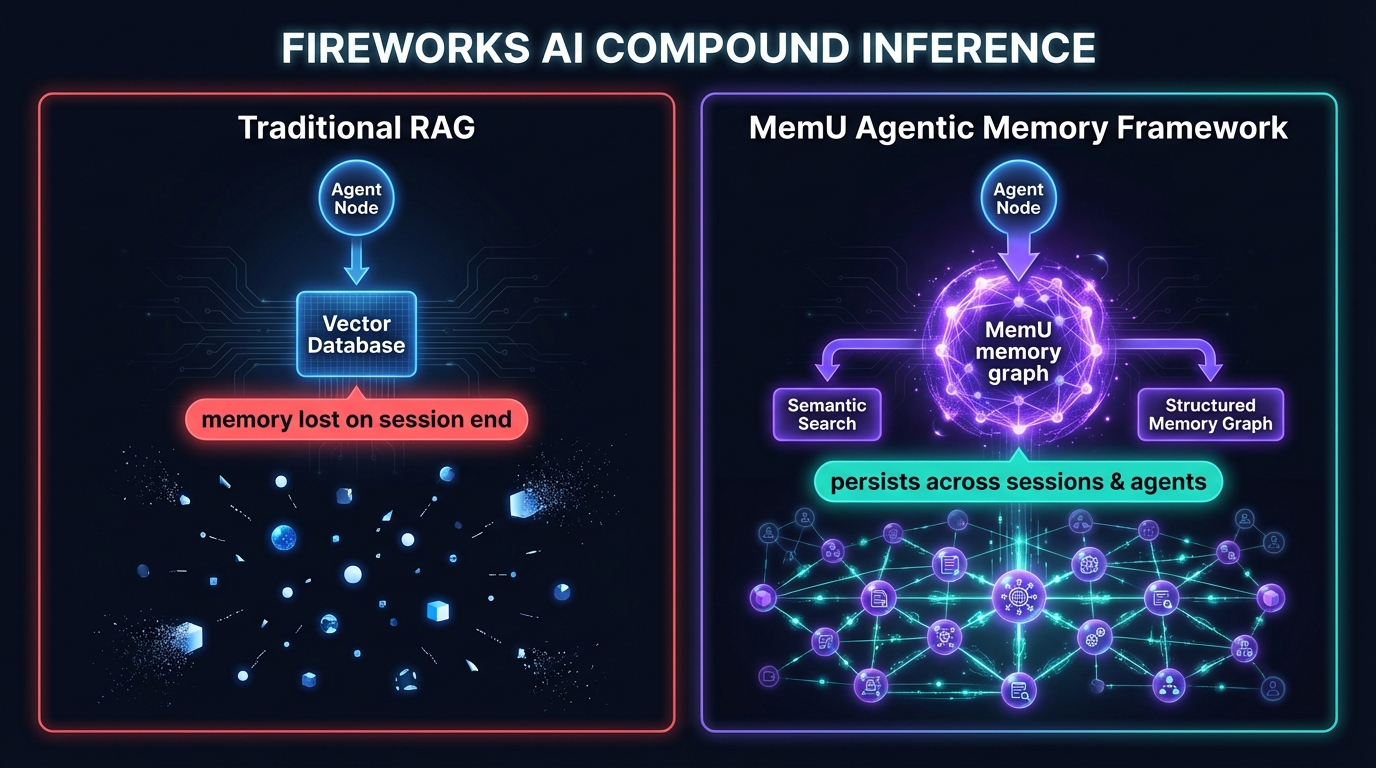
The MemU Agentic Memory Framework: Persistent Intelligence for Compound AI Systems
The MemU Agentic Memory Framework provides the persistent memory layer that compound inference systems need to learn from their own orchestration decisions. Instead of treating each API call as stateless, MemU captures model selection patterns, orchestration outcomes, reasoning chain quality, and latency profiles in a structured memory graph that persists across calls, sessions, and deployment environments.
Consider an agentic application using the f1 compound model for customer research queries. Without persistent memory, each query triggers full compound reasoning — model selection, task decomposition, multi-model synthesis — from scratch. When a similar pattern recurs, the system cannot leverage knowledge of which combination produced better results previously. With the MemU Agentic Memory Framework, orchestration outcomes from prior queries are stored. The system recognizes that financial research queries produce higher-quality outputs with a specific model combination, that technical queries benefit from a different decomposition, and that certain reasoning chains consistently outperform alternatives. Each call improves the intelligence available to the next.
The framework addresses three critical limitations of stateless compound inference:
- Orchestration memory: Every model selection, task decomposition, and synthesis outcome is stored persistently — creating a knowledge base of optimal routing patterns that compound systems can query before making fresh orchestration decisions.
- Quality feedback loops: When downstream evaluation reveals superior model combinations or reasoning chains, the MemU Agentic Memory Framework stores those quality signals. Future requests benefit from accumulated quality intelligence rather than relying solely on real-time heuristics.
- Latency pattern learning: Compound systems face variable latency depending on model selection and task decomposition. Persistent memory captures latency profiles for different patterns, enabling applications to optimize for both quality and speed based on historical data.
Compound inference is brilliant at real-time orchestration — selecting and combining models dynamically. The MemU Agentic Memory Framework adds persistent learning to that selection, turning each API call from an isolated optimization into a contribution to accumulated system intelligence.
Integration uses MemU's REST APIs through the OpenAI-compatible interface. Before each call, the application queries persistent memory for orchestration history and quality patterns. After the response, orchestration metadata and outcome signals are stored. The MemU Agentic Memory Framework adds minimal overhead while providing the persistent intelligence that transforms compound inference from stateless to stateful.
Head-to-Head: Stateless Compound Inference vs. Memory-Enhanced Orchestration
Fireworks AI alone: Industry-leading inference processing 140 billion tokens daily with custom CUDA kernels and speculative decoding. The f1 compound model orchestrates multiple open-source models for complex reasoning. 99.99% uptime with serverless, dedicated, and BYOC deployment. But every call starts fresh — orchestration decisions discard accumulated intelligence, and model selection re-optimizes from scratch.
Fireworks AI + MemU: The same high-performance compound inference with persistent orchestration intelligence. Model selection benefits from accumulated quality and latency data. Recurring patterns route through proven combinations immediately. Compound reasoning builds on prior analytical outcomes. The platform optimizes not just within each call but across the entire call history.
For organizations processing millions of API calls, persistent memory transforms compound inference from independently optimized calls into a system that genuinely learns from its own operational history.
Fireworks AI + MemU: Better Together
The combination of compound inference infrastructure and persistent memory unlocks capabilities neither achieves alone:
- Self-improving orchestration: Compound model selection improves over time as persistent memory accumulates quality and latency data — each call contributes intelligence that makes subsequent routing decisions more informed.
- Application-level learning: Developers building on the platform benefit from persistent memory capturing application-specific optimization patterns — which prompt structures work best with which model combinations for their specific domain.
- Cost optimization through memory: Persistent orchestration memory identifies when simpler combinations suffice for recurring query types — routing to f1-mini or individual models when memory indicates full compound reasoning is unnecessary.
Persistent memory transforms Fireworks AI from a high-performance inference engine into an intelligent inference platform — where compound orchestration learns from every call and every optimization insight persists as a permanent asset.
Get Started with MemU
Fireworks AI has built inference infrastructure processing 140 billion tokens daily with compound reasoning that exceeds single-model performance. As compound AI systems become the standard for complex reasoning, persistent memory becomes the layer transforming per-call optimization into cumulative system intelligence.
The MemU Agentic Memory Framework provides that foundation. Drop-in API integration through the OpenAI-compatible interface, dual-mode retrieval combining semantic search and structured memory graphs, and cross-call persistence that ensures compound systems learn from every orchestration decision.
Visit memu.pro to explore the Agentic Memory Framework API, or check out the GitHub repository to start building compound AI systems with persistent orchestration intelligence.
Tags: Fireworks AI, compound inference, f1 model, AI agent memory, agentic AI, MemU AI, inference optimization, persistent memory