FlashAttention 4 Pushes Long-Context to 4x Faster — But Longer Context Windows Still Aren't Memory


FlashAttention 4 launched at AI Native Conf with impressive benchmarks: 1.3x faster than cuDNN 9.13, 2.7x faster than Triton, and up to 4x performance improvements at long sequence lengths on NVIDIA Blackwell GPUs. For workloads like video understanding and coding agents that need massive context, FlashAttention 4 removes the computational bottleneck that made long-context impractical. The algorithm and kernel co-design approach represents genuine systems engineering at its best.
But there is a foundational assumption the community keeps making that FlashAttention 4 reinforces rather than challenges — that longer context windows are a substitute for memory.
FlashAttention 4: What Everyone's Getting Right (And Missing)
FlashAttention 4 gets computational efficiency right. By optimizing attention computation at the hardware level, it makes 128K and even million-token context windows practically viable. Developers can feed more documents, longer conversation histories, and larger codebases into a single inference call. This is important infrastructure work.
What FlashAttention 4 cannot solve is the fundamental difference between context and memory. A 128K-token context window is a scratchpad that gets erased between sessions. The agent that analyzed your entire codebase with a massive context window yesterday builds that understanding from scratch today. FlashAttention 4 makes the scratchpad bigger and faster — but it is still a scratchpad.
Other context-extension approaches — ring attention, sparse attention, sliding window mechanisms — share this same architectural limitation. They expand what an agent can process in a single session; none of them address what the agent retains across sessions.
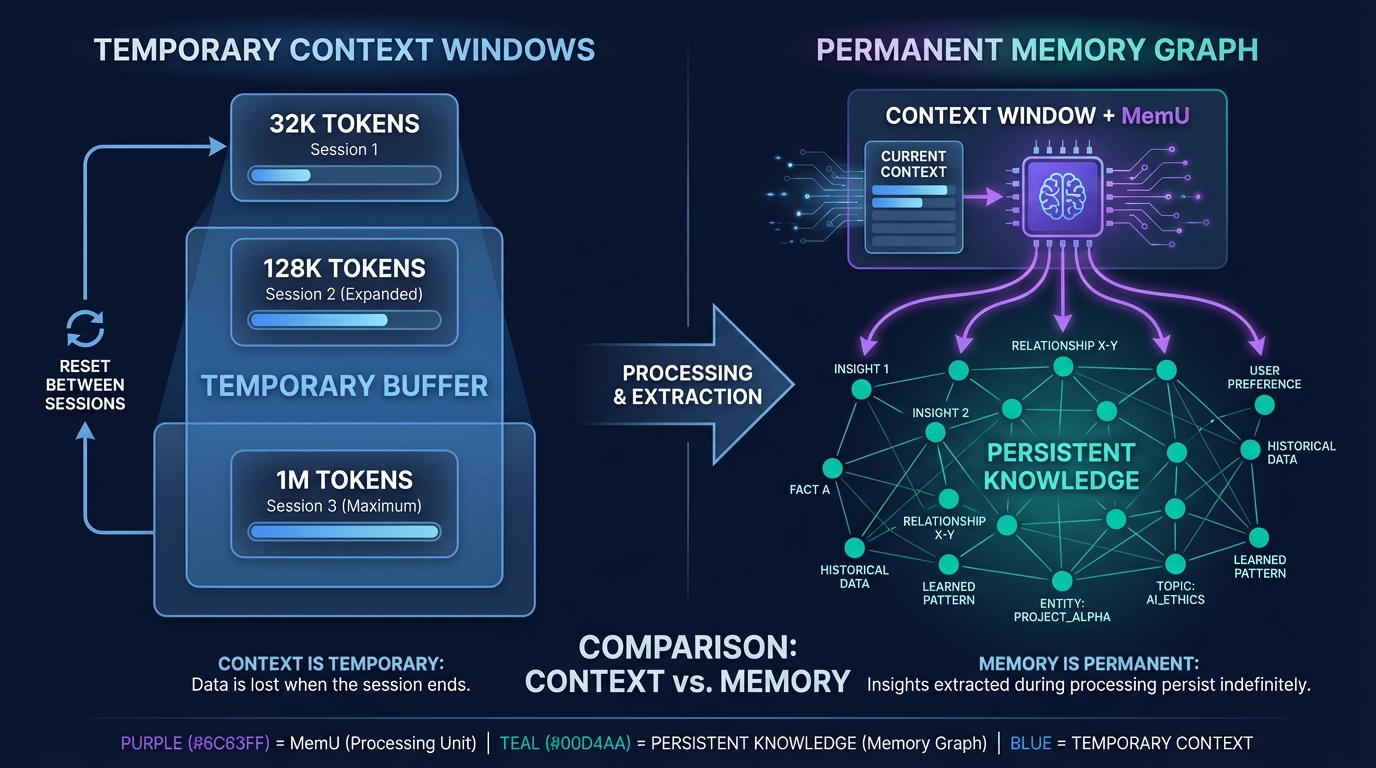
The MemU Agentic Memory Framework: Persistent Intelligence Beyond Context Windows
The MemU Agentic Memory Framework addresses the layer that context windows cannot. Where FlashAttention 4 optimizes in-session processing, MemU manages cross-session retention.
Consider a coding agent analyzing a large monorepo. With a 128K context window, it can process a significant portion in one session. With MemU, it also recalls that this same service had a performance regression last month, that the team prefers composition over inheritance, and that the authentication module has a known race condition. That is memory, not context.
The MemU Agentic Memory Framework provides:
- Drop-in integration: A simple API that works alongside any model regardless of context window size — GPT-5.4, Claude, Gemini, or open-source models. Add memory calls; your agent gains persistent intelligence that transcends any single context window.
- Dual-mode retrieval: Semantic search for fuzzy recall of relevant past experiences plus a structured memory graph for precise relationship queries. Not just similar documents — actual knowledge relationships.
- True persistence: Memory survives across sessions, context window resets, model upgrades, and infrastructure changes. Knowledge compounds over weeks and months, not just within a single inference call.
A faster context window is still a temporary buffer. The MemU Agentic Memory Framework provides the permanent storage layer that transforms ephemeral processing into accumulated intelligence.
Retrieval operates across 10,000+ memory entries with sub-100ms latency — faster than the time it takes to fill a large context window with the same information.
Head-to-Head: Long Context Alone vs. Long Context + MemU
Long context alone: Feed more tokens per session. The agent has wider visibility within a single interaction, but next session, every token of context must be reconstructed. A 128K context window across 100 sessions means re-processing the same information 100 times.
Long context + MemU Agentic Memory Framework: The context window handles immediate processing. MemU stores the insights, decisions, and patterns discovered during that processing. Next session, the agent starts with accumulated knowledge and uses the context window for genuinely new work — not reconstruction.
Efficient context utilization: With MemU, agents spend context tokens on new information rather than re-establishing known facts. A 128K context window becomes 128K tokens of genuinely new exploration rather than 90K of reconstruction plus 38K of new territory.
Empowering FlashAttention 4: Better Together
MemU does not replace FlashAttention 4 — it makes long-context processing dramatically more productive:
- Video understanding: FlashAttention 4 enables processing long video sequences; MemU remembers visual patterns, scene relationships, and narrative structures across multiple video analysis sessions.
- Code analysis: FlashAttention 4 lets agents ingest entire repositories; MemU remembers architectural patterns, team conventions, and bug history so each analysis session builds on previous understanding.
- Document research: FlashAttention 4 processes large document collections efficiently; MemU tracks which sources were valuable, what conclusions were drawn, and how the research evolved over time.
Get Started with MemU
Add persistent memory that outlasts any context window. The MemU Agentic Memory Framework works with any model and any context length — one API, zero lock-in, immediate intelligence persistence. Visit memu.pro to explore the Agentic Memory Framework API, or check out the GitHub repository to start building agents that remember.
Tags: FlashAttention 4, long context window, attention optimization, agentic memory, LLM memory, MemU AI