Gemini 3.1 Pro Scores 77% on ARC-AGI-2 — But Reasoning Still Forgets

Google DeepMind just redefined what AI reasoning can achieve. Gemini 3.1 Pro, released February 19, 2026, scored 77.1% on the ARC-AGI-2 benchmark — more than doubling its predecessor's 31.1% and leaving Claude Opus 4.6 (68.8%) and GPT-5.2 (52.9%) behind. This isn't incremental improvement; it's a 148% leap in abstract reasoning capability in a single generation.
The ARC-AGI-2 benchmark was specifically designed to resist pattern-matching. It tests genuine abstract reasoning — the ability to identify novel rules from minimal examples and apply them to unseen problems. A 77% score suggests Gemini 3.1 Pro is approaching qualitative thresholds that previous models couldn't reach.
But here's what the benchmark doesn't measure: can the model remember what it reasoned about? And that gap matters more than the score itself.
Gemini 3.1 Pro: What the Benchmarks Reveal (And Hide)
The capability leap is genuine. Gemini 3.1 Pro brings natively multimodal reasoning across text, audio, images, video, and code. Its 1 million token context window enables complex document analysis. The 64,000 token output supports detailed, structured responses. Performance on ARC-AGI-1 hits 98.0% — near saturation.
Google DeepMind positioned Gemini 3.1 Pro as their most advanced model, available across Google AI Studio, Vertex AI, Gemini API, and NotebookLM. The architecture represents years of research into scaling reasoning capabilities.
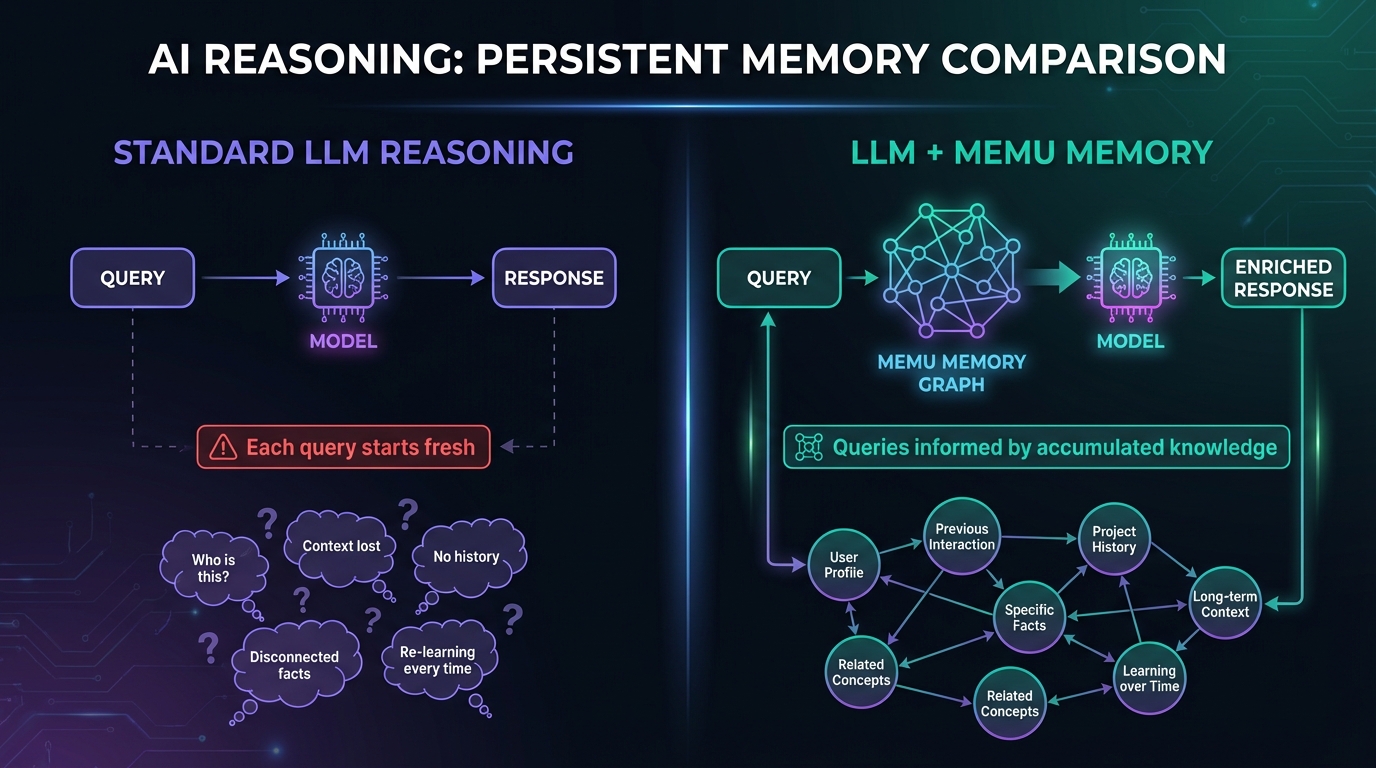
Yet benchmarks measure single-session performance. They don't capture whether reasoning insights persist. A model that brilliantly solves a complex reasoning problem today doesn't necessarily remember that solution approach tomorrow. Each query starts fresh — no accumulated reasoning strategies, no learned problem patterns, no evolving expertise.
For one-shot tasks, this doesn't matter. For systems that need to reason consistently over time — research assistants, analytical agents, decision support systems — it's a fundamental limitation.
How Gemini 3.1 Pro Handles Context
Gemini 3.1 Pro's 1 million token context window is genuinely impressive. You can feed entire codebases, research paper collections, or extensive document sets and get coherent analysis. The model maintains reasoning threads across massive contexts within a single session.
The architecture excels at in-context learning — identifying patterns from provided examples and applying them to new problems. This drives the ARC-AGI-2 performance: given examples of a novel rule, Gemini 3.1 Pro infers the underlying logic and generalizes effectively.
The limitation is context boundary. When a session ends, the in-context learning disappears. A research assistant that developed sophisticated analysis patterns during a deep-dive session loses those patterns when you start fresh. The brilliant inference that solved yesterday's problem isn't available for today's related challenge.
This affects Claude Opus, GPT-5, and every large language model. Context windows are working memory, not persistent knowledge. The reasoning happens; it just doesn't stick.
The MemU Agentic Memory Framework: Reasoning That Persists
The MemU Agentic Memory Framework addresses this by capturing reasoning outputs into persistent memory that survives session boundaries. Rather than losing insights when contexts reset, MemU stores learned patterns, successful reasoning strategies, and accumulated knowledge in a structured graph.
Consider a research team using Gemini 3.1 Pro for literature analysis. Today, the model develops a sophisticated framework for evaluating methodology quality in clinical trials. With Gemini alone, that framework exists only in today's session. With the MemU Agentic Memory Framework, the reasoning approach gets captured — and retrieved automatically when analyzing future papers.
The architecture provides three key capabilities for reasoning systems:
- Reasoning persistence: The MemU Agentic Memory Framework captures not just facts but reasoning patterns — the analytical frameworks, evaluation criteria, and problem-solving approaches that make outputs valuable.
- Cross-session retrieval: Previous reasoning becomes available to new sessions. Queries about related topics automatically surface relevant past analysis, enabling consistent reasoning over time.
- Evolving expertise: Memory accumulates. A research assistant using Gemini 3.1 Pro + MemU develops genuine domain expertise — each analysis building on previous insights rather than starting from scratch.
MemU transforms brilliant single-session reasoning into accumulated intelligence that compounds over time.
Integration works with any Gemini deployment: the MemU Agentic Memory Framework provides API endpoints that store and retrieve memory alongside standard Gemini API calls.
Head-to-Head: Context Windows vs. Persistent Memory
Gemini 3.1 Pro alone: 77% ARC-AGI-2, 1M token context, state-of-the-art reasoning within sessions. But each session is isolated — yesterday's insights don't inform today's analysis. Reasoning quality is consistent but doesn't compound.
Gemini 3.1 Pro + MemU: Same reasoning capabilities plus persistent memory. Previous analyses, successful reasoning patterns, and accumulated domain knowledge become available to every future session. Retrieval works across 10,000+ memory entries with sub-100ms latency. Reasoning quality compounds over time.
Gemini 3.1 Pro proves that AI reasoning can approach sophisticated human-level analysis. The MemU Agentic Memory Framework provides the persistence that makes that reasoning genuinely cumulative.
Empowering AI Reasoning: Better Together
The MemU Agentic Memory Framework isn't a replacement for Gemini's reasoning capabilities — it's the memory layer that makes those capabilities accumulate.
- Research continuity: Literature reviews build on previous analyses. Methodology evaluations reference past assessments. Domain expertise develops over months of use rather than resetting each session.
- Analytical consistency: Organizations get consistent reasoning across team members and time. The framework that worked for last quarter's analysis informs this quarter's approach.
- Knowledge accumulation: Every Gemini interaction contributes to organizational memory. Insights don't disappear — they become retrievable context for future reasoning.
Adding persistent memory takes a single API integration. The MemU Agentic Memory Framework handles the complexity — your Gemini-powered systems just get smarter over time.
Get Started with MemU
Gemini 3.1 Pro represents a genuine breakthrough in AI reasoning. The 77% ARC-AGI-2 score demonstrates capabilities that seemed years away. Google DeepMind has closed significant gaps in abstract reasoning.
The next step is making that reasoning cumulative. Systems that learn from every analysis they perform. Research assistants that develop genuine expertise. Analytical tools where today's insights inform tomorrow's conclusions.
The MemU Agentic Memory Framework provides that foundation. Drop-in integration with Gemini means you can add persistent memory without changing your reasoning workflows. Structured knowledge graphs capture the patterns that make analysis valuable. And retrieval scales to support years of accumulated reasoning.
Visit memu.pro to explore the Agentic Memory Framework API, or check out the open-source repository on GitHub to start building persistent memory into your Gemini-powered systems today.