Gemini 3 Deep Think Scores 84.6% on ARC-AGI-2 — But Each Reasoning Session Starts From Zero Context

Google just built the strongest reasoning model in AI. The Gemini 3 Deep Think upgrade, released February 12, 2026, achieves 84.6% on ARC-AGI-2, gold-level performance on the International Math Olympiad, 3,455 Elo on Codeforces (elite competitive programming), and record scores across physics and chemistry olympiad benchmarks. The model can even detect subtle logical errors in technical research papers.
Deep Think uses inference-time compute scaling — allocating additional processing resources during response generation to enable extended reasoning chains, parallel hypothesis exploration, and multi-step internal analysis. This is "System 2" thinking: slow, deliberate, deeply analytical. The model excels precisely on problems that lack clear constraints, structured data, or single correct answers.
For researchers, engineers, and scientists, Gemini 3 Deep Think is a genuine force multiplier. But here's the gap: each reasoning session builds understanding that vanishes when the session ends.
Gemini 3 Deep Think: What Inference-Time Reasoning Achieves
The upgrade represents a fundamental shift from standard language model inference. Rather than producing immediate responses, Deep Think dynamically allocates compute to match problem complexity. Simple queries get efficient answers. Complex research problems trigger extended reasoning chains that explore multiple hypotheses in parallel before converging on conclusions.
The capability is most visible in specialized domains. Deep Think solves International Math Olympiad problems — the kind that require creative insight, not just pattern matching. It achieves elite competitive programming Elo — solving problems that demand algorithmic invention, not template application. It identifies logical flaws in published research papers — catching errors that peer reviewers miss.
For individual reasoning sessions, Deep Think is extraordinarily capable. The limitation is cumulative reasoning. A research team using Deep Think to analyze a protein folding dataset builds extensive understanding within the session — structural hypotheses, energy landscape models, promising research directions. When the session ends, all that accumulated reasoning context disappears. Tomorrow's session re-derives what today's session discovered.
How Gemini 3 Deep Think Handles Reasoning Context
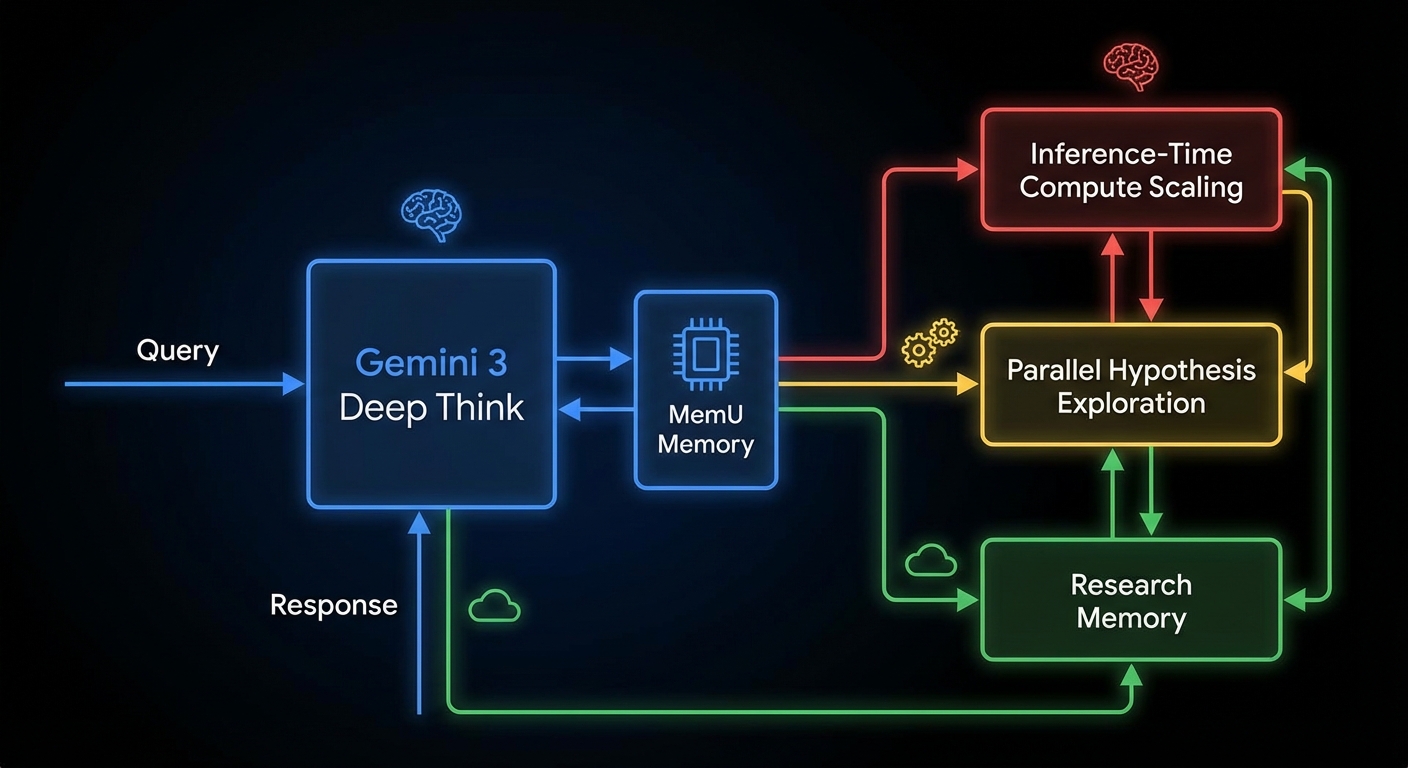
Within a session, Deep Think's reasoning process builds progressively. The model explores hypothesis spaces, evaluates evidence, backtracks when approaches fail, and synthesizes conclusions from multiple analytical threads. This internal reasoning chain can extend substantially — the model willingly spends extra compute when problem complexity demands it.
The parallel hypothesis exploration is particularly powerful. Rather than committing to a single analytical approach, Deep Think evaluates multiple possibilities simultaneously. This reduces the risk of fixating on incorrect approaches and enables more robust conclusions.
Between sessions, the entire reasoning trajectory is lost. The hypotheses evaluated, the dead ends identified, the promising directions discovered — none persist to the next session. A multi-week research project using Deep Think effectively restarts its analytical thread every session, wasting compute on re-deriving previously established conclusions.
This is especially costly for Deep Think because the model's strength is precisely in deep, extended reasoning. The more powerful the reasoning within a session, the more valuable it is to preserve that reasoning across sessions.
The MemU Agentic Memory Framework: Reasoning That Compounds Across Sessions
The MemU Agentic Memory Framework provides the persistent reasoning context that makes Deep Think's capabilities cumulative. Rather than independent analytical sessions, MemU enables research trajectories that build progressively — each session starting where the last one's reasoning left off.
Consider a materials science team using Gemini 3 Deep Think to discover new superconducting compounds. Monday's session analyzes crystal structure candidates, narrowing 200 possibilities to 15 promising ones. Wednesday's session evaluates electronic band structures. With Deep Think alone, Wednesday's session must re-derive Monday's narrowing criteria. With the MemU Agentic Memory Framework, Wednesday's session starts with Monday's full analytical context — the 15 candidates, the reasoning that eliminated the other 185, and the evaluation criteria that emerged.
The architecture enhances Deep Think through three capabilities:
- Reasoning chain persistence: The MemU Agentic Memory Framework captures not just conclusions but the analytical process — hypotheses explored, evidence evaluated, reasoning that led to conclusions. Future sessions can understand not just what was concluded but why.
- Dead-end avoidance: When Deep Think explores approaches that prove unproductive, MemU records those dead ends. Future sessions don't waste compute re-exploring paths already shown to be fruitless.
- Progressive refinement: Each session's reasoning builds on the accumulated analytical foundation. The tenth session on a research problem has access to the full reasoning trajectory of the previous nine.
MemU makes Gemini 3 Deep Think's reasoning cumulative — every analytical session deepens the foundation for the next one.
Head-to-Head: Session Reasoning vs. Cumulative Research
Gemini 3 Deep Think alone: Record-breaking reasoning within sessions. 84.6% ARC-AGI-2, gold IMO, elite Codeforces. But each session is analytically independent — no accumulated research context, no progressive hypothesis refinement, no dead-end memory.
Deep Think + MemU: Same reasoning power plus persistent analytical memory. Research trajectories build across sessions. Hypothesis spaces narrow progressively. Sub-100ms memory retrieval means reasoning context is available instantly without impacting Deep Think's inference-time compute allocation.
Get Started with MemU
Gemini 3 Deep Think represents the frontier of AI reasoning capability. The model's ability to tackle genuinely hard scientific, mathematical, and engineering problems makes it invaluable for research teams.
The MemU Agentic Memory Framework ensures that reasoning power accumulates rather than resets. Research projects that build on previous analysis. Hypothesis spaces that narrow progressively. Analytical investments that compound over weeks and months.
Visit memu.pro to explore the Agentic Memory Framework API, or check out the open-source repository on GitHub to start building persistent memory into your reasoning workflows today.