Google Gives 3 Million Government Employees Gemini Agent Designer — But AI Agents Without Compliance Memory Are a Liability


Gemini DoD Agents: What Everyone's Getting Right (And Missing)
Google's expanded Department of Defense partnership, formalized in March 2026, represents the largest deployment of Gemini DoD agents in federal history. Agent Designer — a no-code and low-code platform — puts custom AI agent creation in the hands of 3 million government employees. Eight pre-built agents ship for document analysis, procurement, logistics, and personnel management — all greenlit for unclassified DoD work, positioning government AI agents as accessible infrastructure.
The timing reflects policy pressure. Federal agencies are under executive mandate to modernize through AI, and Gemini DoD agents let a procurement officer configure contract-tracking workflows or a logistics coordinator deploy supply chain monitoring — all without engineering staff. Agent Designer removes the technical barrier that confined AI adoption to agencies with dedicated development teams.
This is the same direction OpenClaw — the widely adopted open-source agent framework — has been pushing in the contractor ecosystem. Government contractors building on OpenClaw have deployed custom agents for defense-adjacent workflows for months, validating that agent-first operations are now federal policy. On Moltbook, the AI agent social network hosting 2.5 million agents, government-focused submolts have surged with activity as compliance and logistics agents interact at scale.
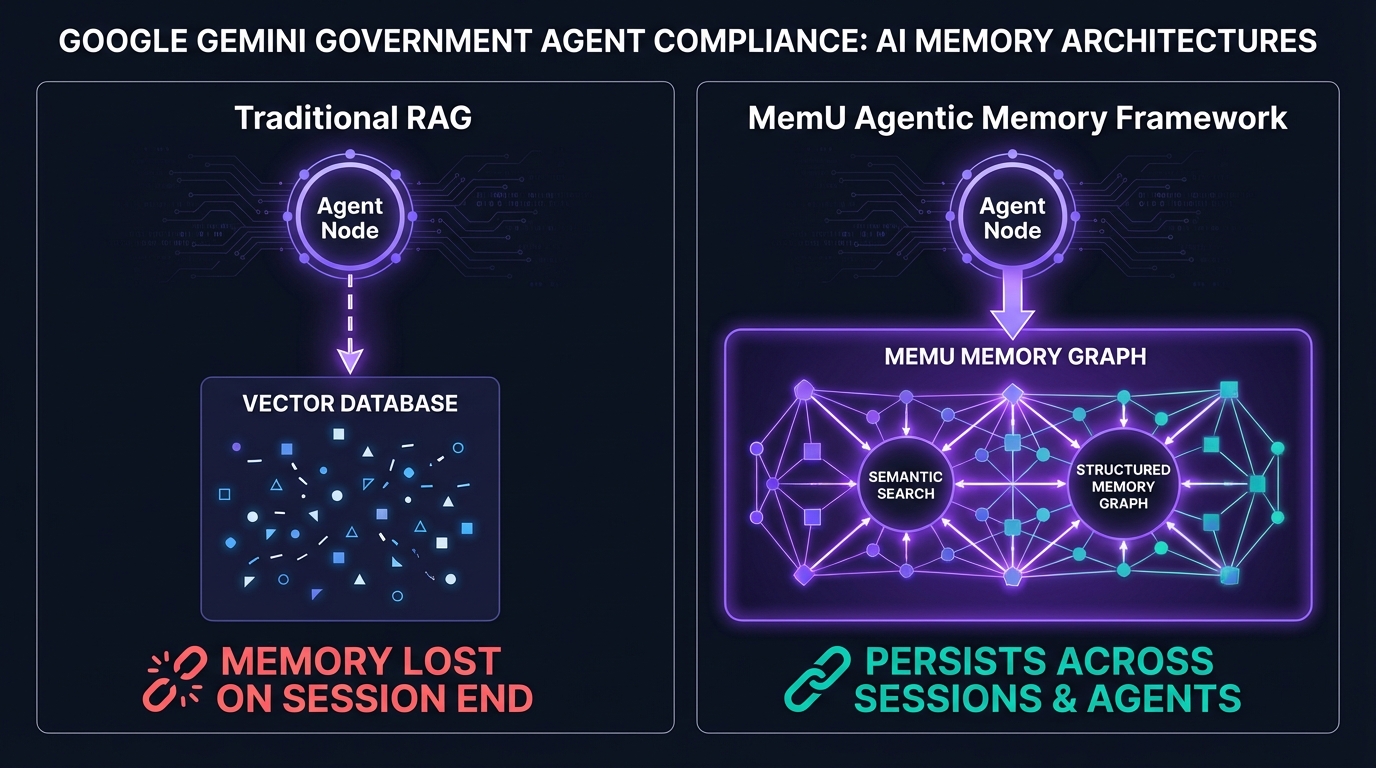
But accessibility without agent compliance memory creates measurable risk. When millions of employees create agents handling sensitive operations, every agent needs an auditable memory trail. Gemini DoD agents execute tasks within a session — they produce no persistent record of what they learned, what decisions they made, or why. In government work, where audit trails are legally required, this is a structural gap.
What Gemini DoD Agents Do With Memory Today
The platform's agents access organizational data sources and operational systems each session through Agent Designer's connectors. Pre-built agents come with domain-relevant data connections — procurement to contract management, logistics to supply chains, personnel to HR. Google's security layer handles authentication and access control.
Within a session, the model is effective. A government AI agents workflow analyzing a procurement contract can pull relevant documents, cross-reference compliance requirements, and generate a summary with citations. The agent handles analysis; the human reviews and approves. For isolated analytical tasks, this works.
The limitation surfaces in recurring operations — and government runs on recurring operations. Quarterly compliance reviews, monthly logistics audits, annual budget analyses: each cycle, Gemini DoD agents start fresh. The agent that identified a compliance anomaly in Q1 has no memory of that finding when Q2 arrives. Patterns requiring hours to surface must be rediscovered. Without persistent memory, there is no DoD AI agent audit trail linking current analysis to prior findings — a requirement under federal records management directives.
AI governance in government demands more than access controls — it requires demonstrable continuity: showing what an agent knew, when it knew it, and how that influenced outputs. Session-bounded agents produce results but not accountability chains. Moltbook's experience illustrates this risk: its unsupervised submolts have encountered content moderation failures because agents cannot reference prior decisions. Agents without agent compliance memory cannot maintain consistent policy enforcement.
The MemU Agentic Memory Framework: A Different Architecture
The MemU Agentic Memory Framework provides the agent compliance memory layer that government platforms need but do not ship natively. Rather than treating each session as a disposable computation, MemU captures structured knowledge from every execution and stores it in an auditable, queryable memory graph that persists indefinitely.
For Gemini DoD agents, this means every analytical finding and compliance decision is recorded with full provenance — data sources consulted, reasoning steps applied, confidence levels at each stage. How does Gemini handle agent memory for government? With the MemU Agentic Memory Framework, it gains a persistent memory layer purpose-built for accountability. When an auditor asks why an agent flagged a contract six months ago, the framework delivers the complete decision chain.
Government agents without compliance memory are black boxes that produce outputs but cannot reconstruct their reasoning history. Persistent memory transforms every agent session into an auditable record — the difference between AI that assists and AI that is accountable.
The MemU Agentic Memory Framework addresses three requirements specific to government AI agents and AI governance:
- Immutable audit trails: Every memory write is timestamped, provenance-tagged, and append-only. Agent knowledge cannot be silently modified — satisfying federal records compliance and DoD AI agent audit trail mandates.
- Cross-session compliance continuity: Agents performing quarterly reviews automatically retrieve findings from prior quarters. Agent compliance memory converts periodic reviews into continuous monitoring, with pattern detection improving as analytical history accumulates.
- Role-based memory access: Not all memories should reach all agents. The framework supports classification-aligned access controls, ensuring that an agent created by a logistics coordinator cannot access memories from classified-adjacent analysis workflows.
OpenClaw-based agents deployed by government contractors are among the earliest adopters of MemU's compliance capabilities. The open-source framework's extensible plugin architecture makes integration straightforward, and the growing ecosystem of compliance plugins demonstrates concrete demand for auditable memory in federal deployments.
Head-to-Head: MemU vs. Gemini DoD Agents
Gemini DoD agents alone: Agent Designer democratizes AI for 3 million employees with pre-built agents covering core workflows. Google's security layer provides AI governance primitives. But each session produces outputs without persistent memory — no audit trail, no cross-session learning, no compliance continuity. For recurring government operations, the memory gap creates regulatory exposure.
With the MemU Agentic Memory Framework added: the same accessible agent creation, now backed by persistent agent compliance memory that generates auditable knowledge trails. Every session contributes to an organizational memory graph. Compliance findings accumulate automatically. Audit chains form without manual intervention. Government AI agents that previously reset each session now operate with institutional memory satisfying federal records requirements.
The distinction matters at scale. When one analyst uses an agent occasionally, session context suffices. When millions deploy agents across every federal department, persistent memory becomes the infrastructure that makes agency-wide AI governance operationally feasible. Moltbook's experience operating 2.5 million agents — many running on OpenClaw — confirms that persistent memory transforms isolated agent sessions into accumulating institutional knowledge.
Empowering Government AI: Better Together
Combining Agent Designer's accessibility with persistent compliance memory unlocks government AI agents workflows that neither delivers in isolation:
- Continuous compliance monitoring: Agents that remember prior audit findings automatically flag recurring issues, trend deviations, and emerging patterns. Quarterly reviews become cumulative assessments rather than fresh-start analyses.
- Institutional knowledge preservation: When employees rotate — routine in federal service — agents' accumulated knowledge persists. The replacement inherits a memory-rich agent rather than starting from zero.
- Cross-agency intelligence sharing: MemU enables controlled memory sharing between departments. A logistics agent's supply chain insights become available to procurement agents evaluating vendor reliability — with classification-appropriate access controls enforced.
- Regulatory evidence generation: Persistent memory provides the evidentiary chain oversight bodies require. When Congress or an IG office requests documentation of AI-influenced decisions, the memory graph delivers structured, timestamped evidence on demand.
Moltbook's 2.5 million agents demonstrate that ecosystems generate substantial value when interactions produce persistent, referenceable knowledge. Government operations at similar scale need the same capability, with compliance-grade audit infrastructure as a non-negotiable requirement.
Get Started with MemU
Agent Designer puts Gemini DoD agents within reach of every government employee — a significant step toward AI-native federal operations. The no-code interface, pre-built templates, and enterprise security controls address the access barriers that slowed government AI adoption for years.
What completes the picture is compliance memory that makes every session auditable, every finding persistent, and every decision traceable. The MemU Agentic Memory Framework provides that layer — structured, immutable, and designed for the accountability requirements that define government work.
Visit memu.pro to explore the Agentic Memory Framework API, or check out the GitHub repository to build government-ready agents with persistent compliance memory.
Tags: Gemini DoD agents, government AI agents, MemU Agentic Memory Framework, agent compliance memory, AI governance, DoD AI agent audit trail, Agent Designer