Gemini Robotics Brings AI Agents Into the Physical World — Embodied Intelligence Without Embodied Memory

Google DeepMind's Gemini Robotics family represents the most significant advance in embodied AI since the original transformer architecture. Gemini Robotics-ER 1.5 provides high-level reasoning — task planning, spatial understanding, progress estimation — while Gemini Robotics 1.5 translates those plans into motor commands through a vision-language-action model. Together, they enable robots to handle genuinely complex tasks: sorting objects into compost, recycling, and trash by searching the internet for local guidelines, visually identifying objects, and executing multi-step manipulation sequences.
The architecture is an agentic framework for the physical world. The ER model acts as the reasoning "brain," planning multi-step tasks and calling tools (including Google Search). The VLA model acts as the "body," converting plans into precise motor actions. Skills transfer across different robot embodiments — the same high-level reasoning works whether the body is an arm, a mobile robot, or a humanoid. For developers, the model is available through Google AI Studio and the Gemini API, making physical AI as accessible as chatbot development.
But physical AI faces a memory challenge that's even more critical than digital AI: robots that interact with the physical world generate irreplaceable experiential knowledge — and currently lose all of it between sessions.
Why Physical World Memory Is Different
Digital AI agents lose conversational context between sessions. Physical AI agents lose environmental knowledge. A robot that has spent eight hours in a warehouse knows the layout, the typical object positions, the lighting conditions, and the movement patterns of human workers. This environmental model, built through real-time observation and interaction, is far richer than any map or configuration file.
When the robot restarts, all of this environmental understanding resets. It must re-map the space, re-learn the typical patterns, and re-discover the operational context. In a factory running three shifts, each shift change erases the accumulated environmental intelligence. The robot that handled a tricky corner case at 2 PM has no memory of it at 10 PM when the same case recurs.
Gemini Robotics' ability to search the internet and plan complex tasks amplifies this. A robot that researched local recycling guidelines and learned which items go in which bin has generated valuable operational knowledge. Without memory, the next session requires the same internet research, the same reasoning chain, and the same learning process — wasting compute, time, and bandwidth on knowledge that was already acquired.
Embodied Reasoning Needs Embodied Memory
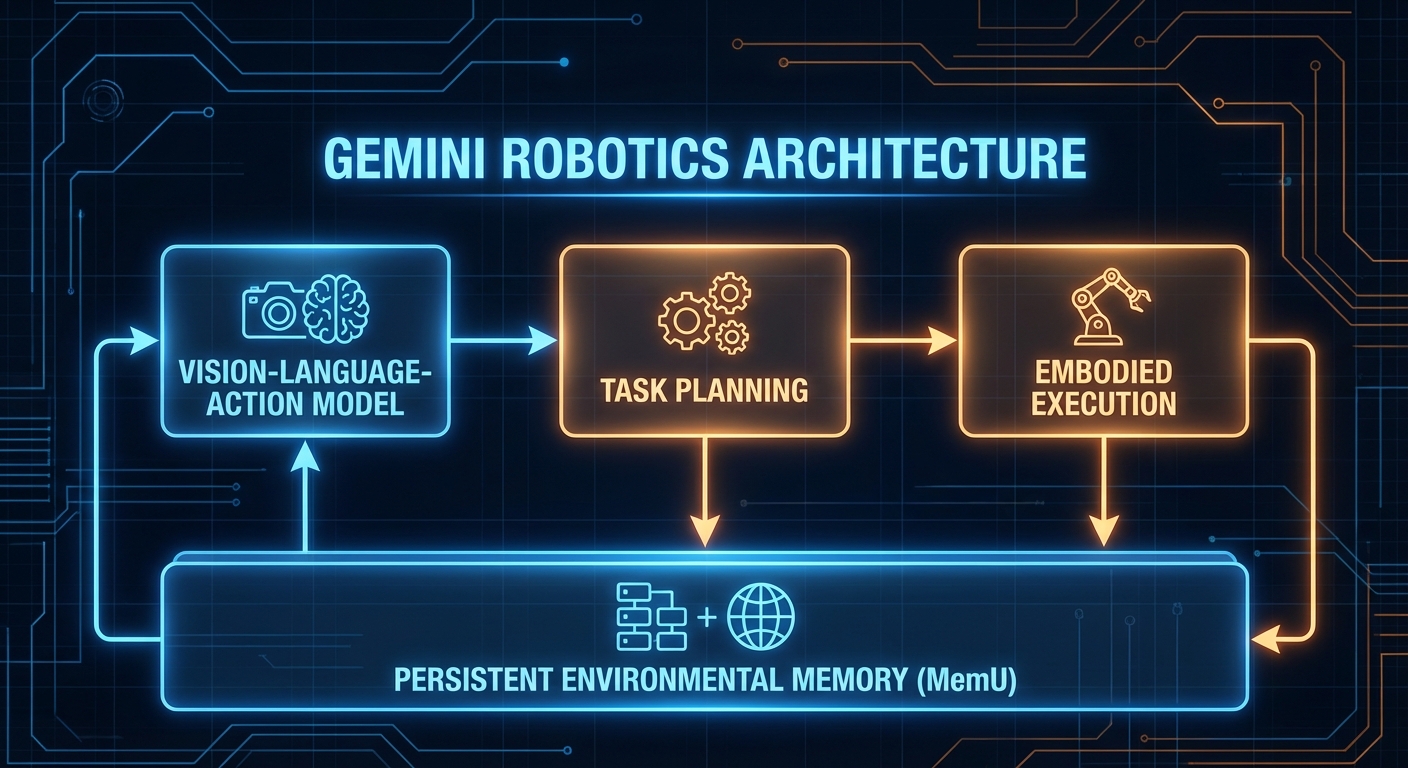
The ER model's task planning capability benefits enormously from persistent memory. Planning a multi-step task in a familiar environment is fundamentally different from planning in an unknown one. A robot with environmental memory can plan shorter paths, anticipate obstacles, and predict where objects will be based on past observation. Without memory, every plan is generated from scratch, treating the environment as if the robot has never encountered it.
Skill transfer across embodiments — one of Gemini Robotics' key features — creates another memory opportunity. When a manipulation skill is refined on one robot body, the improvements should benefit other robots with different embodiments. A mobile robot that learned an efficient approach to a task can share that approach with a humanoid performing the same task. Cross-embodiment skill transfer requires a persistent memory layer that's independent of any specific robot body.
How MemU Adds Memory to Physical AI
MemU provides the persistent memory layer that embodied AI needs. Environmental knowledge — spatial layouts, object patterns, operational contexts — is stored as structured memories that persist across sessions and transfer across robot embodiments. Before each shift, the robot retrieves relevant environmental memories, starting with institutional knowledge rather than a blank spatial model.
For multi-robot deployments, MemU enables fleet learning. A discovery made by Robot A is available to Robots B through Z. An edge case handled by the morning shift informs the afternoon shift. Operational knowledge compounds across the entire fleet, accelerating the learning curve for every new deployment.
Gemini Robotics brings AI into the physical world. MemU gives physical AI the memory to truly inhabit it.
Get Started
Add persistent memory to your embodied AI systems. Explore MemU at memu.pro and on GitHub.