GitHub Copilot Coding Agent Self-Reviews Its Own Code — But Agents That Don't Persist Project Knowledge Relearn Every Repository From Scratch

The GitHub Copilot coding agent has evolved from autocomplete assistant to autonomous development partner. As of March 2026, the agent is generally available across JetBrains IDEs alongside VS Code, bringing capabilities that push the boundaries of AI-assisted development. Model selection tools automatically choose the optimal AI for each task — faster models for simple completions, more capable ones for complex refactoring. Self-review means the agent reviews its own generated code before submitting pull requests. Integrated security scanning runs code scanning, secret scanning, and dependency vulnerability checks on generated code before it ships. Agent hooks let teams define custom commands at critical workflow points. MCP auto-approve streamlines tool usage. Available through Copilot Pro+, Business, and Enterprise plans, it is becoming the default AI pair programmer for millions of developers.
But the agent that self-reviews its code today has no memory of what it reviewed yesterday. An agent that spent two hours understanding a legacy authentication module, identified three critical edge cases, and produced a PR requiring specific error handling patterns cannot recall any of that context when assigned a related task next week. Self-reviewing agents without persistent project memory repeat the same discovery process and cannot accumulate the codebase intelligence that experienced human developers carry implicitly.
GitHub Copilot Coding Agent: What the Industry Gets Right (And What Resets Every Session)
The self-review capability represents a meaningful advancement. Rather than generating code and immediately creating a PR, the agent reviews its own output — checking for logical errors, style consistency, and security issues — before presenting it for human review. This catches errors that previously slipped through, reducing the back-and-forth cycle that makes AI-generated PRs frustrating. The integrated security scanning layer adds another filter: generated code is automatically checked for exposed secrets, known vulnerability patterns, and insecure dependencies.
Model selection intelligence is another strong design decision. Simple autocompletions route to fast, efficient models responding in milliseconds. Complex refactoring routes to more capable models producing higher-quality output. This dynamic selection optimizes both developer experience and code quality where each matters most.
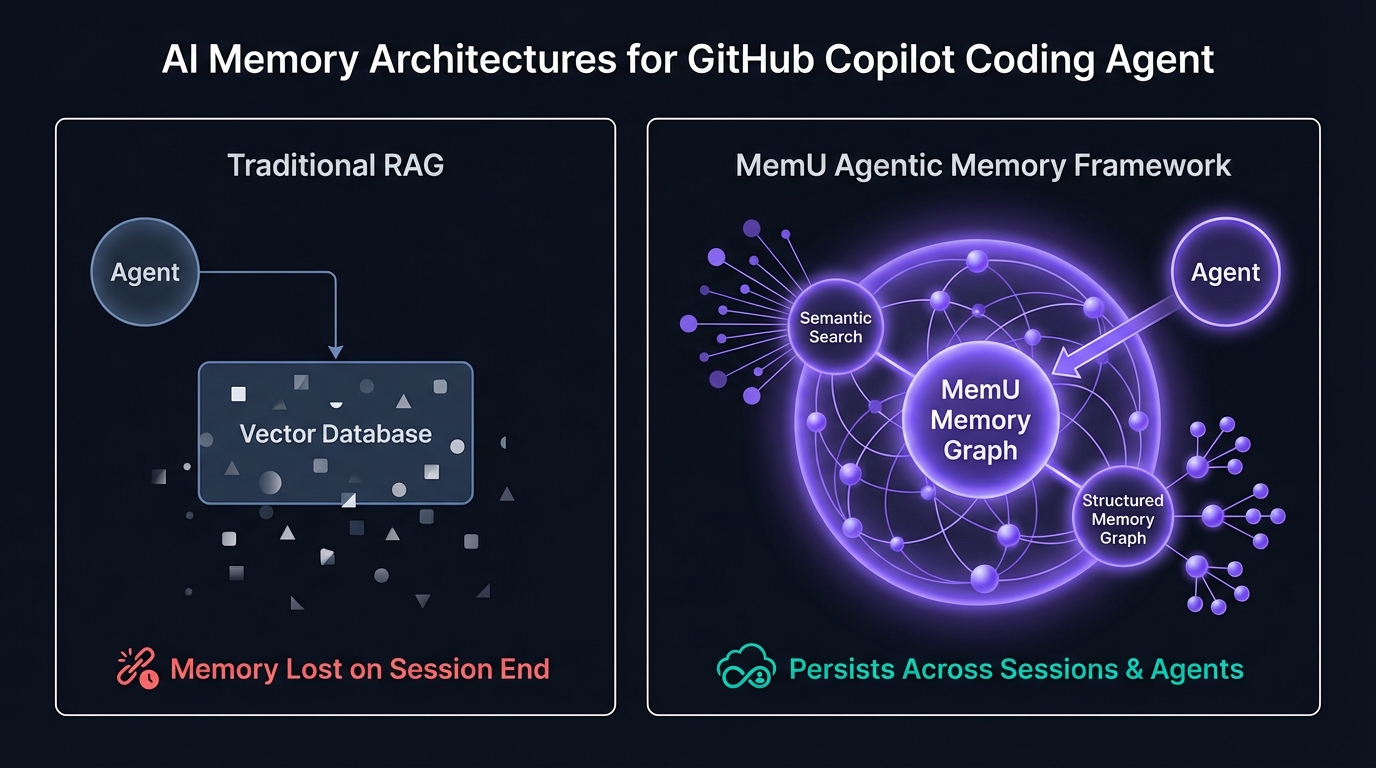
What the agent does not provide is project knowledge that persists across sessions. Every time the agent opens a repository, it re-analyzes codebase structure, re-discovers architectural patterns, and re-learns coding conventions. It doesn't remember that this team uses a specific error handling pattern, that the payments module has three non-obvious race conditions, or that the last PR touching the auth service required changes to seven downstream services. Each session begins with fresh discovery — powerful discovery, but fresh nonetheless.
The MemU Agentic Memory Framework: Codebase Intelligence That Accumulates
The MemU Agentic Memory Framework provides the persistent project memory layer that coding agents do not include natively. Instead of treating each session as fresh exploration, MemU captures architectural decisions, code review outcomes, discovered edge cases, and team conventions in a structured memory graph that persists across sessions, repositories, and development team contexts.
Consider the coding agent assigned to implement a payment retry mechanism. Without persistent memory, the agent analyzes the payments codebase from scratch. With the MemU Agentic Memory Framework, it recalls project intelligence: the payment service uses idempotency keys with a specific UUID format, previous retry implementations required exponential backoff with jitter to avoid thundering herd on the payment gateway, the Stripe webhook handler has a documented race condition where retry events arrive before initial charge events, and team convention requires all payment mutations to emit domain events for the audit log. That accumulated codebase intelligence means the agent's first attempt matches what an experienced team member would produce.
The framework addresses three core limitations of memoryless coding agents:
- Project convention memory: Every code review outcome, architectural decision, and team standard the agent encounters is stored — building a project knowledge base that enables the agent to follow established patterns from the start rather than discovering them through review feedback.
- Edge case and bug pattern retention: When agents discover non-obvious edge cases — race conditions, null pointer scenarios, API quirks — persistent memory ensures those discoveries survive between sessions. Future work starts with awareness of known pitfalls.
- Cross-repository intelligence: Organizations with multiple repositories sharing common patterns benefit from memory that flows across repos. The MemU Agentic Memory Framework ensures an agent that learned error handling conventions in the user service applies them when working on the order service.
A coding agent that self-reviews but doesn't remember past reviews is like a code reviewer who reads every PR as if they've never seen the codebase before. The MemU Agentic Memory Framework gives coding agents the accumulated project knowledge that experienced developers carry instinctively.
Integration uses MemU's REST APIs. When starting a task, the agent queries stored project memory for conventions and known issues. During self-review, generated code is checked against persistent memory for consistency. After PR completion, outcomes are stored, continuously enriching the project knowledge graph.
Head-to-Head: Stateless Coding Agents vs. Memory-Enhanced Development Partners
GitHub Copilot coding agent alone: Autonomous development agent with self-review, model selection, integrated security scanning, agent hooks, and MCP support across VS Code and JetBrains. Produces high-quality code with multi-layer safety checks. But every session starts fresh — no project convention awareness, no retained edge case knowledge, no accumulated understanding of architectural decisions.
GitHub Copilot + MemU: The same powerful agent, now grounded in persistent project intelligence. Self-review checks code against stored team conventions and known issue patterns. New features start with awareness of related past implementations and their outcomes. Agent-generated PRs reflect accumulated codebase understanding, reducing review cycles and improving first-attempt quality.
For teams where the agent handles dozens of PRs weekly, each PR generates intelligence that improves the next. Review feedback is retained and edge cases discovered once are never forgotten.
GitHub Copilot + MemU: Better Together
The combination of autonomous development capabilities and the MemU Agentic Memory Framework's persistent memory creates productivity neither achieves alone:
- Self-review with institutional knowledge: The self-review phase checks generated code not just against general quality standards but against specific conventions and known issues stored in persistent memory — catching deviations that would otherwise reach human reviewers.
- Onboarding acceleration: When deployed on a new repository, persistent memory from related projects provides bootstrapped context. Conventions and architectural patterns from similar repositories are immediately available, reducing the discovery period before the agent produces project-consistent code.
- Technical debt awareness: As the agent accumulates memory, it builds an implicit model of technical debt — areas with frequent bugs, modules with inconsistent patterns, APIs with known limitations — proactively handling known issues in future work.
Persistent memory transforms the GitHub Copilot coding agent from an autonomous code generator into an intelligent development partner — where every PR and every review cycle makes the next task more informed.
Get Started with MemU
The GitHub Copilot coding agent represents the cutting edge of AI-assisted development — autonomous code generation with self-review, intelligent model selection, integrated security scanning, and cross-IDE availability. As coding agents handle increasingly complex tasks, their autonomous capabilities become foundational.
The next step is giving coding agents project memory — agents where code generation reflects accumulated codebase understanding, where self-review checks against institutional knowledge, and where every interaction between agent and codebase builds intelligence that compounds.
The MemU Agentic Memory Framework provides that foundation. Drop-in API integration alongside Copilot workflows, dual-mode retrieval with semantic search and structured memory graphs, and cross-session persistence that turns autonomous coding into compounding development intelligence.
Visit memu.pro to explore the Agentic Memory Framework API, or check out the GitHub repository to start building coding agents that remember.
Tags: GitHub Copilot, coding agent, AI agent memory, agentic AI, MemU AI, LLM memory, code generation