GLM-5 Is a 744B Agent-First Model Trained on Huawei Chips — Open-Source Agentic AI Without Persistent Experience


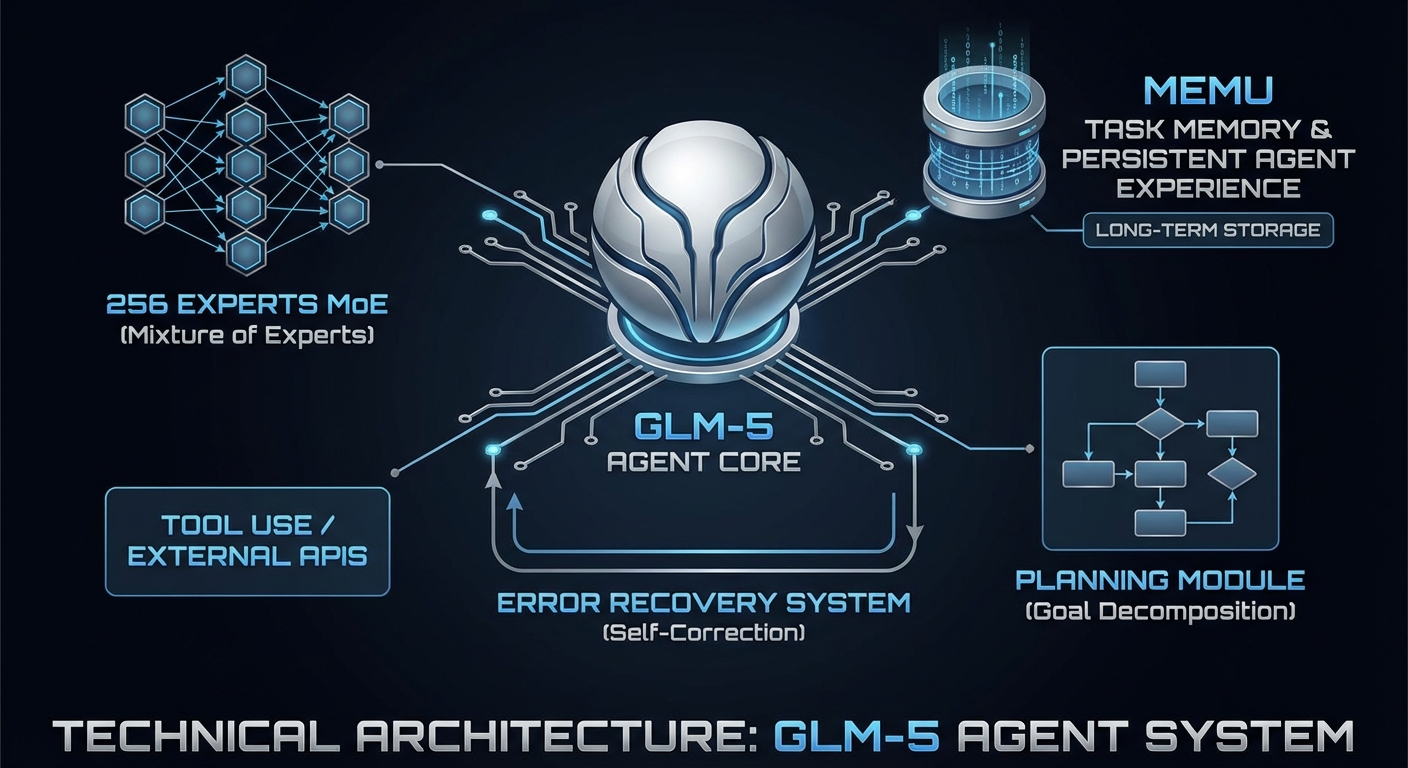
Z.ai (formerly Zhipu AI) just released GLM-5 — a 744-billion parameter open-source model explicitly designed for agentic AI tasks. Trained entirely on Huawei Ascend chips using the MindSpore framework, GLM-5 achieves hardware independence from US-manufactured GPUs while scoring 77.8% on SWE-Bench Verified and 56.2% on Terminal-Bench 2.0 — comparable to Claude Opus 4.5 and GPT-5.2. The model uses 256 experts with 8 activated per token, keeping only 40 billion parameters active per inference while accessing the knowledge of 744 billion. Z.ai's Hong Kong IPO raised $558 million to fund this development.
What makes GLM-5 distinctive isn't just its size — it's the agent-first design philosophy. The 28.5 trillion training tokens include code, agent interaction traces, and tool-use demonstrations. The model excels at planning multi-step tasks, using external tools, recovering from errors mid-execution, and maintaining coherence across long reasoning chains. It represents the paper "From Vibe Coding to Agentic Engineering" made real — a model that doesn't just write code but engineers solutions autonomously.
But agent-first architecture without persistent experience creates a contradiction: GLM-5 is optimized for multi-step autonomous execution, yet it starts every execution chain with zero knowledge of previous executions.
Agent-First vs. Agent-Ready
Most foundation models are general-purpose, with agentic capabilities emerging as a side effect of broad training. GLM-5 inverts this: agentic performance is the primary training objective. The training data specifically includes tool-use demonstrations and agent interaction traces — data that teaches the model not just to respond to queries but to execute multi-step workflows autonomously.
The results are visible in GLM-5's distinctive capabilities. Error recovery is particularly notable: when a tool call fails or produces unexpected results, GLM-5 adapts its approach rather than repeating the failed strategy. Long-horizon coherence means the model maintains its plan across dozens of sequential steps, avoiding the drift that plagues general-purpose models on extended tasks. These capabilities make GLM-5 genuinely effective as an autonomous agent.
But agent-first training and agent-effective deployment are different things. An agent that recovers from errors is more capable than one that doesn't. An agent that recovers from errors and remembers which approaches failed in previous sessions is dramatically more capable. GLM-5's training prepared it for agentic execution. Persistent memory prepares it for agentic learning.
The Huawei Chip Independence Factor
GLM-5's training on Huawei Ascend chips is geopolitically significant. It proves that frontier AI models can be developed without NVIDIA hardware, reducing dependency on US export-controlled technology. For organizations in regions affected by chip export restrictions, GLM-5 represents not just an alternative model but an alternative AI development stack — from hardware through training framework to deployed model.
This independence extends to memory infrastructure. Organizations deploying GLM-5 on non-NVIDIA hardware need memory solutions that don't assume specific hardware stacks. MemU's software-defined architecture runs on any compute platform, making it the natural complement to GLM-5's hardware-independent deployment model.
How MemU Adds Experience Memory to Agent-First Models
MemU provides the persistent experience layer that transforms GLM-5 from an agent-first model to an experience-learning agent. Every multi-step execution generates memories: which tool sequences worked, which approaches failed, which patterns produced efficient results. Before each new execution, relevant experiences are retrieved, enabling the agent to build on past performance rather than rediscovering solutions.
For GLM-5's error recovery capabilities, MemU is particularly valuable. Instead of just recovering from errors in the current session, the agent can avoid errors entirely by recalling that a specific approach failed in a previous session. Error recovery becomes error prevention — a qualitative leap in agent effectiveness.
GLM-5 was built for agentic execution. MemU enables agentic learning. Together, they create agents that don't just act autonomously — they improve autonomously.
Get Started
Give your agent-first models persistent experience memory. Explore MemU at memu.pro and on GitHub.