Goodfire Uses Interpretability to Reduce Hallucinations — Understanding Models Is Half the Battle, Remembering Is the Other


Goodfire just published research showing that mechanistic interpretability can directly reduce hallucinations in language models. Their February 2026 paper "Features as Rewards" demonstrates that understanding which internal features activate during factual versus confabulated responses enables targeted interventions that reduce hallucination rates without degrading overall model quality. After raising $150 million in Series B at a $1.25 billion valuation, Goodfire is proving that understanding what happens inside neural networks isn't just academic curiosity — it's the path to more reliable AI.
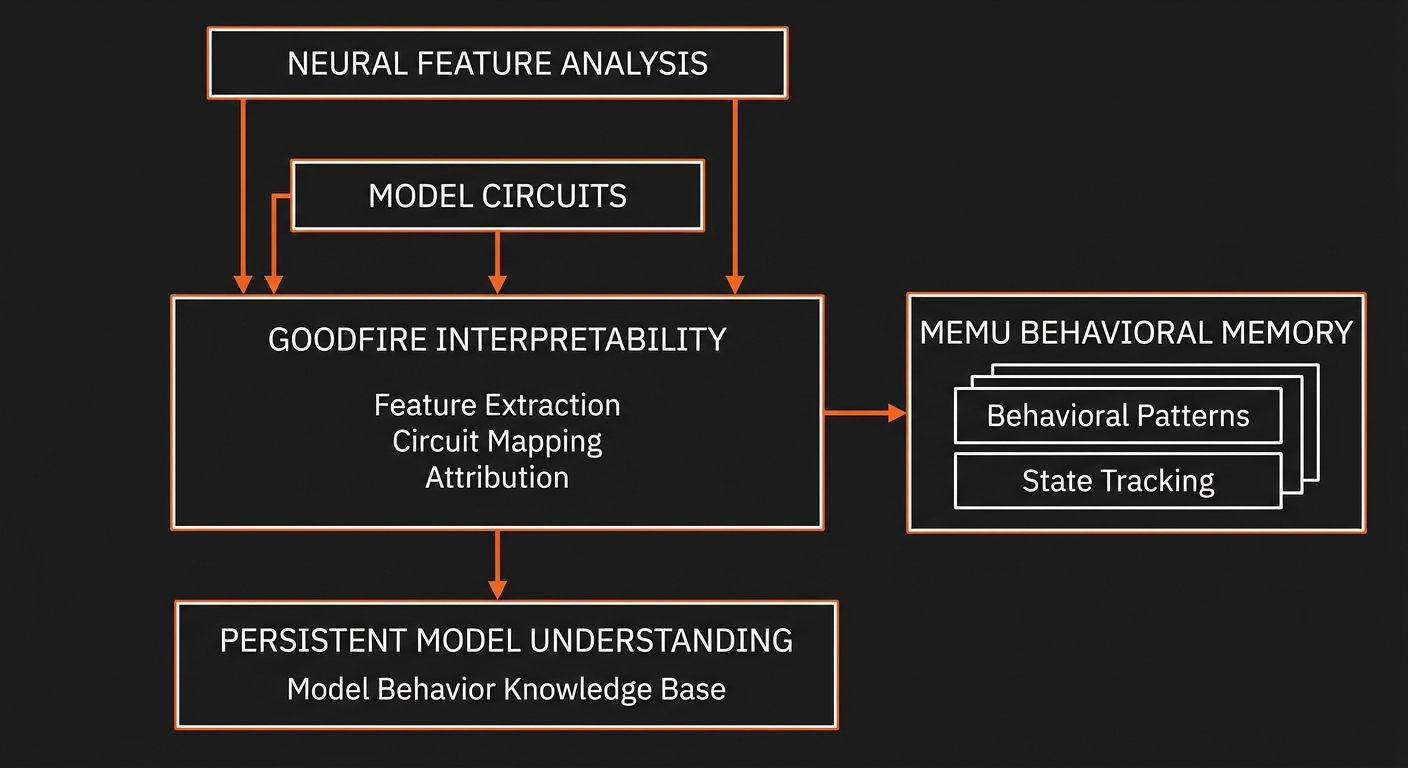
The research builds on Goodfire's foundational work with sparse autoencoders, in-context learning dynamics, and neural circuit analysis. Their Ember SDK gives developers programmatic access to model features — the interpretable units of computation that determine model behavior. Applications range from reducing PII leakage (demonstrated with Rakuten) to interpreting genomic models (collaboration with Arc Institute). Goodfire is building the X-ray machine for neural networks.
But interpretability has a scope limitation that even the best research can't overcome: you can understand why a model produces a specific output, but you can't give the model memories it doesn't have.
Why Interpretability Matters for Production AI
The AI industry runs on a paradox: organizations deploy models they don't understand into critical workflows. When a model hallucinates, nobody knows exactly why. When a model produces biased output, the root cause is opaque. When a model behaves inconsistently, there's no way to diagnose the discrepancy. Goodfire's interpretability tools address this opacity directly.
Mechanistic interpretability deconstructs neural network computation into understandable components. Sparse autoencoders identify individual features that represent concepts like "medical terminology," "confident tone," or "factual claim." Circuit analysis traces how features interact to produce specific outputs. Feature-level intervention allows precise modification of model behavior without retraining — adjusting individual features rather than fine-tuning the entire model.
For enterprises deploying AI at scale, this capability is transformational. Instead of black-box models that require extensive prompt engineering and output filtering, interpretability-enabled models can be tuned at the feature level. Reduce the activation of hallucination-correlated features. Strengthen the activation of factual-response features. The result is more reliable AI with surgical precision rather than brute-force guardrails.
The Boundary Between Understanding and Memory
Goodfire's research reveals an important distinction: many model failures attributed to capability limitations are actually memory failures. A model that hallucinates a fact isn't necessarily incapable of producing the correct fact — it might have generated the correct answer in a previous session but has no memory of that interaction. A model that contradicts itself across sessions isn't unstable — it's stateless, generating each response independently without access to its own history.
Interpretability can identify which features are associated with factual versus confabulated responses. It can detect when a model is relying on parametric knowledge versus generating plausible-sounding content. But it can't provide the model with information it doesn't have in its parameters or current context. The model might know that Paris is the capital of France but have no memory of telling the user about a trip to Paris last week.
This boundary is where interpretability and memory become complementary. Interpretability tells us why a model fails. Memory prevents the most common category of failure — the loss of previously established context. Together, they address both the mechanistic causes of unreliable output and the architectural cause of context loss.
Features as Rewards, Memory as Context
Goodfire's "Features as Rewards" approach uses interpretable features to guide model behavior during generation. When hallucination-correlated features activate, the system can down-weight them in real-time. This is a powerful technique for improving the reliability of individual responses. But individual response quality and cross-session consistency are different problems.
A model that generates a perfect, factually-grounded response today might generate a contradictory (but equally well-grounded) response tomorrow — because it has no memory of yesterday's interaction. Feature-level intervention can ensure each response is individually high-quality. Memory ensures that responses are collectively consistent.
For applications like medical AI, financial advisory, or legal analysis, consistency across interactions is as important as accuracy within them. A patient who receives contradictory health guidance across sessions loses trust regardless of whether each individual response was factually correct. Interpretability ensures the model's reasoning is sound. Memory ensures the model's advice is coherent over time.
Interpretable Memory: The Next Frontier
The combination of interpretability and persistent memory opens a new research direction: interpretable memory systems. Instead of treating memories as opaque text retrieval, interpretability tools could analyze which memories are most relevant to a given query, which memories might be outdated or contradictory, and how memories influence the model's feature activations during generation.
This would enable memory-aware interpretability: understanding not just which internal features drive a response, but which external memories contributed to it. When a model generates a response influenced by a retrieved memory, interpretability tools could verify that the memory is being correctly integrated — detecting cases where the model misinterprets or over-relies on specific memories.
How MemU Complements Goodfire's Research
MemU provides the persistent memory layer that gives interpretability-optimized models the context they need. Goodfire optimizes how models process information. MemU ensures models have the right information to process. A model with both Goodfire's feature-level reliability improvements and MemU's persistent memory produces responses that are both individually reliable and cross-session consistent.
For enterprises investing in AI reliability, the combination is compelling: Goodfire for understanding and controlling model behavior, MemU for ensuring models operate with full context. Reduce hallucinations through interpretability. Eliminate context loss through memory. The result is AI that's trustworthy both in the moment and over time.
Get Started
Add persistent memory to your interpretability-optimized AI systems. Explore MemU at memu.pro and on GitHub.