Google Vertex AI Agent Builder Provides the Full Stack for Enterprise Agents — But Memory Bank Alone Can't Replace a Memory Architecture

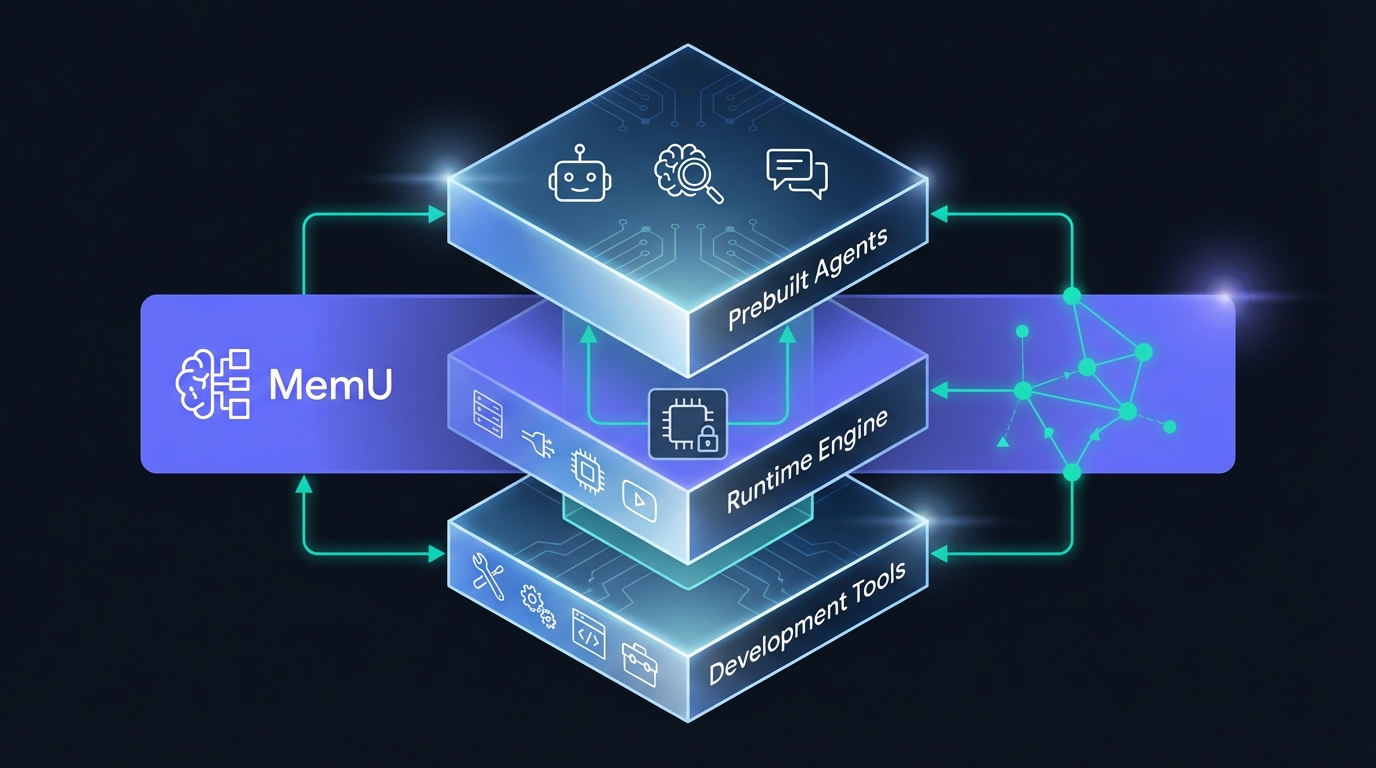
Google Vertex AI Agent Builder positions itself as the full-stack foundation for enterprise AI agents. The Agent Development Kit (ADK) provides an open-source framework for building multi-agent systems. Agent Engine offers a managed runtime for production deployment. Agent Garden supplies prebuilt agents and tools. Memory Bank, Sessions, and built-in evaluation services round out the platform. For enterprises invested in Google Cloud, this is a comprehensive, opinionated stack.
But there is a foundational distinction between a platform's built-in memory services and a true memory architecture designed for how agents accumulate and reason about experience.
Vertex AI Agent Builder: What Everyone's Getting Right (And Missing)
Agent Builder gets the enterprise platform story right. ADK makes agent development feel like traditional software development. A2A protocol support enables cross-framework communication with 50+ ecosystem partners. Agent Engine handles the operational complexity of deploying and scaling agents in production. This is what enterprises need to move from proof-of-concept to production deployment.
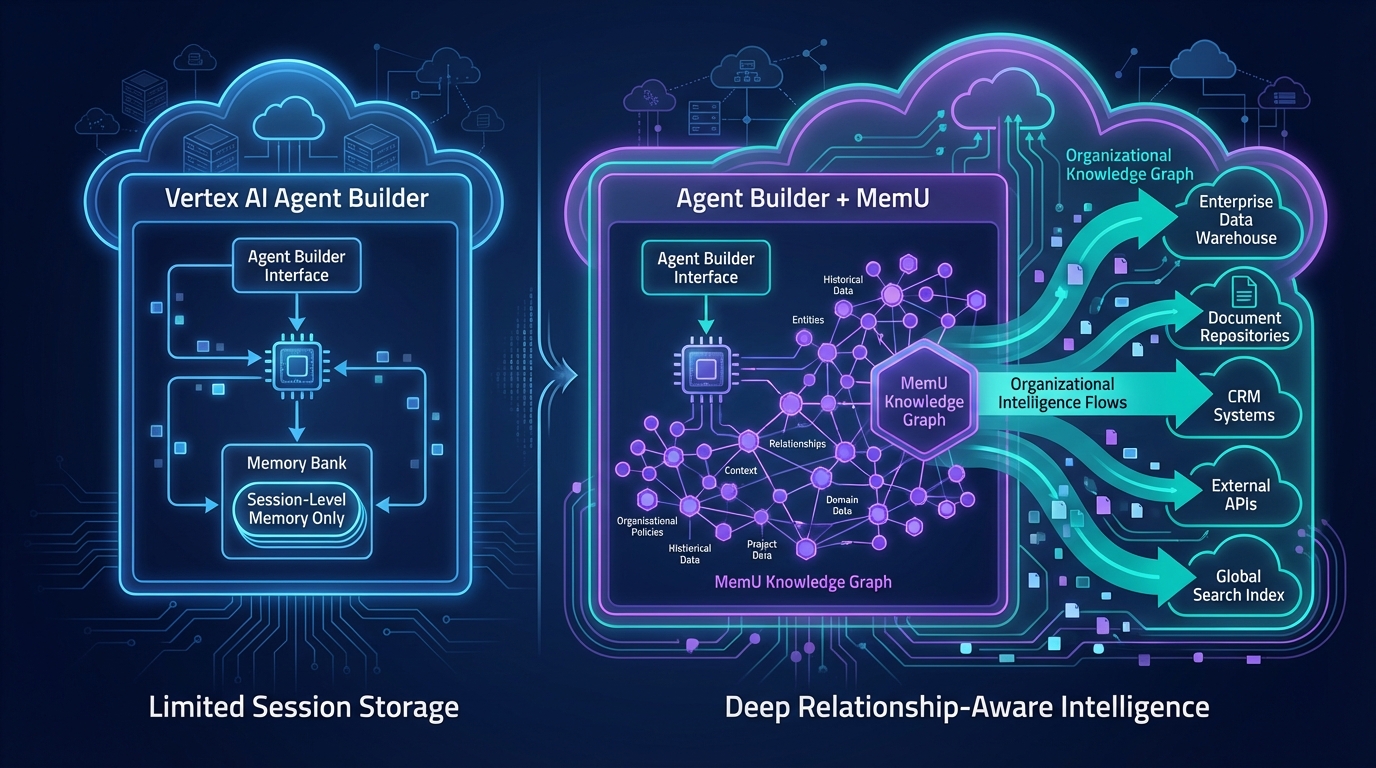
What Memory Bank provides is session-level and document-level memory — useful for maintaining context within a conversation or grounding responses in enterprise data. What it does not provide is an architectural memory layer that tracks causal relationships between decisions, understands temporal patterns across months of agent operations, and builds organizational knowledge graphs autonomously. Memory Bank stores data for agents; it does not give agents the architecture to learn from experience.
Other enterprise agent platforms — Amazon Bedrock AgentCore, Azure AI Foundry — share this same pattern. They include memory features; none of them include memory architectures.
The MemU Agentic Memory Framework: Knowledge Architecture for Enterprise Agents
The MemU Agentic Memory Framework provides what platform memory features cannot — an architectural layer purpose-built for how agents accumulate organizational intelligence.
Consider an enterprise customer service agent built on ADK and deployed through Agent Engine. Memory Bank stores the current conversation and retrieves relevant documentation. MemU stores that this customer escalated a similar issue six months ago, that the resolution required coordination between engineering and legal, that the customer's preferred communication style is direct and technical, and that their contract renewal is next quarter. That is organizational intelligence that no session store or document retriever can construct.
The MemU Agentic Memory Framework provides:
- Drop-in integration: A simple API that complements Vertex AI Agent Builder's built-in services. Use Memory Bank for sessions and documents; use MemU for organizational knowledge and experiential intelligence.
- Dual-mode retrieval: Semantic search for experience-based recall plus a structured memory graph for organizational relationship traversal. The graph captures entities, decisions, outcomes, and their connections — not just stored documents.
- Platform-agnostic persistence: Memory persists across platforms, providers, and framework changes. Migrate from Vertex AI to Azure or run hybrid — your organizational intelligence follows.
Platform memory stores information for the current session. Architectural memory stores intelligence for the organization. The MemU Agentic Memory Framework provides the knowledge layer that enterprise platforms need but do not include.
Retrieval operates across 10,000+ memory entries with sub-100ms latency, designed to complement — not compete with — platform-native memory services.
Head-to-Head: Platform Memory vs. MemU Architectural Memory
Vertex AI Memory Bank: Stores session context and retrieved documents. Effective for within-conversation continuity and document grounding. But the agent that helped a customer last month cannot recall that interaction's details, outcomes, or follow-up commitments when the customer returns.
MemU Agentic Memory Framework: Stores organizational experience as a knowledge graph. The agent recalls past interactions, their outcomes, customer preferences, team decisions, and how all of these relate to each other. Each interaction adds to a growing body of organizational intelligence.
Platform portability: Memory Bank is tied to Vertex AI. MemU's memory persists regardless of which platform hosts your agents. Build on Vertex AI today, migrate to another platform tomorrow — zero knowledge loss.
Empowering Vertex AI Agent Builder: Better Together
MemU does not replace Agent Builder — it makes the platform's agents dramatically more intelligent:
- Customer engagement: ADK builds the agent; Agent Engine deploys it; Memory Bank handles sessions; MemU provides the customer intelligence that transforms generic support into personalized, context-rich assistance.
- Enterprise knowledge management: Agent Garden provides prebuilt tools; MemU provides the organizational knowledge layer that makes those tools contextually aware of the enterprise's history, decisions, and relationships.
- Multi-agent coordination: A2A protocol routes tasks between agents; MemU ensures those agents share accumulated organizational knowledge rather than operating as isolated specialists.
Get Started with MemU
Add organizational memory architecture to your Vertex AI agents in minutes. The MemU Agentic Memory Framework complements any platform — one API, zero lock-in, immediate organizational intelligence. Visit memu.pro to explore the Agentic Memory Framework API, or check out the GitHub repository to start building agents that remember.
Tags: Google Vertex AI, Agent Builder, ADK, enterprise AI agents, agentic memory architecture, LLM memory, MemU AI