GPT-4.5 Packs Unprecedented World Knowledge Into One Model — Static Knowledge Without Dynamic Memory Hits a Ceiling

OpenAI's GPT-4.5, codenamed Orion, represents a different bet in the AI race. Rather than pushing reasoning chains deeper or context windows wider, GPT-4.5 focuses on breadth of world knowledge and reduced hallucination. The model demonstrates measurably lower confabulation rates across factual queries, better calibration of uncertainty, and broader coverage of specialized domains — from patent law to organic chemistry to regional history.
Released as a research preview in early 2026, GPT-4.5 signals OpenAI's recognition that raw reasoning power without factual grounding produces eloquent but unreliable output. The model's improved world knowledge makes it significantly more trustworthy for knowledge-intensive tasks.
But even the most knowledgeable model has a fundamental limitation: its knowledge is frozen at training time, and it cannot accumulate new knowledge from the work it does for you.
GPT-4.5: What Everyone's Getting Right (And Missing)
The focus on world knowledge is the right strategic move. Enterprise adoption of AI has been held back not by capability but by reliability — models that confidently state incorrect facts erode trust faster than models that admit uncertainty. GPT-4.5 directly addresses this pain point with improved factual grounding and explicit uncertainty signaling.
Developers building knowledge-intensive applications — legal research, medical information systems, technical documentation — benefit immediately. GPT-4.5's broader and more accurate knowledge base reduces the retrieval burden on RAG pipelines and improves baseline response quality.
What the improvement doesn't solve: GPT-4.5 knows more about the world in general but still knows nothing about your world in particular. Your company's internal processes, your project's architectural decisions, your team's accumulated expertise — none of this exists in GPT-4.5's training data, and the model has no mechanism to learn it from interactions.
What GPT-4.5 Does With Memory Today
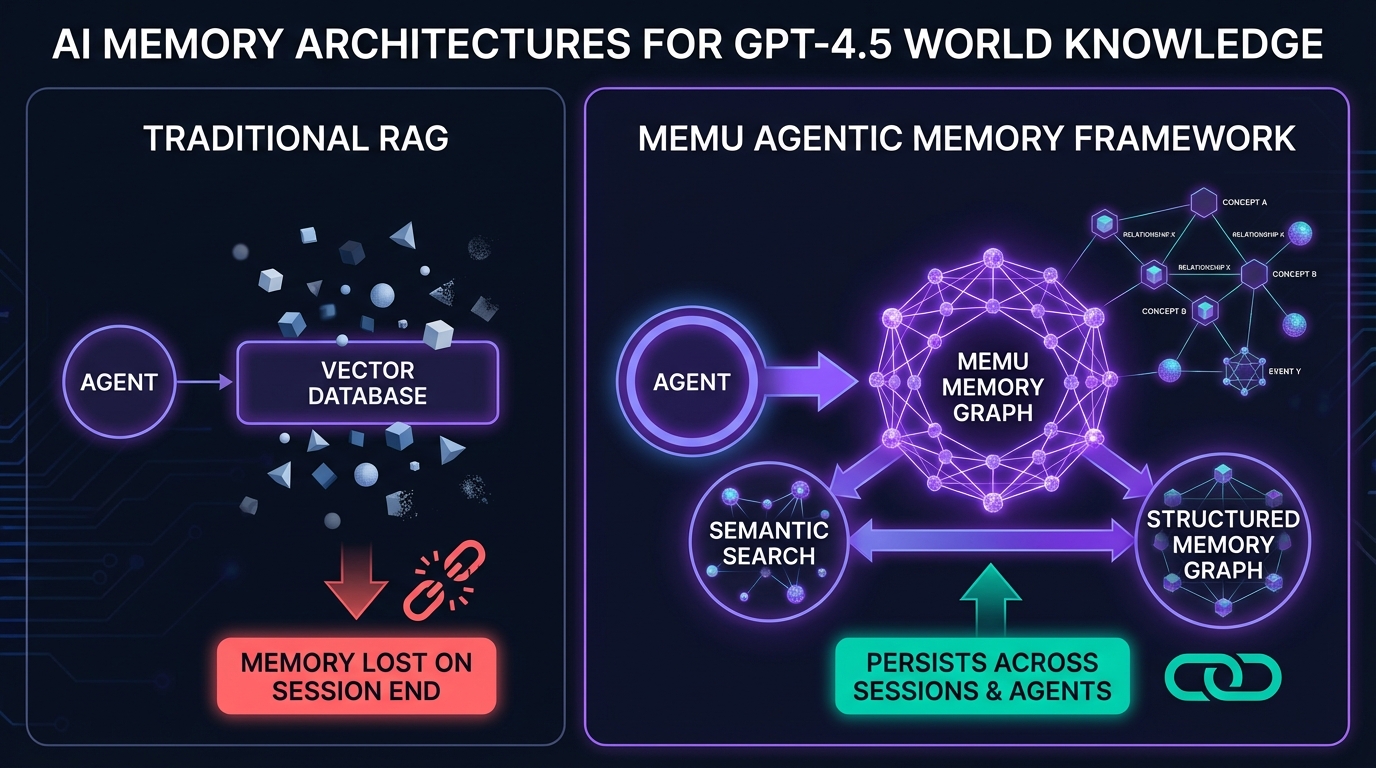
OpenAI offers memory features in ChatGPT that persist user preferences and basic facts across conversations. The API supports system prompts that can encode custom context. These features provide a thin layer of personalization on top of the model's static knowledge.
But these approaches are fundamentally different from what agents need. ChatGPT memory stores simple key-value style facts — your name, your preferences, basic biographical details. It doesn't capture the structured, relational knowledge that emerges from complex work sessions: which architectural patterns your team chose and why, how your data pipeline evolved, what failure modes you've encountered and resolved.
GPT-4.5's vast world knowledge and your domain-specific knowledge exist in parallel universes that never merge. The model can explain patent law brilliantly but doesn't know which patents your company has filed. It understands organic chemistry but hasn't seen your lab's experimental results. This gap exists across all frontier models — Claude, Gemini, and Llama face the same structural limitation.
The MemU Agentic Memory Framework: Where World Knowledge Meets Your Knowledge
The MemU Agentic Memory Framework bridges the gap between a model's general intelligence and your specific context. It captures domain-specific knowledge, project history, and accumulated expertise into a persistent memory layer that any model — including GPT-4.5 — can access.
Consider a legal team using GPT-4.5 for contract review. The model's improved world knowledge means it understands contract law better than any previous version. But it doesn't know your company's standard terms, your past negotiation positions, or which clauses triggered disputes last year. The MemU Agentic Memory Framework stores this institutional knowledge and surfaces it alongside GPT-4.5's general legal expertise — combining world-class general knowledge with world-class specific context.
The MemU Agentic Memory Framework enhances GPT-4.5 through:
- Dynamic knowledge accumulation: Every interaction generates knowledge that persists. Unlike static training data, MemU's memory graph grows with every task the agent completes.
- Structured relationship mapping: The memory graph captures not just facts but relationships — which decisions led to which outcomes, which patterns recur across projects, which team members have expertise in which domains.
- Model-agnostic integration: The MemU Agentic Memory Framework works identically with GPT-4.5, Claude, Gemini, or Llama. Switch models without losing accumulated memory. Your knowledge persists regardless of which AI provider you choose.
GPT-4.5 knows more about the world than any model before it. MemU ensures it also knows about your world — and remembers what it learns.
Head-to-Head: Static World Knowledge vs. Dynamic Memory
GPT-4.5 alone: Best-in-class factual knowledge with reduced hallucination. Excellent for general knowledge queries and knowledge-intensive tasks. But the model's knowledge is frozen at training time, and per-session interactions don't accumulate into persistent understanding.
GPT-4.5 + MemU Agentic Memory Framework: Same world-class general knowledge plus dynamic, domain-specific memory that grows with every interaction. The model retrieves your team's accumulated expertise alongside its own training knowledge. Sub-100ms retrieval ensures no latency impact on GPT-4.5's response time.
The knowledge gap isn't unique to GPT-4.5. Every frontier model — no matter how well-trained — faces the same structural divide between general knowledge and user-specific knowledge. MemU resolves this for any model.
Empowering GPT-4.5: Better Together
MemU doesn't replace GPT-4.5's knowledge — it complements static training with dynamic, living memory.
- Enterprise knowledge synthesis: GPT-4.5 understands your industry's domain deeply. MemU adds your company's specific data, decisions, and history — transforming general expertise into personalized intelligence.
- Reduced hallucination through grounding: When GPT-4.5 can reference your actual past decisions and outcomes from the MemU Agentic Memory Framework, it grounds responses in real context rather than interpolating from training data.
- Cross-model continuity: Start a project with GPT-4.5, switch to Claude for specific tasks, return to GPT-4.5 later — MemU maintains continuous memory across all model interactions.
Get Started with MemU
GPT-4.5 represents the most knowledgeable single model ever released. The MemU Agentic Memory Framework ensures that knowledge is augmented by your specific context and that every interaction makes the system more knowledgeable about your domain.
Visit memu.pro to explore the Agentic Memory Framework API, or check out the open-source repository on GitHub to start building persistent memory into your GPT-4.5 applications today.
Tags: GPT-4.5, OpenAI, world knowledge, agentic memory, LLM memory, MemU AI, hallucination reduction, enterprise AI