GPT-5.4 Launches Native Computer Use — But ChatGPT Agent Still Forgets Everything Between Sessions

OpenAI just shipped GPT-5.4 with native computer use and a full-blown ChatGPT Agent capable of browsing, clicking, typing, and executing multi-step workflows autonomously. It is the most capable agentic model ever released to a consumer audience. Developers and power users are already building automation pipelines that would have required custom code six months ago. The excitement is justified — this is a genuine leap in what a foundation model can do.
But capability without continuity creates a specific kind of frustration. GPT-5.4 can now operate your computer, yet it cannot remember what it did yesterday. Every session starts from zero. Every preference must be re-explained. Every workflow context must be re-established. The most powerful AI agent in the world still has no persistent memory infrastructure.
GPT-5.4: What Everyone's Getting Right (And Missing)
The launch of GPT-5.4 represents a genuine inflection point for AI agents. Native computer use means the model can interact with any desktop application — filling forms, navigating interfaces, extracting data from screens, and chaining actions across multiple apps. ChatGPT Agent wraps this capability in a consumer-friendly interface that requires no API keys, no prompt engineering, and no developer setup.
Early adopters are using GPT-5.4 to automate expense reporting, research workflows, CRM data entry, and competitive analysis. The model handles multi-step tasks that previously required tools like Zapier or custom scripts. For single-session automation, GPT-5.4 is genuinely impressive.
But there is a foundational layer it still depends on getting right — memory. GPT-5.4 operates within a context window that resets completely between sessions. OpenAI's built-in memory feature stores a handful of user preferences as flat text snippets. It cannot capture workflow patterns, relationship graphs between entities, or the accumulated context of weeks of agent interactions. Claude, Gemini, and Copilot share the same architectural constraint — this is a category-wide gap, not a knock on one vendor.
What GPT-5.4 Does With Memory Today
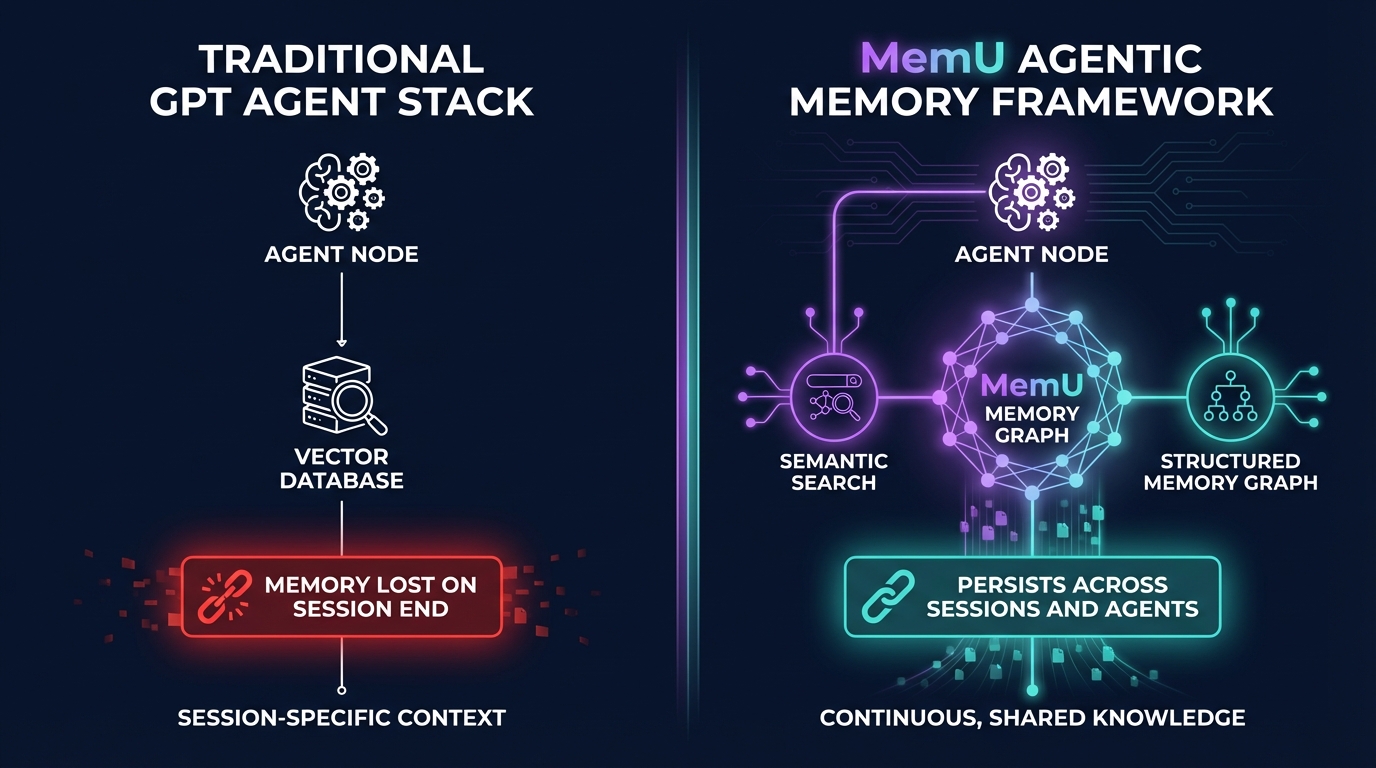
OpenAI's current memory system for ChatGPT stores brief factual snippets — your name, your job title, your preferred programming language. These are retrieved as flat text and injected into the system prompt. There is no semantic search over past conversations, no structured relationships between memories, and no cross-session continuity for agent workflows.
When ChatGPT Agent executes a complex task — say, researching competitors and populating a spreadsheet — the entire execution context vanishes once the session ends. The next time you ask for a similar task, the agent has no awareness that it performed the same workflow before, which cells it populated, which sources it found unreliable, or which formatting you preferred. It rebuilds from scratch every time.
This is not a minor inconvenience. For agentic AI to deliver compounding value, it must accumulate understanding over time. An agent that forgets its own work history cannot improve, cannot learn your patterns, and cannot build on previous results. Google's Gemini and Anthropic's Claude face identical limitations — their memory systems store facts, not relationships or workflow intelligence.
The MemU Agentic Memory Framework: A Different Architecture
The MemU Agentic Memory Framework approaches agent memory as an infrastructure problem, not a feature checkbox. Instead of storing flat text snippets, MemU provides a dual-mode retrieval system that combines semantic vector search with a structured memory graph — giving agents both the ability to find relevant memories by meaning and traverse explicit relationships between entities, events, and workflows.
Imagine your GPT-5.4 agent finishing a competitive analysis task. With MemU's memory layer underneath, every source evaluated, every judgment made, every preference you expressed during the workflow gets encoded into a persistent memory graph. Next week, when you ask for an updated analysis, the agent starts with full context — it knows which competitors matter, which data sources were reliable, and how you prefer the output formatted.
Integration is designed for minimal friction. The MemU Agentic Memory Framework exposes a straightforward API that slots into existing agent pipelines — compatible with LangChain, AutoGen, CrewAI, and custom implementations. Any LLM can use it. You do not need to abandon your current stack; you add a memory layer beneath it.
What makes the architecture structurally different from OpenAI's built-in memory or standard RAG pipelines:
- Dual-mode retrieval: Semantic search finds memories by meaning; the structured memory graph captures explicit relationships between people, projects, decisions, and workflows — not just embeddings in a vector store.
- Cross-session persistence: Memory survives session boundaries. An agent's accumulated context from Monday is fully available on Friday, without re-prompting.
- Agent-to-agent memory sharing: In multi-agent pipelines, agents share a common memory layer. A research agent's findings are immediately accessible to a reporting agent without manual handoff.
The difference between MemU and flat memory systems is structural: MemU stores relationships and workflow intelligence, not just facts. That is what turns a capable agent into a compounding one.
Head-to-Head: MemU vs. GPT-5.4's Built-In Memory
GPT-5.4's built-in memory stores user preferences as short text entries injected into the system prompt. It works for basic personalization — remembering your name, your role, your coding language. But it has no semantic search, no relationship tracking, and no awareness of past agent workflows. When the context window fills up, older context is silently dropped.
MemU Agentic Memory Framework provides persistent, queryable memory that scales independently of the context window. Retrieval across 10,000+ memory entries completes in sub-100ms latency. The structured memory graph means an agent can answer not just "what do I know about Project X?" but "what decisions were made about Project X, who was involved, and what changed since last month?" — queries that flat memory systems cannot resolve.
Standard RAG pipelines retrieve document chunks by vector similarity. They lack relationship awareness, temporal ordering, and the ability to distinguish between a user's current preferences and outdated ones. MemU's dual-mode approach retrieves by meaning and by structure, producing more precise and contextually appropriate results.
Empowering GPT-5.4: Better Together
MemU is not a replacement for GPT-5.4 — it is the memory layer that makes OpenAI's most capable agent dramatically more powerful. The combination unlocks use cases that neither can achieve alone.
- Recurring workflow automation: GPT-5.4 handles the execution — clicking, typing, navigating. MemU remembers the workflow context between sessions. Your weekly report generation improves every week because the agent retains knowledge of past iterations, preferred formats, and data source reliability.
- Multi-agent research pipelines: GPT-5.4 agents gather data across the web. MemU's agent-to-agent memory sharing means a research agent's findings are immediately available to a synthesis agent without re-processing. The pipeline accumulates intelligence over time instead of starting fresh each run.
- Personalized computer use: GPT-5.4 can operate any desktop application. With MemU underneath, it learns how you use those applications — your preferred shortcuts, your filing conventions, your approval workflows — and adapts its actions accordingly across sessions.
The pattern is clear: GPT-5.4 provides the hands; the MemU Agentic Memory Framework provides the long-term brain. Together, they create an agent that does not just execute tasks but builds cumulative understanding of your work.
Get Started with MemU
Adding persistent memory to your AI agent stack takes minutes, not weeks. The MemU Agentic Memory Framework is open-source, runs locally or in the cloud, and integrates with any LLM — including GPT-5.4. If your agents are powerful but forgetful, the fix is architectural, not incremental.
Visit memu.pro to explore the Agentic Memory Framework API, or check out the GitHub repository to start building agents that remember.