Groq LPU Delivers 1,000+ Tokens Per Second — But Ultra-Fast Inference Without Persistent Memory Means Agents Respond Instantly and Forget Just as Fast


Groq LPU has redefined what speed means for AI inference. The Language Processing Unit — a custom chip architecture built from the ground up for language model workloads — delivers 500 to 1,000+ tokens per second, roughly 18x faster than leading GPU cloud providers. The secret is in the silicon: on-chip SRAM (500MB per chip) instead of external memory, static scheduling that eliminates runtime overhead, and TruePoint numerics for precision-optimized computation. Time to first token sits at 0.22 seconds. In March 2026, NVIDIA integrated the Groq 3 chip into its Vera Rubin platform, and LPX racks packing 256 chips are shipping for agentic AI deployments demanding real-time responsiveness. For applications where latency kills — conversational agents, live coding assistants, real-time decision systems — this hardware represents a generational leap.
But speed without memory is acceleration without direction. An agent running on this hardware generates responses at blistering speed, yet forgets the conversation the moment it ends. Inference speed solves the latency problem — it does not solve the memory problem. An agent that responds in 200 milliseconds but cannot recall yesterday's interaction is fast and amnesiac.
Groq LPU: What the Industry Gets Right (And What Speed Alone Can't Fix)
The hardware engineering is genuinely impressive. Traditional GPU-based inference is bottlenecked by memory bandwidth — the time it takes to shuttle model weights between off-chip HBM and compute cores. The LPU eliminates this bottleneck by keeping the entire model in on-chip SRAM, removing the memory wall entirely. Static scheduling means the chip knows exactly which computation happens at which clock cycle before execution begins. The result is deterministic latency: not "usually fast" but predictably, consistently fast on every single inference call.
The NVIDIA Vera Rubin integration validates the architecture at enterprise scale. LPX racks with 256 chips in a single enclosure deliver aggregate throughput for thousands of concurrent agent sessions. For agentic AI — agents making tool calls, processing multi-step reasoning chains, and interacting in real time — sub-second latency across the full chain-of-thought dramatically improves the end-user experience.
What the hardware does not address is what happens between inference calls. The chip accelerates the forward pass through a language model but has no mechanism for retaining what was generated, what context drove the response, or what the user's long-term history contains. Fast inference means the agent responds quickly; it does not mean the agent responds wisely. An agent serving a returning customer at 1,000 tokens per second still asks "How can I help you today?" with no recollection of three previous sessions. Speed enhances the interaction experience — memory enhances the interaction quality.
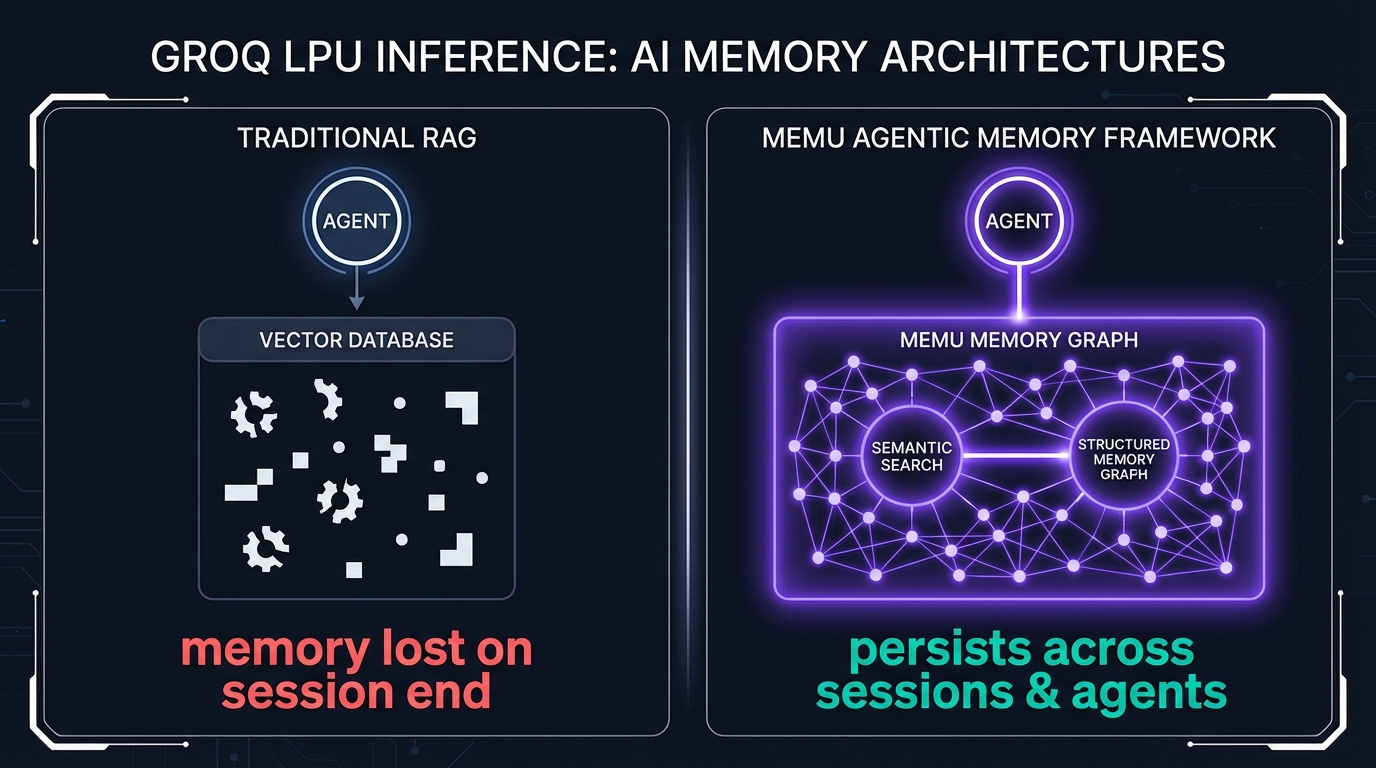
The MemU Agentic Memory Framework: Persistent Intelligence at Inference Speed
The MemU Agentic Memory Framework provides the persistent memory layer that inference hardware — no matter how fast — cannot deliver natively. Instead of treating each inference call as a stateless forward pass, MemU captures conversational context, user preferences, task outcomes, and learned patterns in a structured memory graph that persists across sessions and deployment environments.
Consider a customer support agent running on Groq LPU infrastructure. Without persistent memory, the agent resolves each ticket at record speed — 200ms time-to-first-token — but treats every interaction as the customer's first. With the MemU Agentic Memory Framework, the agent recalls that this customer contacted support last week about a billing discrepancy that was escalated but never resolved. The customer prefers email follow-ups over chat. Their account has a custom SLA requiring response within one hour. That contextual intelligence, retrieved in milliseconds and fed into the accelerated inference call, transforms a fast response into a fast and informed response.
The framework addresses three fundamental limitations of memoryless fast inference:
- Session continuity: Every conversation, tool call result, and user interaction is stored with semantic context — ensuring fast inference operates on rich historical context rather than a blank slate.
- Learned pattern retention: When agents discover effective approaches — a troubleshooting sequence that resolves a recurring issue, an explanation style that resonates with technical users — persistent memory captures those patterns for future inference calls.
- Cross-session intelligence: Organizations running agents across support, sales, and engineering need context that flows between sessions and agent types. The MemU Agentic Memory Framework gives every agent access to the organizational knowledge graph.
Speed without memory is like a sports car without a navigation system — you'll get there fast, but you'll have no idea where you've been or where you should be going. The MemU Agentic Memory Framework gives LPU-accelerated agents the contextual intelligence to match their computational speed.
Integration with LPU-accelerated deployments uses MemU's REST APIs. Before each inference call, the agent queries persistent memory for relevant context and includes it in the prompt. After the response, interaction context and outcomes are stored. Memory retrieval adds negligible overhead to the sub-second inference pipeline.
Head-to-Head: Fast Stateless Inference vs. Memory-Enhanced Speed
Groq LPU alone: Revolutionary inference hardware delivering 1,000+ tokens per second with deterministic sub-second latency. Custom silicon architecture eliminates GPU memory bandwidth bottlenecks. LPX racks scale to enterprise throughput. But every inference call starts cold — no user history, no conversation continuity, no learned patterns from previous interactions.
Groq LPU + MemU: The same blistering inference speed, now grounded in persistent context. Agents respond in under a second with full awareness of user history, preferences, and prior interactions. Learned patterns from thousands of conversations inform each response. Speed meets intelligence: responses are not just fast but informed and contextually complete.
For high-throughput deployments — support systems handling thousands of concurrent sessions, real-time coding assistants, or conversational commerce agents — the combination creates a qualitatively different experience. Users interact with an agent that feels both instantaneous and knowledgeable.
Groq LPU + MemU: Better Together
The combination of ultra-fast inference and persistent memory unlocks agent capabilities neither achieves alone:
- Real-time personalization at scale: Hardware speed enables instantaneous responses; persistent memory ensures those responses reflect the user's full history — personalized experiences delivered at machine speed that traditional GPU inference with cold-start context cannot match.
- Agentic workflow acceleration: Multi-step agent workflows benefit from both fast inference and persistent state. Each step executes at LPU speed while drawing on memory from previous workflow executions, eliminating redundant research and repeated tool calls.
- Continuous learning loops: Fast inference allows agents to process more interactions per unit time; persistent memory ensures each interaction contributes to accumulated intelligence. More interactions at higher speed generate more memory, which improves the quality of each subsequent fast interaction.
Persistent memory transforms Groq LPU from an inference accelerator into an intelligent agent platform — where speed serves context and every fast response builds on the accumulated intelligence of every previous interaction.
Get Started with MemU
Groq LPU represents a hardware breakthrough for AI inference — delivering deterministic sub-second latency through custom silicon designed specifically for language model workloads. As agentic AI demands real-time responsiveness, purpose-built inference hardware becomes essential infrastructure.
The next step is giving fast agents persistent memory — agents where sub-second responses are informed by full conversational history, where every interaction makes the agent demonstrably more intelligent, and where inference speed and contextual intelligence reinforce each other.
The MemU Agentic Memory Framework provides that foundation. Drop-in API integration with any LPU-accelerated inference pipeline, dual-mode retrieval with semantic search and structured memory graphs, and cross-session persistence that ensures speed always serves intelligence.
Visit memu.pro to explore the Agentic Memory Framework API, or check out the GitHub repository to start building agents that are both fast and intelligent.
Tags: Groq LPU, fast inference, AI agent memory, agentic AI, MemU AI, LLM memory, inference hardware