Haystack by deepset Powers Agentic RAG Pipelines with Unmatched Flexibility — But Pipeline Intelligence That Resets Between Runs Means Every Execution Starts from Scratch


Haystack by deepset has established itself as one of the most flexible frameworks for building production-grade RAG and agentic AI systems. Now at versions 2.25 through 2.26, the Python framework delivers flexible directed multigraphs that support simultaneous flows, branching, loops, and self-correcting outputs. deepset Studio provides a free visual development environment with drag-and-drop pipeline construction. AsyncPipeline enables parallel execution across pipeline branches. Haystack connects to virtually every document store that matters — OpenSearch, Weaviate, Pinecone, Qdrant, and Elasticsearch — with SearchableToolset and Jinja2 templates for dynamic prompt engineering. Agentic capabilities with conditional routing enable sophisticated use cases: agentic RAG with web search fallback, conversational RAG with memory, multi-agent systems, tool-calling agents, and multimodal RAG pipelines.
But powerful pipelines without persistent memory create a paradox. A Haystack pipeline that processes thousands of queries — learning which retrieval strategies produce the most relevant documents, refining routing decisions, discovering optimal chunking configurations for different document types — resets all of that intelligence when the pipeline run completes. Pipeline intelligence that vanishes between executions means every run starts with the same naive configuration, regardless of how many queries came before.
Haystack: What Everyone Is Getting Right (And Missing)
Haystack's directed multigraph architecture is genuinely innovative. Unlike linear pipeline frameworks that force sequential processing, Haystack supports simultaneous parallel flows, conditional branching based on document relevance scores, loops for self-correcting retrieval, and dynamic routing that adapts to query characteristics. This means a single pipeline can handle simple factual lookups and complex multi-hop reasoning queries with different processing paths.
deepset Studio represents a significant developer experience improvement. The free visual development environment lets teams prototype pipelines through drag-and-drop construction, then export production-ready code. AsyncPipeline takes this further by enabling parallel execution across independent pipeline branches, reducing latency for complex multi-source retrieval. The breadth of document store integrations — OpenSearch, Weaviate, Pinecone, Qdrant, Elasticsearch — means teams can match storage infrastructure to their specific performance and cost requirements.
What Haystack does not address is the gap between session-level conversational memory and persistent pipeline intelligence. Conversational RAG with memory maintains context within a chat session. But the pipeline that learned which document store delivers the fastest results for financial queries, or discovered that a specific chunking strategy produces better retrieval accuracy for legal contracts, or found that three-hop reasoning outperforms single-hop for technical documentation — that intelligence does not persist across independent pipeline runs. Other RAG frameworks share this identical limitation: they optimize retrieval within a session while treating cross-session optimization as outside their scope.
The MemU Agentic Memory Framework: Persistent Intelligence for RAG Pipelines
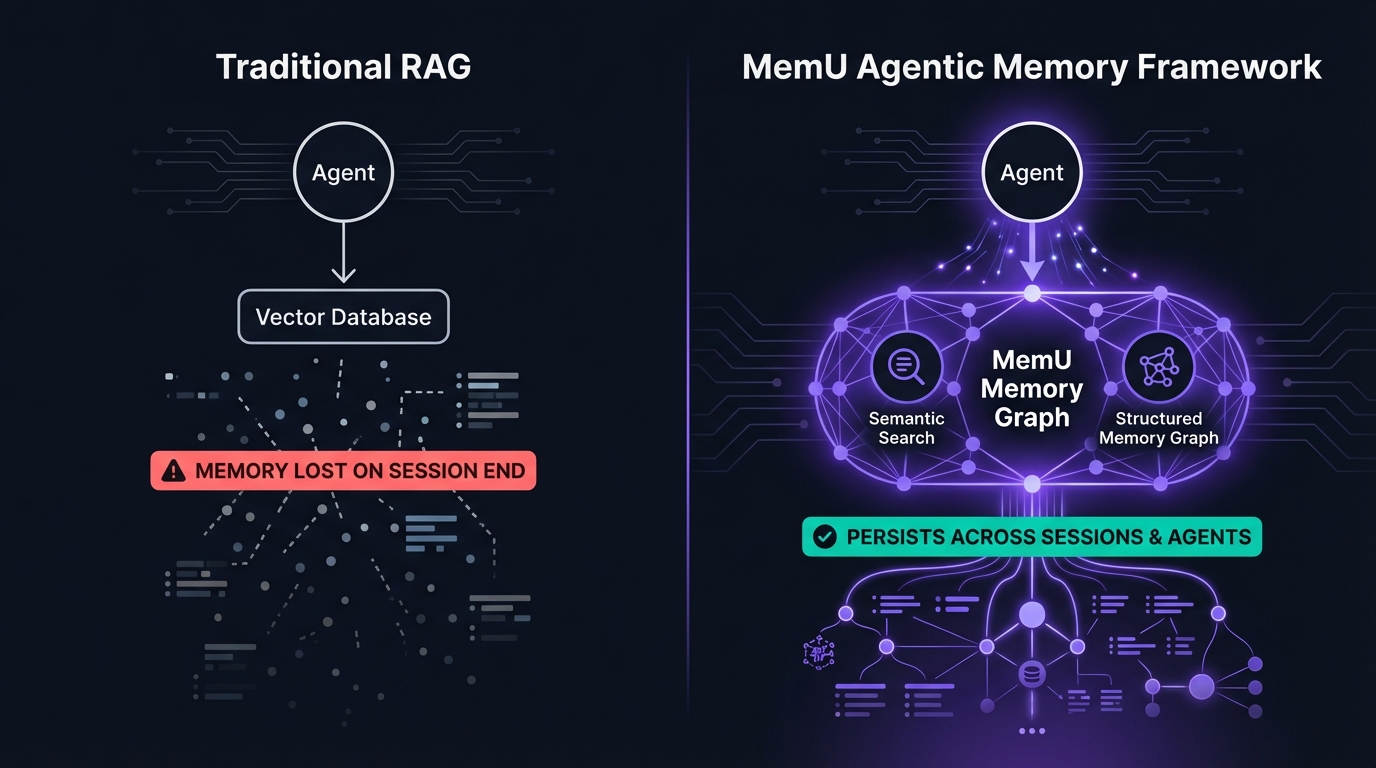
The MemU Agentic Memory Framework provides the persistent intelligence layer that transforms Haystack from a powerful per-run pipeline engine into a continuously learning retrieval system. Instead of treating each pipeline execution as isolated, MemU captures operational intelligence — retrieval strategy effectiveness, routing decision outcomes, document store performance characteristics, and chunking optimization results — storing it in a structured memory graph that persists across pipeline runs, service restarts, and infrastructure changes.
Consider a Haystack agentic RAG pipeline serving a legal research platform. Without persistent memory, each pipeline run initializes with default retrieval configurations. With the MemU Agentic Memory Framework, the pipeline recalls operational history: Qdrant delivers forty percent faster retrieval for case law queries while OpenSearch produces better relevance scores for regulatory documents, three-hop reasoning chains improve accuracy by twenty-five percent for multi-jurisdictional questions, and the web search fallback should activate when initial retrieval confidence drops below a learned threshold that was refined across ten thousand prior queries. That accumulated intelligence loads at pipeline startup, turning every execution into an informed operation rather than a cold start.
The framework addresses three core limitations of execution-bounded RAG pipelines:
- Retrieval strategy optimization: With multiple document stores and retrieval approaches available, the optimal configuration varies by query domain. The MemU Agentic Memory Framework captures which retrieval strategies produced the highest relevance scores for specific query categories, enabling optimized retrieval from the first query of every session.
- Routing intelligence persistence: Conditional routing decisions improve with experience as the pipeline learns which branches produce the best outcomes. Persistent memory preserves those learned routing patterns across pipeline restarts.
- Cross-run self-correction: Haystack's self-correcting loops refine results within a single run. The MemU Agentic Memory Framework extends this across runs — preserving which correction strategies worked and which retrieval paths consistently needed correction, enabling preemptive optimization.
A RAG pipeline that routes and retrieves brilliantly on its ten-thousandth query but starts fresh on query ten-thousand-and-one after a restart is wasting accumulated intelligence. The MemU Agentic Memory Framework gives Haystack pipelines persistent memory that compounds retrieval accuracy across every execution.
Integration with Haystack leverages the framework's REST APIs through custom pipeline components. A MemU retrieval component loads accumulated intelligence at pipeline initialization. During execution, the pipeline queries persistent memory for insights on similar past queries. After execution, new optimization discoveries are stored. The memory layer operates within Haystack's async architecture, adding persistence without impacting parallel execution performance.
Head-to-Head: Stateless Pipelines vs. Memory-Enhanced RAG
Haystack alone: The most flexible RAG pipeline framework available — directed multigraphs with branching, loops, and self-correction, deepset Studio for visual development, AsyncPipeline for parallel execution, five major document stores, SearchableToolset with Jinja2 templates, agentic routing with web search fallback, and multimodal RAG support. Conversational memory works within a session. But every pipeline restart initializes from default configurations.
Haystack + MemU: The same powerful pipeline architecture, now backed by persistent operational memory. Pipelines initialize with accumulated intelligence about retrieval strategies, routing decisions, and document store performance. The system delivers measurably better retrieval accuracy from the first query of each session — not just well-architected, but continuously improving across restarts.
For production RAG systems processing thousands of queries daily, the compounding effect is decisive. A Haystack deployment with months of persistent memory routes and retrieves with the precision of a deeply tuned system, while a freshly initialized pipeline spends its initial queries rediscovering optimal configurations through trial and suboptimal results.
Empowering Haystack: Better Together
The combination of Haystack's flexible pipeline architecture and MemU's persistent memory unlocks capabilities neither achieves independently:
- Adaptive document store routing: Persistent memory reveals which document store delivers the best results for each query domain, enabling automatic routing optimization that improves with every pipeline execution rather than resetting.
- Cross-pipeline knowledge transfer: When multiple Haystack pipelines share persistent memory, optimization discoveries from one benefit others. A chunking strategy refined by the legal research pipeline becomes available to the compliance audit pipeline.
- Predictive self-correction: Instead of correcting errors reactively within a run, persistent memory enables pipelines to preemptively adjust retrieval strategies based on patterns learned from thousands of previous self-correction cycles.
Persistent memory transforms Haystack from the most flexible RAG framework into the most adaptive RAG framework — where every pipeline execution compounds retrieval intelligence across the entire system.
Get Started with MemU
deepset has built a genuinely exceptional RAG pipeline framework with Haystack — directed multigraphs, visual development, async parallel execution, multi-store retrieval, agentic routing, and self-correcting outputs that represent the current state of the art in pipeline architecture.
The next step is giving those pipelines persistent operational memory. The MemU Agentic Memory Framework provides that foundation — API-based integration through custom Haystack components, dual-mode retrieval with semantic search and structured memory graphs, and cross-execution persistence that turns powerful pipelines into compounding intelligence systems.
Visit memu.pro to explore the Agentic Memory Framework API, or check out the GitHub repository to start building RAG pipelines that remember.
Tags: Haystack, deepset, RAG pipelines, agentic RAG, document retrieval, agent memory, MemU AI, LLM memory, pipeline optimization