Helicone Brings Open-Source Agent Observability to 100+ AI Models — But Observation Without Persistent Memory Means Logging the Same Mistakes Repeatedly

Helicone, a Y Combinator W23 company with 5,264 GitHub stars, has built a comprehensive open-source agent observability platform under the Apache 2.0 license. With one-line integration, the platform connects to OpenAI, Anthropic, Google AI, LangChain, Vercel AI SDK, and over 100 models — providing instant visibility into agent behavior without code changes. The platform delivers agent tracing, session monitoring, cost dashboards, and an AI Gateway with intelligent routing. Prompt versioning tracks changes across iterations, session replay enables step-by-step debugging of agent workflows, and A/B testing experiments validate prompt improvements with statistical rigor. A generous free tier of 10,000 requests per month, SOC 2 and GDPR compliance, and self-hosting via Docker make Helicone accessible from individual developers to enterprise teams requiring agent observability with full data sovereignty.
But agent observability that watches without remembering creates a frustrating cycle: teams observe their agents making mistakes, fix the immediate issue, and then watch the same mistake pattern emerge weeks later in a different context. Observability captures what happened — it does not ensure the agent learns from what happened. The dashboards show recurring failure patterns, but the agents themselves have no mechanism to internalize those patterns and avoid them proactively.
Agent Observability for AI Systems: What Helicone Gets Right (And What It Misses)
Helicone addresses a growing pain point in AI agent development: as agents become more autonomous, understanding their behavior becomes exponentially harder. A single agent task might involve dozens of LLM calls, tool invocations, and decision points. Without comprehensive observability, debugging why an agent produced a poor result requires manually reconstructing the reasoning chain from scattered logs. Helicone's session-based tracing captures the complete execution flow, enabling developers to replay and inspect every step of an agent's reasoning process.
The cost and analytics capabilities are equally critical for production agent systems. Per-model and per-user spending analysis reveals which workflows consume the most resources and whether that spending correlates with quality outcomes. Latency tracking pinpoints bottlenecks across model providers, tool calls, and prompt patterns, enabling data-driven optimization of agent architectures.
Prompt versioning and A/B testing bring scientific methodology to agent improvement. Rather than changing prompts and hoping for better results, teams can run controlled experiments comparing prompt versions across statistically significant sample sizes. Session replay allows qualitative analysis of how agents behave differently under each variation. This combination of quantitative metrics and qualitative replay creates a powerful observability workflow for iterative improvement of agent behavior.
The AI Gateway layer combines monitoring with routing reliability, letting teams react to issues in real time while analyzing patterns from a single open-source platform with TypeScript powering 91.3 percent of the codebase.
The limitation is the gap between observation and action. Helicone excels at showing teams what their agents are doing — but the agents themselves do not benefit from that observation. Observability generates insights for human developers who must then manually translate those insights into code changes, prompt updates, or configuration adjustments. The agents continue with no awareness of historical performance, repeating patterns already identified as suboptimal.
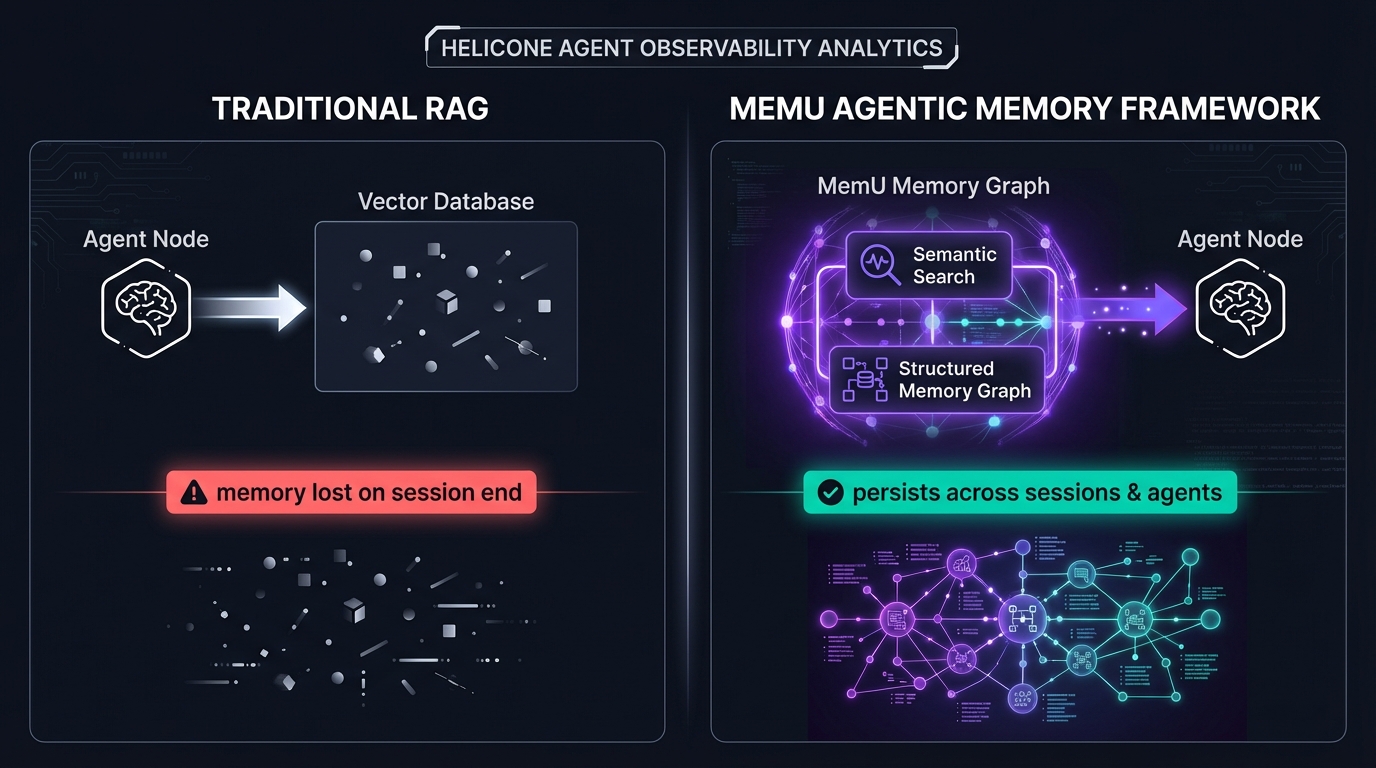
The MemU Agentic Memory Framework: Closing the Loop Between Observation and Intelligence
The MemU Agentic Memory Framework transforms agent observability from a human-facing dashboard into an agent-facing intelligence layer. Where Helicone captures what agents do for developer analysis, MemU ensures agents themselves can access and learn from their operational history — closing the feedback loop between observation and behavior improvement without requiring human intervention for every insight.
Consider an AI agent handling customer onboarding workflows — qualifying leads, customizing product recommendations, generating personalized documentation, and scheduling follow-up sequences. Helicone provides complete observability: which LLM calls succeed, where latency spikes occur, how costs distribute across customers, and which prompt versions produce better outcomes. After three thousand customers over six months, clear patterns emerge — certain segments respond better to specific strategies, particular formats reduce support tickets, and timing correlates with conversion rates. With MemU, these patterns become agent intelligence that actively improves future onboarding. Without persistent memory, the agent handles customer three thousand and one using the same generic approach as customer one while teams study dashboards showing the patterns the agent itself could act on.
The MemU Agentic Memory Framework provides capabilities that enhance observability infrastructure:
- Observation-to-intelligence pipeline: Helicone captures performance metrics, error patterns, and quality signals; MemU transforms these observations into structured memories that agents query during planning — enabling agents to proactively avoid patterns that observability has shown to correlate with poor outcomes.
- Session-level learning: Session replay shows how agent reasoning unfolds; MemU persists the lessons from those sessions — which reasoning paths led to successful outcomes, which tool sequences produced the highest-quality results, and which decision patterns should be reinforced or avoided in future sessions.
- Prompt evolution persistence: A/B testing identifies superior prompt versions; MemU ensures agents retain contextual knowledge about when different prompting strategies work best — learning not just which prompt is better on average but which prompt works better for specific input types, user segments, and task categories.
Agent observability shows what agents do. The MemU Agentic Memory Framework ensures agents learn from what they do — transforming passive monitoring into active intelligence that closes the feedback loop between observation and improved behavior.
Head-to-Head: Helicone vs. Other Agent Observability Platforms
Helicone alone: Agent observability provides one-line integration, comprehensive tracing, cost analytics, prompt versioning, A/B testing, session replay, and an open-source foundation with self-hosting options. SOC 2 and GDPR compliance ensure enterprise readiness. But observability data flows to human dashboards — three thousand agent sessions generate three thousand traced histories that inform developer decisions without informing the agents themselves.
Helicone + MemU Agentic Memory Framework: Every observed session contributes to accumulated agent intelligence. Performance patterns are surfaced not just in dashboards but in agent planning. Error correlations inform proactive avoidance strategies. Cost optimization insights translate directly into agent behavior changes. The observability platform becomes not just a monitoring tool but an intelligence pipeline where every observed interaction compounds into operational expertise that agents themselves can leverage.
Compared to other observability approaches — LangSmith, Weights and Biases Weave, Arize Phoenix, Datadog LLM Monitoring — Helicone offers the most accessible open-source platform with Apache 2.0 licensing, self-hosting support, and one-line integration simplicity. But all share the same fundamental limitation: observation of agent behavior without persistence of agent intelligence. MemU provides the memory layer that transforms any observability platform from a passive monitoring system into an active learning system.
Observed and Intelligent: Better Together
MemU does not replace Helicone's observability — it ensures every observed agent interaction contributes to growing operational intelligence:
- Analytics enrichment: Helicone dashboards show current metrics and trends; MemU adds agent-level context showing how individual agents improve over time — whether agents internalize lessons, whether prompt improvements persist, or whether new patterns require attention.
- Cost reduction: Helicone tracks spending per model and per user; the MemU Agentic Memory Framework reduces spending by enabling agents to make smarter model selection decisions based on historical outcome quality — avoiding expensive model calls when observability data shows cheaper alternatives produce equivalent results for specific task types.
- Agent evolution: Helicone users gain visibility into agent behavior; MemU enables agents to act on that visibility — applying accumulated knowledge from observed sessions, transforming observed agents into self-improving agents whose performance compounds over months of monitored operation.
Get Started with MemU
Give your agents persistent memory to transform agent observability from passive monitoring into active intelligence that compounds learning across every session. The MemU Agentic Memory Framework integrates with any observability infrastructure — one API, instant persistence, zero changes to existing Helicone configurations. Visit memu.pro to explore the Agentic Memory Framework API, or check out the GitHub repository to start building agents that remember.
Tags: Helicone, agent observability, open-source AI analytics, LLM monitoring, agent tracing, persistent agent intelligence, prompt versioning, MemU AI