Hexaware Agentverse Deploys 600+ Enterprise AI Agents — But Without Shared Memory, Every Agent Starts from Zero


Hexaware Agentverse launched on March 17, 2026 as a sweeping enterprise AI agent platform offering more than 600 ready-to-deploy agents spanning customer experience, financial services, manufacturing, retail, healthcare, and enterprise operations. The platform integrates with CRM systems, ITSM platforms, knowledge repositories, data platforms, telephony infrastructure, and collaboration applications. With advanced orchestration handling conversations, knowledge retrieval, process documentation, and operational actions, Hexaware Agentverse targets concrete enterprise outcomes: 40-60% productivity gains, 60-80% faster response times, 20-35% satisfaction improvement, and 20-50% cost reductions. Built-in governance provides RBAC, audit trails, observability dashboards, and policy guardrails.
But there is a foundational limitation embedded in that scale. When 600 agents deploy across an organization, each one begins its engagement from zero context. The customer experience agent that resolved a complex multi-channel complaint yesterday carries no memory of the resolution strategy today. The manufacturing agent that identified a supply chain bottleneck last week cannot share that pattern with the financial services agent forecasting costs. Six hundred agents without organizational memory are six hundred independent operators — not a learning organization.
Hexaware Agentverse: What Everyone's Getting Right (And Missing)
The platform gets the breadth equation right. Six hundred pre-built agents is not a marketing number — it represents genuine coverage across the enterprise stack. A manufacturing company deploying the platform gets agents for quality inspection, predictive maintenance, supply chain optimization, inventory management, and production scheduling, all pre-configured for industry-specific workflows. A financial services firm gets agents for KYC verification, fraud detection, regulatory reporting, and customer onboarding. No months of custom development are needed; operational agents are available from day one.
The orchestration layer is equally sophisticated. It coordinates conversations across multiple agents, retrieves knowledge from connected repositories, documents processes for compliance, and executes operational actions across integrated systems. RBAC ensures the right agents access the right data. Audit trails provide the accountability regulators demand. Policy guardrails prevent agents from exceeding their authorized scope.
What the platform does not provide is memory continuity across those 600 agents. Each agent operates within its deployment context — processing current inputs against its training and connected data sources. When a healthcare agent discovers that a particular patient intake workflow reduces processing time by 30%, that insight does not persist for the next shift. When a retail agent learns a return pattern that indicates a manufacturing defect, the manufacturing agent in the same deployment never receives that signal. The orchestration is excellent; the organizational learning is absent.
Other enterprise agent platforms — ServiceNow AI Agents, SAP Joule, Microsoft Copilot Studio — share this architectural gap. They deploy, coordinate, and govern agents. None compound organizational knowledge across agent interactions over time.
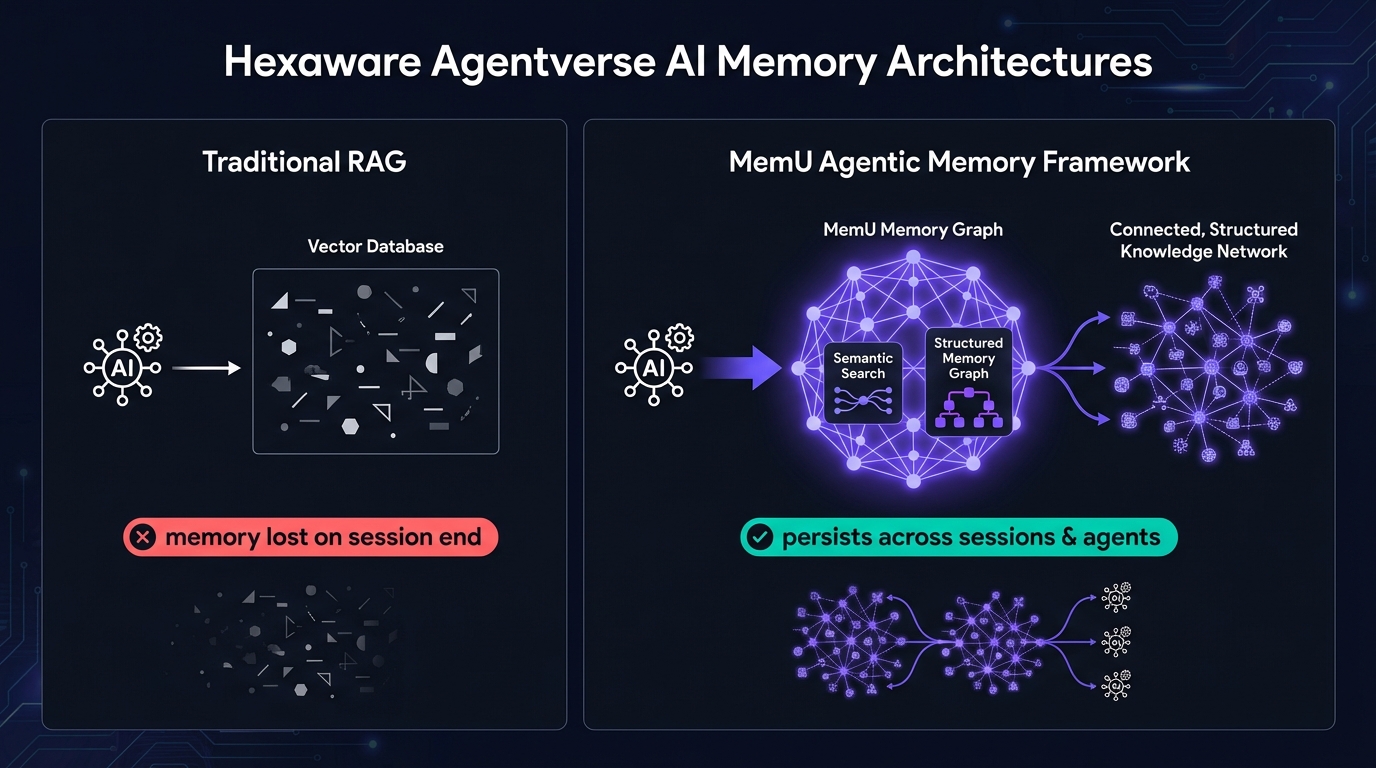
The MemU Agentic Memory Framework: Organizational Memory for Agent Fleets
The MemU Agentic Memory Framework provides the persistent organizational memory layer that enterprise agent platforms like Hexaware Agentverse do not include natively. Instead of treating each agent interaction as an isolated event, MemU captures operational insights, resolution patterns, cross-domain correlations, and accumulated expertise, storing them in a structured memory graph that persists across sessions, agents, and departments.
Consider a deployment at a large hospital network. The patient scheduling agent discovers that rescheduling oncology appointments within 48 hours reduces no-show rates by 40%. Without persistent memory, that insight exists only in session logs. With the MemU Agentic Memory Framework, the scheduling pattern is captured, indexed by department and outcome, and made retrievable by any agent in the fleet. The billing agent adjusts revenue projections. The staffing agent optimizes nurse schedules around improved appointment adherence. The quality metrics agent incorporates the pattern into care continuity scoring. One discovery propagates across the entire operational network.
The MemU Agentic Memory Framework addresses three limitations of memory-less agent fleets:
- Cross-agent knowledge propagation: When one agent among 600 discovers an operational pattern, that knowledge becomes available to every other agent with appropriate access. The framework maintains structured relationships between insights — linking the retail return pattern to the manufacturing defect to the supplier quality score — enabling agents to traverse knowledge graphs rather than query isolated facts.
- Temporal learning persistence: Enterprise operations follow cycles — quarterly closes, seasonal demand, annual compliance reviews. Agents that operated through previous cycles retain that contextual intelligence. A financial agent approaching quarter-end retrieves resolution strategies from the last four quarterly closes, each refined by experience.
- Organizational expertise accumulation: Every agent interaction generates potential organizational knowledge. Persistent memory captures the resolution strategies that worked, the escalation paths that resolved fastest, and the cross-department coordination patterns that avoided bottlenecks.
Six hundred agents that start from zero every engagement represent enormous capability without continuity. The MemU Agentic Memory Framework transforms them into a learning organization where every interaction compounds the collective intelligence.
Head-to-Head: Stateless Agent Fleet vs. Memory-Enhanced Enterprise Deployment
Hexaware Agentverse alone: A comprehensive enterprise agent platform with 600+ ready-to-deploy agents, advanced orchestration, full governance, and deep system integration. Agents execute effectively within their current context. But each engagement starts fresh — no recall of previous resolutions, no cross-agent learning, no compounding organizational intelligence from thousands of daily interactions.
Hexaware Agentverse + MemU: The same 600+ agent catalog and enterprise orchestration, now backed by persistent organizational memory. Agents begin each engagement informed by accumulated operational intelligence. The customer experience agent recalls how similar complaints were resolved across channels. The manufacturing agent retrieves quality patterns identified by supply chain agents. Resolution times decrease through accumulated expertise that prevents repeating solved problems.
For organizations deploying at scale — where hundreds of agents process thousands of interactions daily — the difference compounds rapidly. After six months, a memory-backed fleet operates with the institutional knowledge of an organization that has been learning continuously from every agent interaction.
Empowering Hexaware Agentverse: Better Together
The combination of the enterprise agent platform and MemU's persistent memory creates capabilities that neither achieves independently:
- Predictive issue resolution: Persistent memory tracks issue patterns across the full agent fleet. When a new support ticket arrives, the customer experience agent retrieves resolution strategies from similar cases across departments, regions, and time periods — not just its own prior interactions, but the collective experience of all 600+ agents.
- Cross-industry pattern transfer: Organizations deploying agents across multiple business units benefit from cross-domain memory. A quality pattern discovered in manufacturing informs the retail agent's product recommendations. A retention strategy proven in financial services adapts to healthcare patient engagement.
- Continuous governance refinement: Persistent memory tracks which policy guardrails triggered, why, and what the resolution was. Over time, governance rules refine based on accumulated operational evidence rather than static policy definitions.
Get Started with MemU
Hexaware Agentverse has built a remarkable enterprise agent platform — 600+ agents, advanced orchestration, built-in governance, and deep integration across the enterprise technology stack.
The next step is giving that fleet organizational memory. Engagements where agents recall resolution patterns from thousands of prior interactions. Deployments where cross-department intelligence compounds automatically. Organizations where every agent interaction strengthens collective operational expertise.
The MemU Agentic Memory Framework provides that foundation. Structured memory graphs for cross-agent knowledge propagation, temporal persistence for cyclical business intelligence, and governance-aware retrieval for regulated environments.
Visit memu.pro to explore the Agentic Memory Framework API, or check out the GitHub repository to start building agents that remember.
Tags: Hexaware Agentverse, enterprise AI agents, agent orchestration, agent memory, MemU AI, LLM memory, organizational intelligence