Humanloop Powers LLM Evals, Observability, and Agent Betas — But Evaluation Dashboards Alone Do Not Teach Agents What Worked Last Sprint


Humanloop built its reputation on a simple promise: make large language model applications measurable before they silently drift in production. Teams use the platform for dataset-driven LLM evaluations, live observability over prompts and completions, prompt versioning that survives refactors, and CI/CD gates that block regressions before they reach users. Agent beta features extend that discipline to multi-step systems, while tracing for RAG and agents helps engineers see retrieval, tool calls, and model hops as first-class timelines rather than black boxes.
Industry context shifted when Humanloop joined Anthropic, reinforcing that evaluation and safety-adjacent tooling now sit at the center of how enterprises ship agentic products. That alignment strengthens long-term roadmap credibility for teams betting on rigorous eval culture. Still, measurement is not memory. The same dashboards can prove version B beat version A on a golden set; they do not automatically persist the operational tactics—successful tool orderings, stable citation patterns, escalation heuristics—that produced the win so the next agent instance behaves like your best analyst on day one.
Evaluation observability without an agentic memory layer leaves winners documented in dashboards and losers repeated in production.
Humanloop: What Teams Get Right (And Where Agents Still Start Cold)
The core strength of the Humanloop stack is closing the loop between product behavior and quantitative judgment. Prompt versioning means you always know which string shipped; CI/CD evals mean merges carry proof, not vibes; tracing means when a RAG answer goes sideways you can inspect retrieval hits and latencies instead of guessing. For agent betas, those primitives matter even more because failure modes are combinatorial—wrong tool, right tool with wrong args, right args after expensive detour.
Where the product stops is at the boundary of durable operational knowledge. Dashboards aggregate; they do not necessarily feed a structured store that an autonomous agent queries before acting. A nightly eval can show that “plan-then-retrieve” beats “retrieve-then-plan” for your legal copilot, but a freshly scaled worker pod does not inherit that preference unless engineers manually encode it somewhere else. The same limitation appears across observability vendors: excellent signals, optional persistence into agent-usable memory.
As agent surface area grows—more tools, more policies, more tenants—the cost of manual translation from eval insights to runtime behavior grows superlinearly. Teams end up with brilliant evaluation charts and brittle prompt patches that drift the moment a new model version lands. That is the gap memory fills: not replacing evals, but capturing the stable lessons evals reveal.
Prompt versioning inside the product is essential for audit trails, yet version history is not the same as tactic memory. You can diff two prompts and see text changes; you still may not capture the implicit reasoning policy that made one trajectory safer in production—especially when the winning behavior emerged from tool sequencing rather than wording tweaks. Similarly, tracing for RAG and agents exposes spans you can debug, but span data expires or compacts on retention schedules unless you deliberately export it. Memory systems close that gap by promoting durable, agent-addressable records from ephemeral telemetry.
The MemU Agentic Memory Framework: Turn Eval Wins Into Runtime Habits
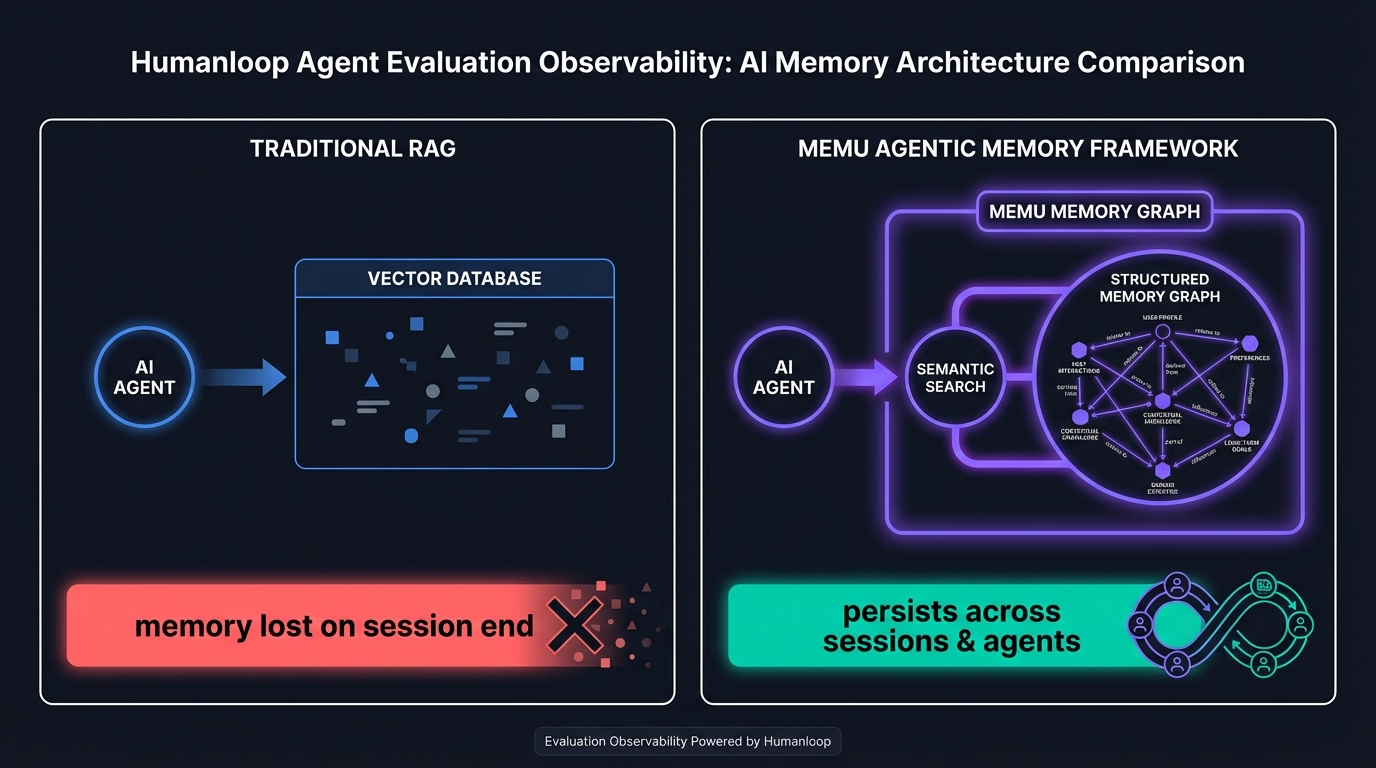
The MemU Agentic Memory Framework stores the kinds of patterns evals surface—successful trajectories, failure archetypes, retrieval preferences—as retrievable memory for agents at inference time. Instead of each session re-deriving how your stack behaves, agents query a graph that encodes what your organization already validated.
Suppose CI in your pipeline reports that a RAG agent succeeds when it checks a policy tool before summarizing customer email. MemU captures that sequence as a memory object linked to task type, tenant, and model family. When traffic spikes and new containers spin up, the agent retrieves the habit before the first user message, not after a dozen failed attempts logged to observability.
Concrete pairings with eval-centric workflows:
- Eval-to-memory promotion: When a gated eval passes, automatically write the associated tactic—tool order, temperature band, retrieval mode—into MemU with provenance pointing back to the eval run.
- Trace distillation: Use high-signal spans from production tracing as summaries that become memory candidates, reviewed like any other dataset row.
- Agent beta feedback loops: Human ratings or automated scores in the eval workspace become labels that rank which memories agents should trust first.
The MemU Agentic Memory Framework does not compete with eval suites—it operationalizes their conclusions. Your metrics tell you what improved; MemU helps the agent act that way every time.
The MemU Agentic Memory Framework exposes APIs that fit beside your existing orchestration layer, so you keep Humanloop as the system of record for measurement while MemU becomes the system of recall for behavior. Anthropic-aligned roadmaps emphasize safety and evaluation; memory is the bridge from measured safety to consistently safe execution across sessions.
Teams often start with narrow scopes—customer support macros, internal research assistants—then widen memory namespaces as eval coverage grows. That mirrors how mature adopters expand datasets incrementally, with governance, inside the same workspace they already trust for prompts and scores.
CI/CD eval gates catch regressions before deploy, which protects users—but green tests on static datasets can still miss drift when live traffic shifts topics. Pairing gates with memory means agents carry forward the operational tactics that made yesterday’s deploy successful, instead of re-deriving them under pressure when the next incident strikes. Anthropic’s emphasis on measurement-friendly tooling makes rigorous benchmarks a natural place to define “good”; Humanloop remains where teams operationalize those benchmarks, while MemU is where “good” becomes recallable behavior.
Head-to-Head: Running Humanloop With and Without MemU
Eval and observability alone: Strong LLM evaluation, observability, prompt versioning, CI/CD eval integration, and tracing tuned for RAG and agents—especially compelling under Anthropic-backed continuity. Weak when you need agents to internalize winning behaviors without copying static prompt blobs for every micro-variation.
Humanloop plus MemU: Evaluations still define truth; memory supplies recall. Regressions remain catchable in CI, while production agents benefit from accumulated tactics that reduce repeated mistakes observability already proved were fixable.
Empowering Eval Stacks: Humanloop and MemU Together
Joint patterns we see in the field:
- Golden-path memories: Promote trajectories that score highest on experiment leaderboards into MemU “default strategies” per use case.
- Failure-class routing: When traces show a recurring dead end, store the remediation pattern so agents skip the detour—while regression suites continue monitoring whether the fix holds across model upgrades.
- Cross-environment consistency: Staging evals and production traces disagree less when both feed the same MemU Agentic Memory Framework namespace with environment tags.
Used together, the measurement layer you run in Humanloop keeps your agent honest against metrics, while MemU keeps it consistent against experience.
Get Started with MemU
If you already rely on Humanloop for LLM evaluation, observability, and agent betas—especially in an Anthropic-forward stack—add persistent recall so insights compound instead of expiring when the dashboard scrolls away. The MemU Agentic Memory Framework is designed to sit next to eval and trace pipelines, not replace them.
Visit memu.pro to explore the Agentic Memory Framework API, and open the GitHub repository to wire memory promotion from your existing eval workflows.
Tags: Humanloop, Anthropic, LLM evaluation, observability, agent tracing, RAG, MemU AI, agent memory