HyperNova 60B Is a Free Quantum-Compressed Frontier Model at 32GB — Small Enough for Your Laptop, Still No Memory


Multiverse Computing just released HyperNova 60B 2602 — a free, quantum-compressed AI model that fits in 32GB while maintaining near-frontier performance. Derived from OpenAI's gpt-oss-120B using quantum-inspired compression technology, HyperNova halves the parameter count while preserving the capabilities that matter: tool calling, agentic coding, and complex reasoning. The model is free to use, runs on consumer hardware, and doesn't require cloud API subscriptions. This is frontier AI capability at the cost of a laptop upgrade.
Multiverse Computing, a Spanish startup specializing in quantum-inspired algorithms for classical hardware, applied their compression expertise to the emerging challenge of model size. The gpt-oss-120B model requires enterprise-grade infrastructure to run. HyperNova 60B runs on a machine with 32GB of RAM. The compression isn't simple quantization — it uses quantum-inspired tensor decomposition that preserves the mathematical relationships that encode model capability while reducing the physical storage required.
But compression solves the size problem, not the memory problem: HyperNova fits on your laptop, but it still forgets everything when you close the terminal.
Why Quantum Compression Changes Accessibility
The AI accessibility gap isn't just about model capabilities — it's about who can run those capabilities. Frontier models require expensive cloud infrastructure or enterprise-grade hardware. This concentrates AI power in organizations with cloud budgets and excludes individual developers, researchers in resource-constrained environments, and organizations with data sovereignty requirements that prevent cloud deployment.
HyperNova's 32GB footprint changes this equation. A developer with a modern laptop can run frontier-competitive AI locally. A research lab in a developing country can access capabilities that previously required a Silicon Valley budget. An organization handling sensitive data can process it entirely on-premises. The quantum-inspired compression doesn't just shrink the model — it expands who can use frontier AI.
The tool calling and agentic coding improvements in the 2602 release are particularly significant for local deployment. Users aren't just getting a chatbot that runs locally — they're getting an AI agent that can call tools, write code, and execute multi-step tasks on their own machine. This is the full agentic capability stack, compressed to consumer hardware.
Local Models Need Local Memory
Cloud-hosted models benefit from server-side state management — conversation histories stored on the provider's infrastructure. Local models have no such infrastructure. When you close the terminal, the model's context is gone. Restart the model, and it has no memory of previous sessions. For users who choose local models specifically for privacy and control, this is a particularly acute problem — they can't even fall back on cloud-based conversation history.
The free pricing model compounds this. Cloud APIs charge per token but provide conversation management as a service. Free local models charge nothing but provide nothing beyond raw inference. The user is responsible for their own memory management — and most users don't have the infrastructure expertise to build persistent memory systems.
HyperNova users represent exactly the audience that needs simple, lightweight memory solutions. They've chosen local execution for privacy, cost, or sovereignty reasons. They need persistent memory that respects the same constraints: runs locally, requires minimal infrastructure, and preserves the privacy guarantees that motivated the local deployment choice.
How MemU Adds Memory to Local Models
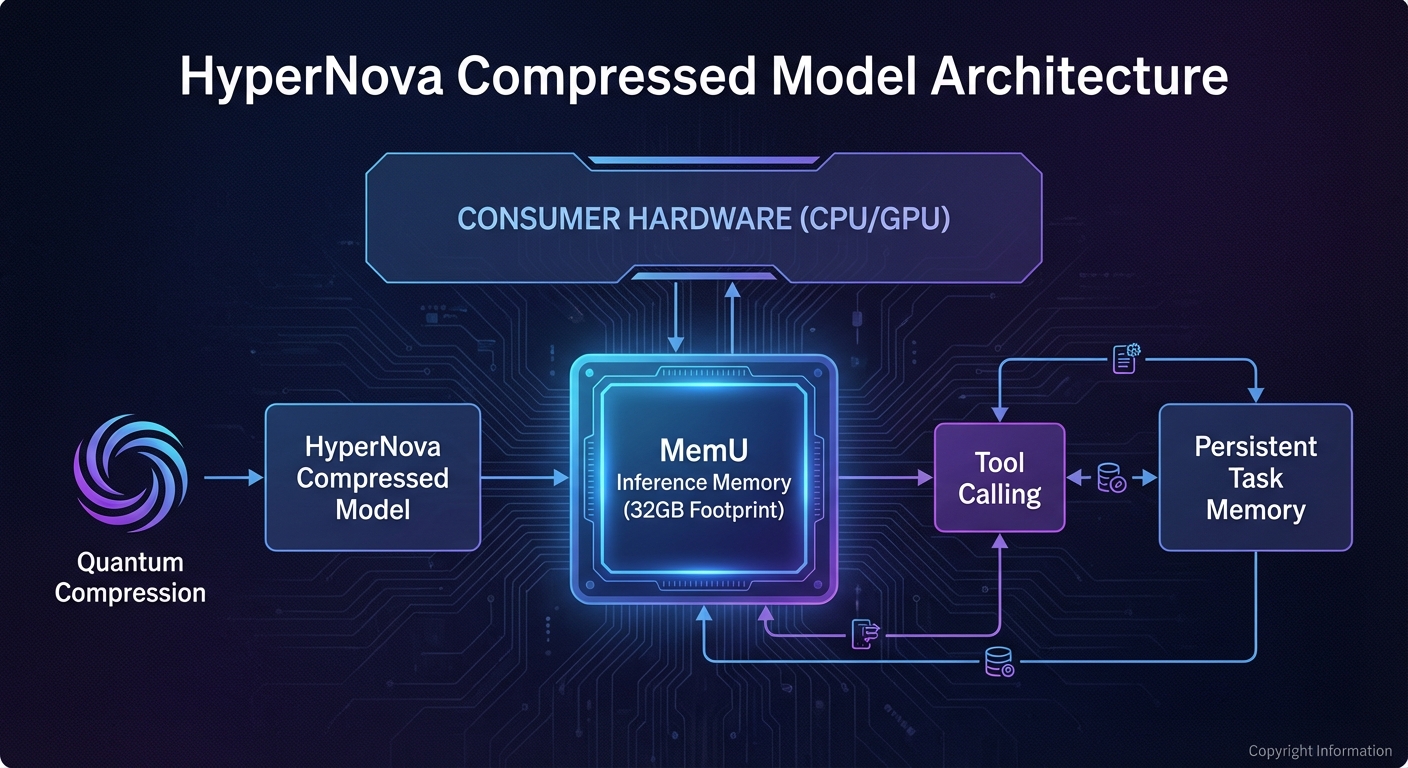
MemU provides lightweight persistent memory that runs alongside local models like HyperNova. Every session's interactions are stored locally in MemU's memory system. Before each new session, relevant memories are retrieved, giving the model accumulated context without requiring cloud connectivity. The memory stays on the same machine as the model — preserving the privacy and sovereignty guarantees that motivated local deployment.
For HyperNova's 32GB footprint, MemU adds negligible overhead. The memory operations are lightweight compared to model inference. The combined system — HyperNova for inference, MemU for memory — delivers a frontier-competitive AI assistant with persistent memory that runs entirely on consumer hardware, costs nothing, and keeps all data local.
Multiverse compressed frontier AI to laptop size. MemU gives laptop AI persistent memory. Together, they democratize not just AI capability but AI continuity.
Get Started
Add persistent local memory to your compressed AI models. Explore MemU at memu.pro and on GitHub.