Inngest Builds Durable Execution for AI Agent Workflows — But Durability Within Workflows Does Not Preserve Intelligence Across Them


Inngest has established itself as a leading event-driven durable execution platform, purpose-built for the probabilistic nature of AI agent workflows. The platform's step-based architecture provides automatic retry, caching, parallel execution, and the ability to pause for external events or time periods — capabilities that handle the inherent unpredictability of AI behavior with sophisticated reliability guarantees. Multi-step agent workflows spanning planning, tool calls, memory retrieval, and synthesis run with durable state at every checkpoint. Human-in-the-loop patterns enable workflows to suspend and resume for hours or days awaiting approval. In 2025, Durable Endpoints brought durability directly into API handlers, recognizing that AI products need reliability and real-time responsiveness simultaneously. Moving into 2026, Inngest is focused on bringing durability to user-facing AI workflows with optimized checkpointing and step transitions that deliver durability without latency penalties.
But durable execution preserves workflow state — it does not preserve the intelligence workflows generate. An agent workflow on Inngest can survive crashes, suspend for days, and resume precisely where it left off. That same agent cannot carry forward what it learned during execution — which strategies produced the best results, which tool calls failed and why, which planning approaches led to optimal outcomes — into a completely new workflow instance.
Durable Execution for AI Agents: What Inngest Gets Right (And What It Misses)
Inngest addresses a fundamental challenge in AI agent infrastructure: the probabilistic nature of AI makes traditional execution guarantees insufficient. An LLM call might return different results on retry, a tool call might fail intermittently, and a multi-step reasoning chain might need to branch based on intermediate results. Inngest's step primitives handle this gracefully — each step can retry independently, cache results to prevent redundant computation, run in parallel when tasks are independent, and pause execution until external conditions are met. This step-level granularity makes durable workflows practical for workloads where every operation carries uncertainty.
The human-in-the-loop architecture demonstrates mature understanding of production agent systems. Complex workflows frequently require human judgment at critical decision points — approving financial transactions, validating medical recommendations, or confirming destructive operations. Inngest enables workflows to suspend indefinitely at these checkpoints, persisting complete execution state, and resume seamlessly once approval arrives. This pattern transforms agents from fully autonomous systems into collaborative ones where human oversight is architecturally supported rather than bolted on.
Durable Endpoints represent an important evolution recognizing that AI experiences need durability in the request path, not just in background processing. When a user asks an AI agent a complex question, the response might require multiple LLM calls, tool invocations, and reasoning steps that take seconds or minutes. Durable Endpoints bring checkpoint-based recovery to these user-facing flows, ensuring a network hiccup does not destroy minutes of accumulated reasoning and intermediate results. This bridges the gap between background durability and interactive user experiences.
The limitation is the scope of durability. Inngest guarantees a workflow instance will not lose state during execution, even across crashes, suspensions, and infrastructure failures. But when that instance completes, the operational intelligence it generated is not available to future instances. A new run of the same workflow starts with identical code and configuration but zero experiential knowledge: which execution paths produced optimal results, which retry strategies resolved failures fastest, and which planning approaches worked best.
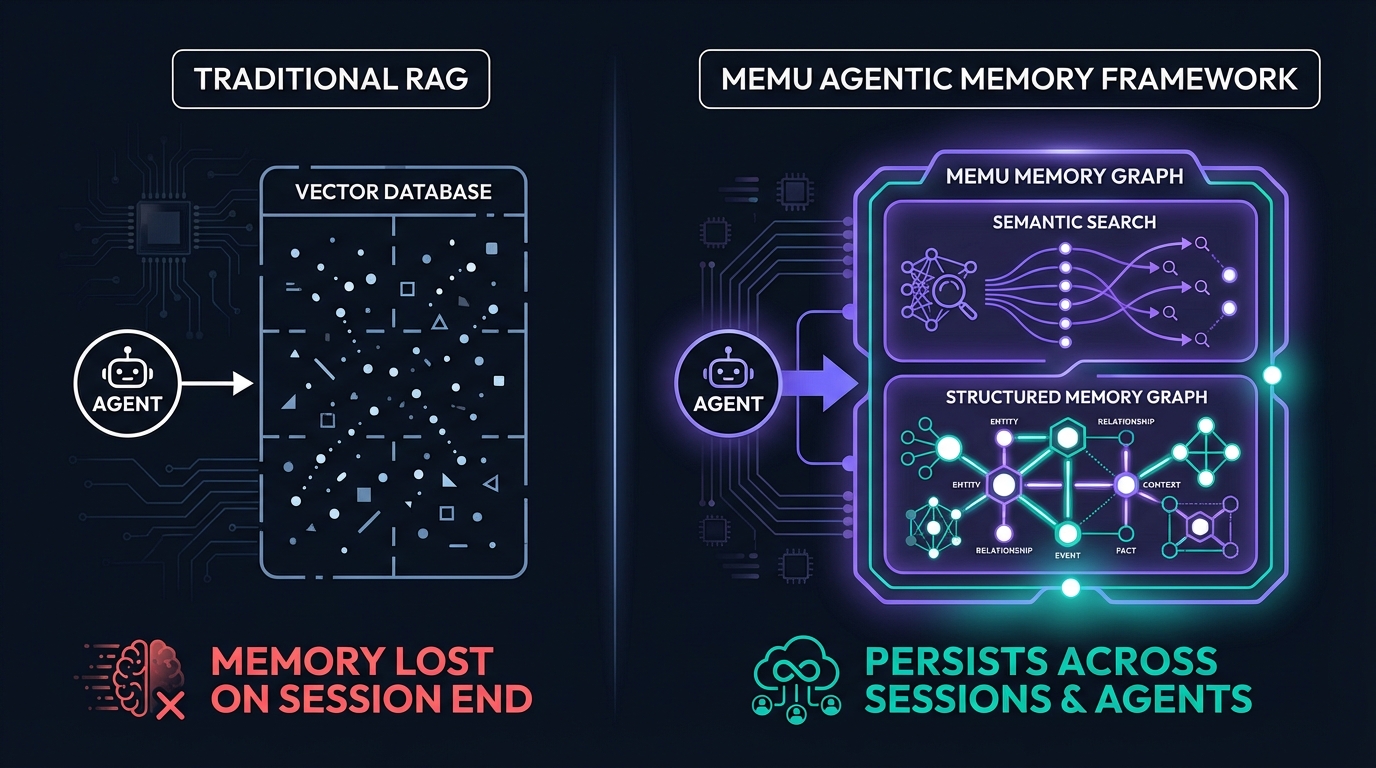
The MemU Agentic Memory Framework: Persistent Intelligence Across Durable Workflows
The MemU Agentic Memory Framework extends durable execution from state preservation to intelligence preservation. Where Inngest guarantees a running workflow survives any failure, MemU guarantees a completed workflow's intelligence survives completion — creating a compounding layer where every completed execution deposits learning that future executions withdraw and build upon.
Consider an AI agent running durable workflows to process legal document reviews — analyzing contracts, identifying risk clauses, cross-referencing precedents, and generating compliance summaries. Inngest ensures each workflow survives interruptions with step-level checkpointing and human-in-the-loop approvals for flagged clauses. After processing a thousand contracts over six months, the agent has implicitly learned which clause patterns correlate with high-risk determinations, which precedent databases yield the most relevant results, and which review sequences minimize revision cycles. With MemU, this intelligence persists across all future reviews. Without persistent memory, contract one thousand and one is reviewed with the same baseline assumptions as contract one.
The MemU Agentic Memory Framework provides capabilities that enhance execution infrastructure:
- Cross-workflow intelligence: Every completed workflow generates operational knowledge about step performance, tool reliability, and outcome quality. MemU captures this as structured memories that future workflows query during planning — enabling new instances to start with accumulated wisdom rather than default configurations.
- Step optimization: Inngest steps retry individually with caching; MemU tracks which step sequences produce optimal outcomes under different conditions — building intelligence about execution ordering, caching strategies, and parallelization decisions based on measured historical performance rather than static logic.
- Suspension pattern learning: Workflows that suspend for human input generate patterns about approval timing, rejection reasons, and escalation triggers; MemU persists these patterns so future workflows can anticipate decision requirements and prepare context that accelerates human review.
Durable execution ensures workflows survive failures. The MemU Agentic Memory Framework ensures the intelligence from those workflows survives completion — transforming reliable state management into intelligent execution that improves with every instance.
Head-to-Head: Inngest vs. Other Durable Execution Platforms
Inngest alone: Durable execution provides step-level checkpointing, sophisticated retry and caching, human-in-the-loop suspension, and the industry's most AI-native execution primitives with Durable Endpoints for real-time flows. But each workflow instance operates in intelligence isolation — a thousand instances of the same workflow generate independent execution histories with no mechanism to aggregate operational intelligence into actionable knowledge for future runs.
Inngest + MemU Agentic Memory Framework: Every workflow benefits from accumulated intelligence of all previous instances. Step strategies are informed by historical performance data, tool selection is optimized based on measured reliability, and planning approaches improve with every completed run. The durable execution platform becomes not just a reliability layer but an intelligence amplifier where each completed workflow compounds into operational expertise accessible to every future instance.
Compared to other execution approaches — Temporal, Restate, Azure Durable Functions, AWS Step Functions — Inngest offers the most AI-native primitives with purpose-built support for probabilistic behavior and human-in-the-loop patterns. But all share the same fundamental limitation: state durability within executions without intelligence durability across them. MemU provides the persistent memory layer that any execution infrastructure needs to transform reliable repetition into progressive improvement.
Durable and Intelligent: Better Together
MemU does not replace Inngest's infrastructure — it ensures every completed workflow contributes to growing operational intelligence:
- Checkpoint enrichment: Inngest checkpoints preserve execution state; MemU adds historical context showing how step performance compares to previous workflows — whether specific tool calls have degrading reliability, whether certain planning patterns correlate with better outcomes, or whether step durations indicate emerging performance issues across the population of workflow runs.
- Human-in-the-loop optimization: Inngest suspends workflows for approval; the MemU Agentic Memory Framework tracks approval patterns over time — learning which request types need human review, which are routinely approved, and which benefit from additional context, enabling smarter routing that respects governance while reducing unnecessary delays.
- Agent evolution: Inngest users build agents with reliable execution guarantees; MemU enables those agents to execute intelligently — applying accumulated knowledge from completed workflows, transforming durable agents into expert agents whose performance compounds over months of continuous operation.
Get Started with MemU
Give your durable agents persistent memory to transform durable execution from reliable state preservation into intelligent execution compounding learning across every workflow instance. The MemU Agentic Memory Framework integrates with any execution infrastructure — one API, instant persistence, zero changes to existing Inngest workflows. Visit memu.pro to explore the Agentic Memory Framework API, or check out the GitHub repository to start building agents that remember.
Tags: Inngest, durable execution, agentic AI infrastructure, workflow state management, step-based durability, persistent agent intelligence, event-driven execution, MemU AI