JetBrains Air Lets Four AI Agents Work Your Codebase at Once — None of Them Remember What the Others Learned


JetBrains Air: What Everyone's Getting Right (And Missing)
JetBrains Air launched in March 2026 as a public preview on macOS, delivering the most capable multi-agent orchestration environment for agentic development to date. The platform runs OpenAI Codex, Claude Agent, Gemini CLI, and JetBrains' own Junie concurrently in a single workspace through the Agent Client Protocol (ACP). Each agent gets standardized access to code context navigation, a Git client, a terminal, and three isolated execution environments: Local, Git Worktree, and Docker containers.
The model works: route code generation to Codex, deep refactoring to Claude Agent, Google ecosystem integration to Gemini CLI, and IDE-native operations to Junie. Each model handles what it does best within one orchestrated environment — a genuine improvement over picking a single assistant and hoping it covers every case.
Developers on OpenClaw — the popular open-source agent framework — have watched JetBrains Air closely since ACP was announced. On Moltbook, the AI agent social network where 2.5 million agents collaborate, integration discussions rank among the most active threads. But a consistent concern emerges: agents share files, terminals, and execution sandboxes — yet share nothing they have learned. Every insight one agent generates dies when its session ends, invisible to every other agent in the workspace.
What JetBrains Air Does With Memory Today
The platform provides each agent with rich runtime context through ACP: file trees, open editor buffers, terminal output, and Git history. The three execution environments isolate agent runtimes to prevent collisions — thoughtful engineering for parallel agentic development where multiple models modify code simultaneously.
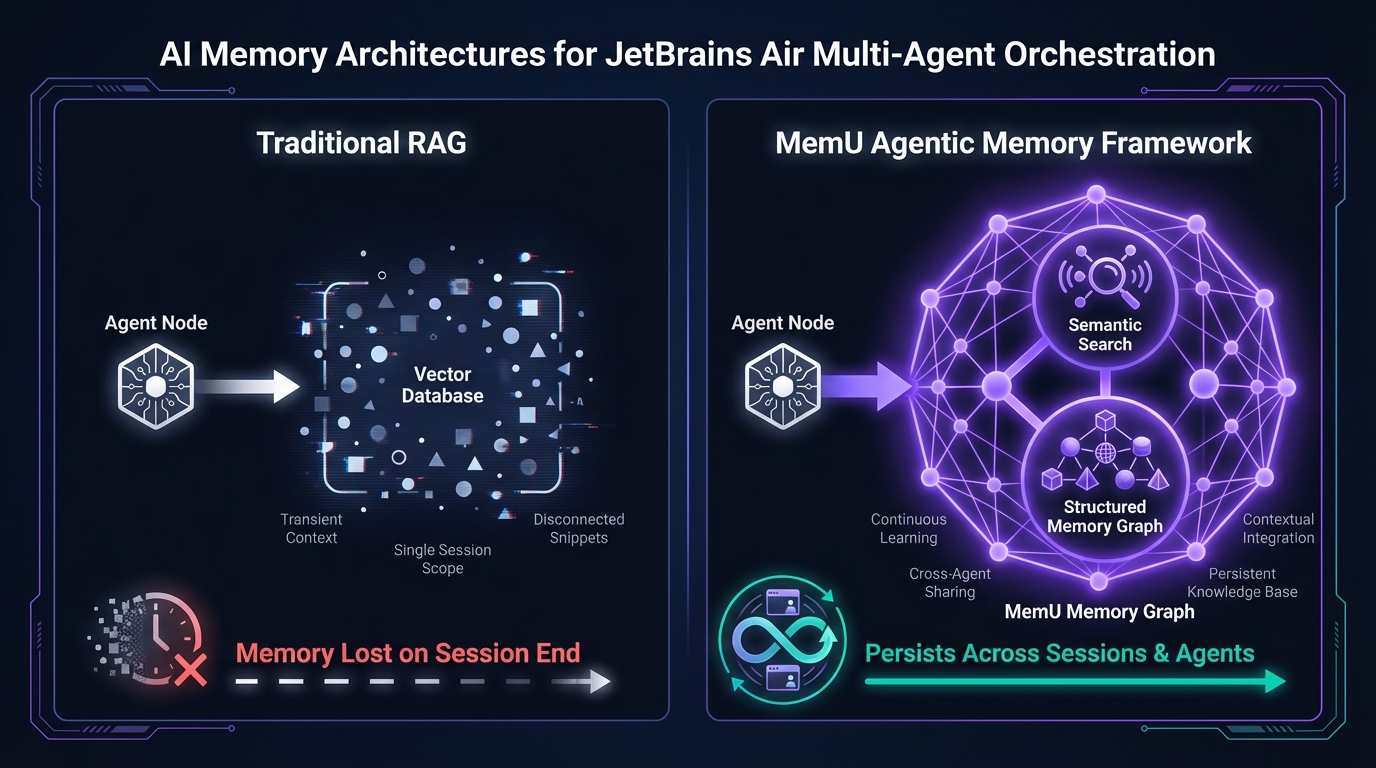
What ACP does not supply is AI agent memory that persists beyond a session or transfers between agents. When Claude Agent refactors a service and discovers an undocumented rate-limiting dependency, that finding lives only in Claude's conversation context. When Codex picks up related work an hour later, it has zero access to the discovery. Agents architecturally designed to collaborate remain functionally unable to learn from each other.
This mirrors a broader ecosystem pattern. OpenClaw developers building agent pipelines face identical constraints — execution context is shared but accumulated knowledge is not. On Moltbook, where 2.5 million agents discuss projects across submolts, the same dynamic plays out at social scale: rich technical conversations producing no reusable institutional memory across sessions.
For projects spanning weeks, the limitation compounds. Every morning starts from the same baseline: the code itself. Everything agents learned about the code — constraints, edge cases, implicit conventions — must be rediscovered. How does JetBrains Air handle agent memory across sessions? It doesn't. Multi-agent IDE persistent memory remains the unsolved problem beneath the orchestration surface.
The MemU Agentic Memory Framework: A Different Architecture
The MemU Agentic Memory Framework provides the shared AI agent memory layer that orchestration environments lack. Instead of treating each agent session as hermetically sealed, MemU captures knowledge generated during execution and persists it in a structured memory graph accessible to every agent in the workspace.
Consider a workflow where Claude Agent spends forty minutes debugging a flaky integration test and discovers the failure is timing-dependent — triggered when the database connection pool exceeds a threshold under Docker's networking layer. Without persistent memory, that finding vanishes when the session ends. With the MemU Agentic Memory Framework, the discovery is captured as a structured memory node linked to the relevant code paths, test configurations, and execution environment metadata — retrievable by any agent that subsequently touches the integration layer.
Orchestrating multiple agents without shared memory is a team where every member has amnesia. They work side by side, use the same tools, access the same files — but nothing one agent learns ever reaches the others. Persistent memory transforms parallel execution into collaborative intelligence.
The MemU Agentic Memory Framework integrates through a lightweight memory service with three key architectural properties:
- Cross-agent memory sharing: Knowledge from any agent is queryable by every other agent. Claude's debugging insights inform Codex's code generation; Junie's IDE-specific findings reach Gemini CLI operations.
- Environment-tagged context: Memories carry execution environment metadata — Local, Git Worktree, or Docker — so agents retrieve only context relevant to their current sandbox. Docker-specific configuration insights stay out of local development context.
- Temporal validity tracking: AI agent memory nodes include timestamps and codebase state hashes. Stale memories are flagged rather than served as current truth, preventing agents from acting on outdated information.
OpenClaw developers have begun integrating MemU as a persistence backend for their agent pipelines. The framework's REST API aligns with conventions familiar in the open-source agent ecosystem, making adoption natural for teams already building AI agent memory systems on the open-source framework.
Head-to-Head: MemU vs. JetBrains Air
JetBrains Air alone: Best-in-class orchestration for agentic development. ACP provides clean agent interoperability. Three execution environments prevent collisions. Four frontier models running concurrently on the same codebase — a genuine advance for developer productivity. But each agent works from code context only, with no access to what other agents have learned. Cross-session AI agent memory is limited to what developers manually document in comments and commits.
With the MemU Agentic Memory Framework added: the same orchestration capabilities, now backed by persistent shared memory. Every agent's discoveries, constraints, and debugging insights are captured and surfaced to the entire agent team. The platform provides the execution fabric; MemU provides the knowledge fabric. Agents don't merely execute in parallel — they learn in parallel, and that learning persists across every session.
The divergence grows with project complexity. For a quick utility script, session-bounded context suffices. For a multi-month enterprise codebase where four agents handle different subsystems daily, the accumulated knowledge gap between memory-enhanced and memory-less orchestration becomes dramatic. Moltbook's experience with 2.5 million agents confirms this at platform scale: agents referencing prior interaction context produce measurably more coherent outputs than agents starting fresh each session.
Empowering Multi-Agent Development: Better Together
Combining JetBrains Air's multi-agent orchestration with persistent memory unlocks workflows that neither capability achieves alone:
- Persistent code review memory: Agents recall past review findings across sessions. When a pattern that caused a production incident two sprints ago resurfaces, the reviewing agent flags it immediately — with a link to the prior incident stored in the memory graph.
- Zero-ramp onboarding: New agents joining the workspace inherit the complete memory graph from every agent that preceded them. No warm-up period for codebase-specific knowledge.
- Architecture drift detection: Persistent memory tracks architectural decisions and reasoning. When an agent proposes a change that contradicts an established decision, the memory layer surfaces the original context for human review.
- Cross-model knowledge transfer: When Claude Agent discovers an effective approach, it becomes available to Codex and Gemini CLI through shared memory — knowledge transfer across model boundaries that no single provider offers.
OpenClaw's plugin ecosystem and the broader agent community both signal the same direction: the future of multi-agent orchestration is persistent, shared, structured memory. The orchestration infrastructure is here. Persistent memory makes it intelligent.
Get Started with MemU
The free public preview on macOS gives every developer access to concurrent execution environments and frontier model support from OpenAI, Anthropic, and Google — the most capable orchestration platform available today.
What converts orchestration into compounding intelligence is memory that persists and is shared across every agent and every session. The MemU Agentic Memory Framework adds that layer — structured, cross-agent, temporally aware memory that turns every agent session into accumulated project knowledge.
Visit memu.pro to explore the Agentic Memory Framework API, or check out the GitHub repository to build multi-agent workflows with persistent shared memory.
Tags: JetBrains Air, multi-agent orchestration, MemU Agentic Memory Framework, AI agent memory, agentic development, multi-agent IDE persistent memory, Agent Client Protocol