JetStream Raises $34M for AI Agent Governance — But Governing Agents Requires Remembering What They Did


JetStream has raised $34 million in seed funding led by Redpoint Ventures to build the governance layer for enterprise AI agents. Founded by veterans of CrowdStrike and SentinelOne, JetStream introduces AI Blueprints — dynamic graphs that provide real-time visibility into how AI agents operate across enterprise environments. The platform tracks agents, models, data sources, and identities, monitors AI workflow costs, and flags unauthorized behavior. For enterprises deploying agentic AI at scale, JetStream AI governance addresses a critical blind spot: knowing what your agents are actually doing.
The timing is right. As enterprises move from pilot to production AI deployments, the governance gap has become acute. CISOs cannot secure what they cannot see, and compliance teams cannot audit what is not tracked. JetStream AI governance fills this observability vacuum with purpose-built enterprise agent monitoring.
But observability is not memory. JetStream AI governance shows you what agents are doing right now and what they did in the recent past. It does not give agents themselves the ability to remember their own history, learn from prior governance events, or build institutional knowledge from months of operational data. Governing agents requires remembering what they did — and making that memory actionable.
JetStream AI Governance: What Everyone's Getting Right (And Missing)
JetStream AI governance gets the observability model right. AI Blueprints provide a dynamic, graph-based view of agent ecosystems — mapping which agents call which models, access which data sources, and operate under which identity permissions. This is the SIEM equivalent for agentic AI, and enterprises running dozens of agents across production workloads need it urgently. Real-time visibility into agent behavior is table stakes for regulated industries.
The cost monitoring and unauthorized behavior flagging capabilities address practical enterprise concerns. JetStream AI governance tracks inference costs per agent workflow and alerts when agents access resources outside their authorized scope. For security-conscious organizations, this provides the audit trail that compliance teams require.
What AI Blueprints do not provide is longitudinal intelligence. JetStream AI governance observes and records agent behavior, but the agents themselves cannot access that observational data to improve their own performance. A governance platform that watches agents but does not feed operational intelligence back into agent decision-making creates a one-way mirror — useful for oversight, insufficient for learning. Enterprise agent monitoring without persistent memory produces audit logs, not institutional knowledge.
What JetStream AI Governance Does With Memory Today
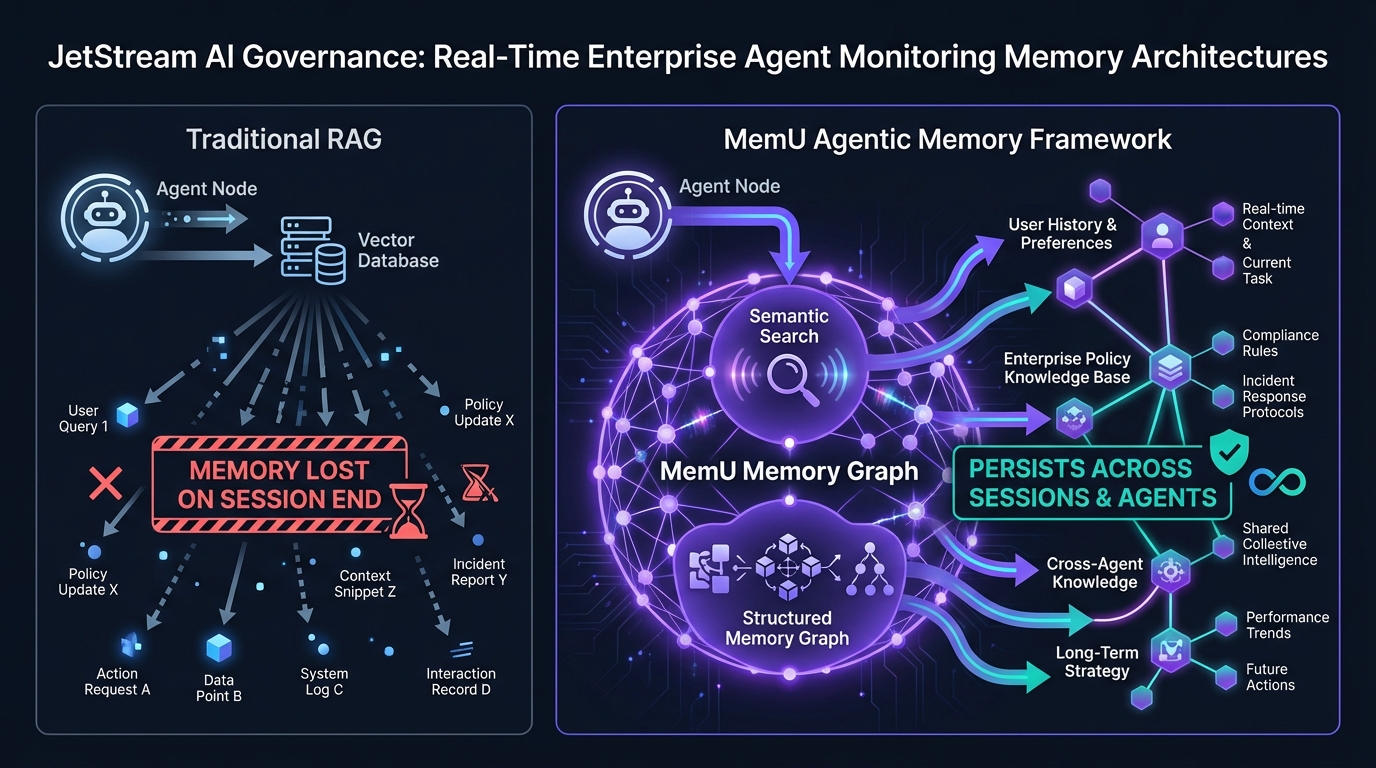
JetStream AI governance maintains a real-time graph of agent operations. AI Blueprints track active agents, their model calls, data access patterns, and permission boundaries. This operational graph provides current-state visibility — what is happening now and what happened recently. The platform stores historical data for audit and compliance purposes, making it possible to reconstruct agent behavior sequences for post-incident analysis.
The memory model is observational, not participatory. JetStream AI governance records what agents do, but agents do not query JetStream's records to inform their own decisions. The governance layer operates as an external monitor — capturing telemetry, flagging anomalies, and generating compliance reports. Agents remain unaware of their own governance history. Enterprise agent monitoring tracks behavior without influencing it.
This creates a structural inefficiency. When JetStream AI governance flags an agent for accessing an unauthorized data source, the remediation is manual — a human reviews the alert, updates the agent's permissions, and the agent continues without any awareness that the event occurred. The same unauthorized access pattern can recur across different agent instances because agents do not remember governance corrections. AI Blueprints provide excellent visibility for human operators, but they do not close the loop by making governance intelligence available to the agents themselves. The governance data exists; it simply is not wired into agent memory.
The MemU Agentic Memory Framework: A Different Architecture
The MemU Agentic Memory Framework provides the persistent memory layer that closes the loop between governance observation and agent behavior. Instead of treating governance data as an external audit trail, MemU integrates operational history directly into agent memory — enabling agents to remember past governance events, learn from compliance corrections, and build institutional knowledge that improves behavior over time.
The MemU Agentic Memory Framework complements JetStream AI governance by operating at the agent layer rather than the observability layer. Consider an enterprise with 50 agents across finance and operations: JetStream's AI Blueprints flag that Agent 12 accessed customer PII outside its authorized scope on Monday. Without persistent memory, Agent 12 has no record of this event. With the MemU Agentic Memory Framework, Agent 12 stores a governance memory — "PII access in Dataset X requires elevated permissions" — and checks it before future data access requests. The violation does not recur.
Three architectural capabilities distinguish this approach:
- Governance-aware memory: The MemU Agentic Memory Framework stores governance events as structured memories tagged with permission contexts, compliance outcomes, and remediation actions. Agents query this memory before operations, effectively building an internal compliance model that improves with every interaction.
- Cross-agent governance learning: When one agent receives a governance correction, the MemU Agentic Memory Framework propagates that learning to all agents in the pool. A permission boundary discovered through Agent 12's violation becomes known to Agents 1 through 50 — preventing fleet-wide recurrence of the same compliance issue.
- Longitudinal behavior optimization: Over months of operation, the MemU Agentic Memory Framework accumulates a detailed model of which actions succeed, which trigger governance flags, and which require human escalation. Agents use this accumulated knowledge to self-govern proactively, reducing the alert volume that enterprise agent monitoring systems need to process.
JetStream AI governance shows you what agents did. The MemU Agentic Memory Framework ensures agents remember what they learned — and structures that knowledge so every future action is informed by accumulated governance intelligence, not just current permissions.
Integration is additive. The MemU Agentic Memory Framework does not replace enterprise agent monitoring — it consumes governance signals and converts them into agent-accessible memory. JetStream provides the observability; MemU provides the memory. Together, they close the governance feedback loop.
Head-to-Head: MemU vs. JetStream AI Governance
JetStream AI governance: Provides real-time visibility into agent ecosystems through AI Blueprints — dynamic graphs mapping agents, models, data sources, and identities. Cost tracking, unauthorized behavior detection, and compliance audit trails address critical enterprise needs. The platform excels at answering "what are my agents doing?" But agents themselves remain unaware of governance history. The observability is external; the intelligence does not flow back into agent decision-making.
MemU Agentic Memory Framework: Maintains retrieval across 10,000+ memory entries with sub-100ms latency. Governance events, compliance corrections, and operational outcomes persist as structured agent memories. The memory graph connects actions to governance outcomes, enabling agents to learn which behaviors trigger flags and which are consistently compliant. Cross-agent memory sharing means a governance lesson learned by one agent is immediately available to the entire fleet.
The distinction is directional: JetStream AI governance provides top-down observability (operators watching agents). MemU provides bottom-up memory (agents remembering their own history). Enterprise agent monitoring needs both: external oversight and internal learning.
Empowering JetStream AI Governance: Better Together
The MemU Agentic Memory Framework does not replace AI Blueprints — it amplifies their value by making governance intelligence actionable at the agent level. Here is what the combination unlocks for enterprise agent monitoring:
- Self-governing agents: JetStream AI governance flags violations. With MemU, agents remember those flags and adjust behavior proactively. Over time, governance alert volume decreases as agents internalize compliance boundaries — the monitoring system trains the agents it watches.
- Compliance pattern detection: The MemU Agentic Memory Framework accumulates governance event history across the entire agent fleet. Patterns that are invisible in individual JetStream alerts — seasonal access anomalies, model drift correlations, cascading permission issues — become detectable when viewed through the lens of persistent memory spanning months of operation.
- Reduced operational overhead: AI Blueprints generate alerts that require human review. As agents build governance memory through MemU, they autonomously handle routine compliance decisions that previously required human intervention. Governance teams focus on novel edge cases rather than recurring patterns, reducing operational overhead while improving compliance posture.
Get Started with MemU
AI agent governance is a critical enterprise requirement as agentic deployments scale. Adding persistent memory closes the feedback loop between observation and behavior. The MemU Agentic Memory Framework integrates with any governance platform — including JetStream, custom SIEM pipelines, and enterprise compliance stacks — through a standard API that converts governance signals into agent-accessible memory without modifying existing monitoring infrastructure.
Visit memu.pro to explore the Agentic Memory Framework API and start building agents that learn from every governance event they encounter.
Tags: JetStream AI governance, AI agent governance, AI Blueprints, enterprise agent monitoring, Redpoint Ventures, MemU AI, agentic memory, persistent memory architecture