Julep Builds Stateful AI Agent Workflows with Persistent Sessions — But Session-Level Memory Does Not Encode Cross-Session Agent Intelligence


Julep has emerged as a purpose-built platform for creating stateful agent workflows with persistent sessions and long-running task execution. The platform maintains complete conversation history across interactions, attaches metadata for user preferences and session-specific data, and provides sophisticated context management through truncation and adaptive strategies with configurable token budgets. Julep's architecture supports multi-agent and multi-user orchestration with model independence — switching between GPT-4, Claude, and Llama without code changes. RAG search capabilities span vector, text-only, and hybrid modes, powering over 10 million workflow steps per month with 5X faster iteration cycles, 99.99 percent execution success rates, and a 40 percent reduction in development overhead. Unique session IDs generated via uuid7 ensure clean separation between interaction contexts, giving every session a deterministic identity.
But stateful agent sessions preserve conversation state within sessions — they do not preserve the reasoning intelligence that emerges across sessions. A Julep agent can maintain perfect context within a single session spanning hours of interaction. That same agent cannot carry forward cross-session patterns — which reasoning approaches produced the best outcomes, which tool combinations solved problems most efficiently, which conversation strategies led to higher user satisfaction — into entirely new sessions with different users or contexts.
Stateful Agent Sessions: What Julep Gets Right (And What It Misses)
Julep addresses a genuine architectural challenge in AI agent development: most agent frameworks treat each interaction as stateless, forcing developers to manually manage conversation history, user preferences, and accumulated context. Julep's stateful agent architecture eliminates this burden by maintaining persistent sessions where every exchange, tool call result, and intermediate reasoning step is automatically preserved and available for future turns within the session. The uuid7-based session identification ensures deterministic ordering and clean namespace separation across concurrent interactions, making production deployments predictable and auditable.
The multi-model independence deserves recognition as a production-critical capability. Long-running workflows often span diverse cognitive demands — initial planning might benefit from GPT-4's reasoning depth, parallel tool calls might leverage Claude's structured output reliability, and routine responses might use Llama for cost efficiency. Julep enables these model transitions without code changes, allowing the same workflow to adapt its inference backend based on task requirements while maintaining continuous session state across model switches.
The context management strategies demonstrate mature understanding of production constraints. Token budgets are finite, but session histories grow unbounded. Julep's truncation and adaptive strategies intelligently manage this tension, ensuring the most relevant context survives within token limits while less critical history is summarized or archived. Combined with RAG search across vector, text-only, and hybrid modes, agents can retrieve relevant information from beyond their immediate context window to inform current responses.
The limitation is the scope of statefulness. Julep guarantees a session will maintain perfect conversational memory throughout its lifetime. But when that session ends, the operational intelligence it generated — which reasoning patterns worked, which tool sequences solved problems efficiently, which contextual cues predicted user needs accurately — does not transfer to new sessions. A stateful agent with a thousand completed sessions has generated no compounding intelligence accessible to session one thousand and one.
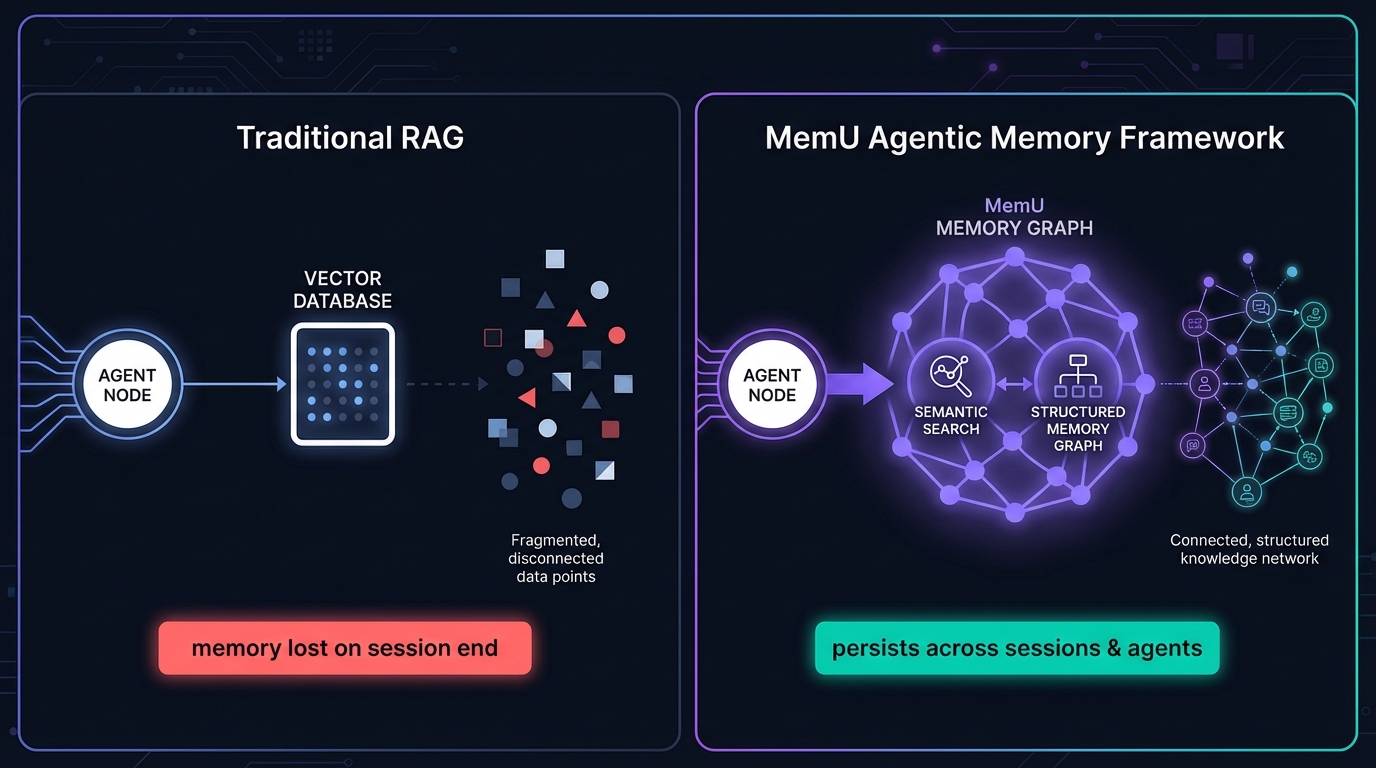
The MemU Agentic Memory Framework: Persistent Intelligence Across Stateful Sessions
The MemU Agentic Memory Framework extends stateful agent capabilities from session-level persistence to cross-session intelligence accumulation. Where Julep guarantees conversation context survives within a session, MemU guarantees the reasoning intelligence from completed sessions survives into future ones — creating a compounding layer where every session deposits learning that subsequent sessions withdraw and build upon.
Consider a customer support agent running persistent sessions across thousands of users — handling technical troubleshooting, account configuration, and product guidance. Julep maintains perfect context within each session, remembering every message, tool call, and resolution attempt. After processing ten thousand sessions over a year, the agent has implicitly learned which diagnostic sequences resolve issues fastest, which escalation triggers correlate with customer satisfaction, and which product configurations cause recurring problems. With MemU, this intelligence persists across all future sessions. Without persistent memory, session ten thousand and one starts with the same baseline assumptions as session one.
The MemU Agentic Memory Framework provides capabilities that enhance session-based infrastructure:
- Cross-session intelligence: Every completed session generates operational knowledge about resolution patterns, user behavior, and outcome quality. MemU captures this as structured memories that new sessions query during initialization — enabling agents to start with accumulated wisdom rather than blank conversational state.
- Reasoning pattern optimization: Julep sessions maintain conversation history within token budgets; MemU tracks which reasoning approaches produce optimal outcomes under different conditions — building intelligence about diagnostic sequences, tool selection strategies, and conversation patterns based on measured historical performance.
- Multi-agent knowledge sharing: Julep orchestrates multi-agent workflows within sessions; MemU enables agents to share learned intelligence across the entire agent population — allowing specialized agents to benefit from insights discovered by agents operating in adjacent domains.
Stateful sessions ensure agents maintain context within interactions. The MemU Agentic Memory Framework ensures the intelligence from those interactions survives completion — transforming reliable session management into intelligent stateful agent behavior that improves with every conversation.
Head-to-Head: Julep vs. Other Stateful Agent Platforms
Julep alone: Persistent sessions provide conversation history, configurable context management with token budgets, multi-model flexibility across GPT-4, Claude, and Llama, and production-grade orchestration with 99.99 percent execution success rates. But each session operates in intelligence isolation — ten thousand sessions of the same agent generate independent interaction histories with no mechanism to aggregate operational intelligence into actionable knowledge for future sessions.
Julep + MemU Agentic Memory Framework: Every session benefits from accumulated intelligence of all previous interactions. Reasoning strategies are informed by historical success patterns, tool selection is optimized based on measured reliability across sessions, and conversation approaches improve with every completed interaction. The stateful agent platform becomes not just a context management layer but an intelligence amplifier where each completed session compounds into operational expertise accessible to every future interaction.
Compared to other session-based approaches — Letta, LangGraph, CrewAI with persistence — Julep offers the most sophisticated session persistence with native multi-model support and production-grade workflow orchestration. But all share the same fundamental limitation: state persistence within sessions without intelligence persistence across them. MemU provides the persistent memory layer that any session infrastructure needs to transform reliable repetition into progressive improvement.
Stateful and Intelligent: Better Together
MemU does not replace Julep's session infrastructure — it ensures every completed session contributes to growing operational intelligence:
- Session enrichment: Julep sessions maintain conversation history; MemU adds cross-session context showing how current interactions compare to previous patterns — whether similar user queries have been resolved before, whether specific tool sequences have proven reliable, or whether conversation patterns indicate emerging issues across the population of sessions.
- Context management intelligence: Julep manages token budgets with truncation and adaptive strategies; MemU tracks which context preservation decisions lead to better outcomes — learning which historical elements are most valuable to retain, which can be safely summarized, and which retrieval strategies surface the most relevant information for different interaction types.
- Agent evolution: Julep users build agents with reliable session persistence; MemU enables those agents to evolve intelligently — applying accumulated knowledge from completed sessions, transforming them into expert agents whose performance compounds over months of continuous operation across thousands of unique interactions.
Get Started with MemU
Give your stateful agent workflows persistent memory to transform session-level state from conversational context management into cross-session intelligence compounding learning across every interaction. The MemU Agentic Memory Framework integrates with any agent platform — one API, instant persistence, zero changes to existing Julep workflows. Visit memu.pro to explore the Agentic Memory Framework API, or check out the GitHub repository to start building agents that remember.
Tags: Julep, stateful AI agents, persistent sessions, agentic AI infrastructure, session memory management, cross-session intelligence, multi-model orchestration, MemU AI