Kai Cyber Raises $125M for Autonomous AI Security Agents — But Agents That Forget Attack Patterns Can't Defend Against Them

Kai Cyber: What Everyone's Getting Right (And Missing)
Kai Cyber launched in March 2026 with a $125 million funding round and a clear mission: autonomous AI agents that monitor networks, detect threats, and execute defensive actions without human intervention. Founded by former Claroty and SecurityMatter executives, the platform has already signed large customers across energy, pharmaceuticals, automotive, and hospitality. The pitch resonates — AI-powered attacks move faster than human response times, so autonomous defense agents are the logical counterweight.
The developer community on OpenClaw has experimented with security agent pipelines for months. On Moltbook, threat-intelligence submolts discuss how agents can correlate indicators across logs, endpoints, and network flows. But a foundational layer every security agent stack depends on is still underspecified — memory.
What Kai Cyber Does With Memory Today
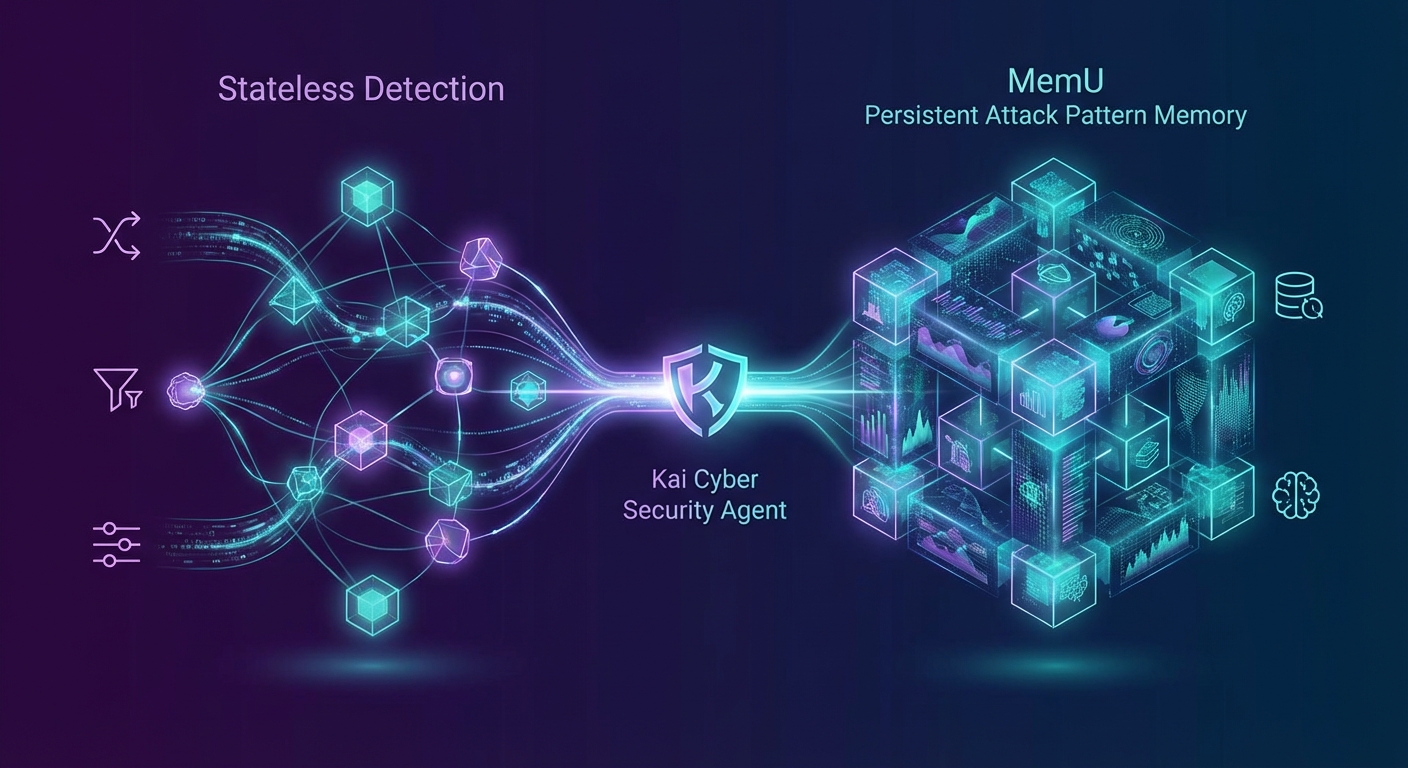
Kai Cyber and similar autonomous security platforms operate on real-time event streams. Agents analyze incoming signals, correlate them against known patterns, and trigger responses when thresholds are exceeded. The architecture handles detection and remediation in a single pipeline — a meaningful improvement over manual SOC workflows.
The gap: each incident investigation and response cycle is session-bounded. When an agent determines that a lateral movement pattern matches an APT toolkit, that finding lives only in the current analysis context. Threat agents that forget attack patterns across sessions cannot build institutional detection intelligence. The next time a similar pattern appears — perhaps weeks later, perhaps in a different segment — the agent starts from zero. Quantro Security's VM.Analyst and other agent-driven vulnerability tools share this constraint: point-in-time analysis without persistent pattern memory.
For defenders, the asymmetry is painful. Attackers learn from prior campaigns. Defenders reset after every incident. OpenClaw pipelines and Moltbook's security-focused agents both run into the same wall: no structured persistence layer for threat intelligence that compounds across investigations.
The MemU Agentic Memory Framework: A Different Architecture
The MemU Agentic Memory Framework provides the persistence layer that autonomous security agents lack. Instead of treating each incident as an isolated event, MemU captures investigation findings, pattern matches, and remediation outcomes in a structured memory graph accessible to every subsequent agent run.
Consider an agent that spends two hours tracing a credential-stuffing campaign across three segments. It identifies the attack vector, the compromised asset, and the remediation that stopped the spread. Without persistent memory, that entire investigation vanishes. With MemU, the findings become queryable nodes — linked to asset IDs, time ranges, and remediation actions — so the next similar incident triggers immediate recall of the prior response.
Security agents that analyze in real-time but forget in between runs are reactive, not adaptive. Persistent threat memory turns every investigation into accumulated intelligence that sharpens the next.
Integration is straightforward. The MemU Agentic Memory Framework exposes REST APIs compatible with OpenClaw, LangChain, and custom agent pipelines. Security agents write investigation outcomes and threat patterns; retrieval enriches the next run with historical context. Dual-mode retrieval — semantic search plus structured memory graphs — ensures both fuzzy pattern matching and exact asset-relationship queries.
Head-to-Head: MemU vs. Session-Bounded Security Agents
Kai Cyber and similar platforms alone: Autonomous detection and response with real-time correlation. Agents execute defensive actions without waiting for human approval — a genuine advance for incident response speed. But every incident starts with the same baseline. No memory of prior investigations, no learned patterns, no compounding threat intelligence across the organization.
Kai Cyber + MemU Agentic Memory Framework: The same autonomous pipeline, now backed by persistent threat memory. Agents recall past attack patterns, successful remediations, and false-positive signatures. Incident N benefits from investigations 1 through N-1. Detection精度 improves as the memory graph grows.
Moltbook's security agents demonstrate the pattern: those with access to persistent context produce more coherent threat assessments than agents starting fresh each session. The principle scales to enterprise deployments.
Empowering Kai Cyber: Better Together
Combining autonomous security agents with persistent memory unlocks capabilities neither achieves alone:
- Campaign correlation: Agents remember attack campaigns across weeks and segments. When a second wave hits, the agent surfaces the first-wave findings and remediation history immediately.
- False-positive learning: Persistent memory tracks which alerts were investigated and dismissed. Over time, agents reduce noise by not re-escalating known benign patterns.
- Remediation effectiveness: Memory stores which fixes worked. When a vulnerability resurfaces, agents recommend proven remediation from prior incidents.
Get Started with MemU
Kai Cyber's $125M launch signals enterprise confidence in autonomous security. What completes the architecture is memory that persists — threat patterns, investigation outcomes, and remediation knowledge that compound across every incident.
The MemU Agentic Memory Framework adds that layer. One API, zero lock-in, immediate continuity for your security agent stack. Visit memu.pro to explore the Agentic Memory Framework API, or check out the GitHub repository to build security agents that remember.
Tags: Kai Cyber, AI security agents, autonomous threat detection, MemU Agentic Memory Framework, agent memory, OpenClaw, Moltbook