JetBrains Launches Koog — An Open-Source Java AI Agent Framework for Enterprise, But Enterprise Agents Without Persistent Memory Restart from Zero After Every JVM Shutdown


JetBrains launched Koog on March 17, 2026 — an open-source, JVM-native AI agent framework built in Kotlin with full Java interoperability. Designed for enterprise teams already invested in the JVM ecosystem, Koog delivers multiple workflow strategies — functional chains for simple sequences, graph-based orchestration for complex pipelines, and planning for autonomous goal pursuit. The framework integrates natively with Spring Boot, supports all major LLM providers including OpenAI, Anthropic, Google, DeepSeek, and Ollama, and features fault tolerance with persistence to recover from failures without repeating expensive LLM calls. OpenTelemetry observability comes built in with Langfuse and Weights & Biases Weave integration. History compression optimizes token consumption across extended conversations. Intuitive @Tool and @LLMDescription annotations, fluent builder-style APIs for Java, and Kotlin Multiplatform support extending reach to JavaScript, WebAssembly, and iOS round out a remarkably complete enterprise offering.
But enterprise-grade reliability without persistent memory creates a fundamental gap. A Koog agent that processes thousands of enterprise requests — learning optimal tool routing, refining planning strategies, discovering which graph-based workflow patterns deliver the strongest outcomes — loses all of that operational intelligence when the JVM shuts down. Enterprise agents that forget after every restart are agents that never mature beyond their initial deployment configuration.
Koog: What the Enterprise Gets Right (And What It Misses)
Koog represents JetBrains at its best: deeply thoughtful developer tooling that makes complex infrastructure accessible without sacrificing power. The multiple workflow strategies give enterprise teams genuine architectural flexibility. Functional chains handle straightforward request-response patterns. Graph-based orchestration manages complex multi-step pipelines with branching and merging. Planning agents pursue autonomous goals with dynamic strategy adjustment. Rather than forcing teams into one paradigm, Koog lets architecture match the problem.
Spring Boot integration dramatically reduces enterprise adoption friction. Java organizations can deploy Koog agents into existing service meshes and deployment pipelines without retooling. The fault tolerance design shows genuine enterprise awareness — persisting intermediate state so agents recover from infrastructure failures without repeating LLM calls that might cost several dollars per planning step. OpenTelemetry observability with Langfuse and W&B Weave provides the production monitoring enterprise operations teams require. History compression keeps token costs manageable across extended agent conversations.
What Koog does not address is the difference between fault recovery persistence and true operational memory. Fault tolerance saves progress within a session so a crashed agent can resume. But the agent that learned which planning strategy works best for procurement workflows, or discovered that graph-based orchestration outperforms functional chains for multi-department approval pipelines, or identified that DeepSeek produces more cost-effective results for document classification while Anthropic excels at contract analysis — that intelligence vanishes when the JVM stops. Other enterprise Java frameworks share this fundamental limitation: they persist state for reliability while treating learned behavior as disposable.
The MemU Agentic Memory Framework: Persistent Intelligence for Enterprise Agents
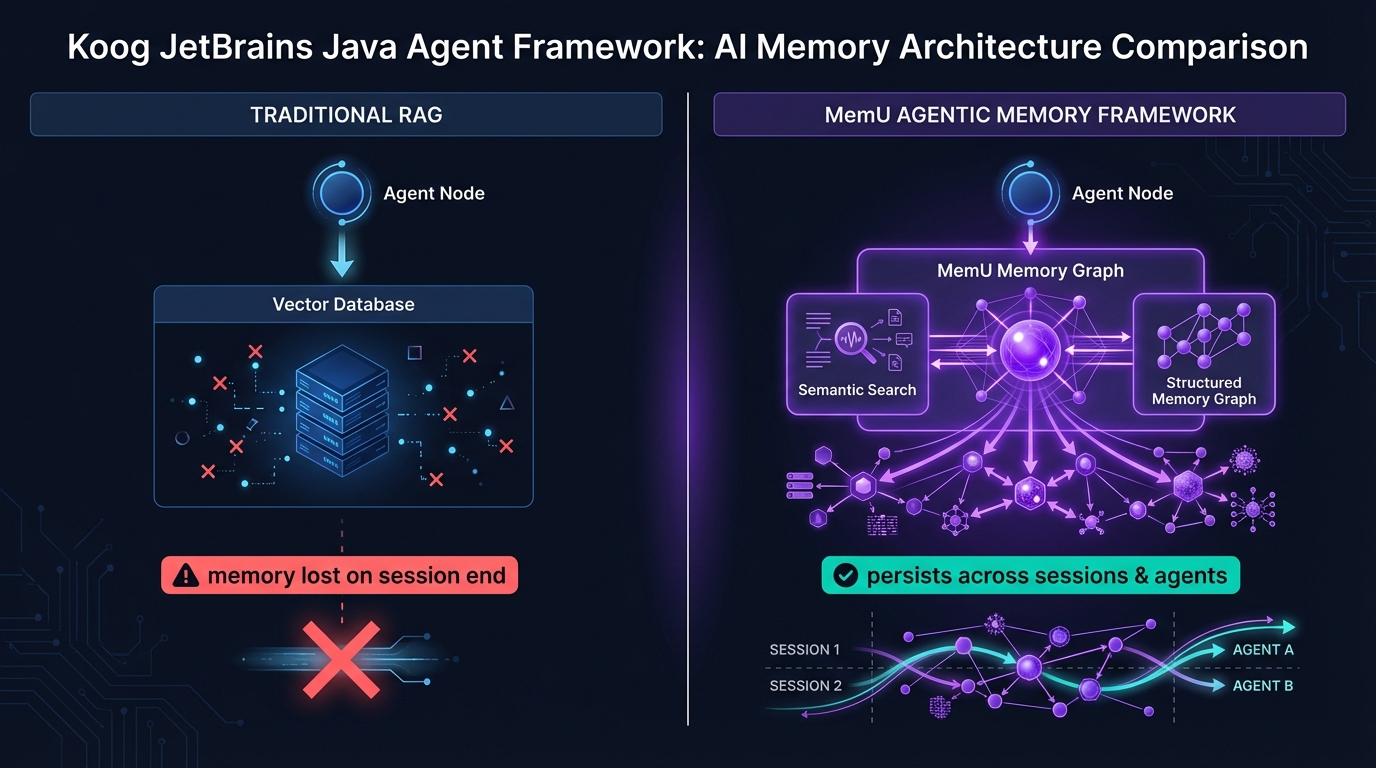
The MemU Agentic Memory Framework provides the persistent intelligence layer that transforms Koog from a fault-tolerant execution engine into a continuously learning enterprise system. Instead of treating each JVM lifecycle as isolated, MemU captures operational intelligence — workflow strategy effectiveness, tool selection patterns, planning optimizations, and cross-provider performance — storing it in a structured memory graph that persists across JVM restarts, blue-green deployments, and infrastructure migrations.
Consider a Koog agent managing enterprise procurement workflows across a large manufacturing organization. Without persistent memory, each JVM restart initializes with default configurations. With the MemU Agentic Memory Framework, the agent recalls operational history: graph-based workflows complete procurement approvals thirty percent faster than functional chains for multi-department requests, the DeepSeek provider delivers more cost-effective responses for document classification while Anthropic produces better results for contract negotiation analysis, and planning agents resolve complex vendor negotiations more effectively when initialized with a three-step constraint decomposition learned from processing two thousand prior negotiations. That accumulated intelligence loads at startup, turning every deployment into a continuation rather than a fresh start.
The framework addresses three core limitations of session-bounded enterprise agents:
- Workflow strategy optimization: With functional, graph-based, and planning strategies available, choosing the right approach depends on context. The MemU Agentic Memory Framework captures which strategies produced the best results for specific enterprise domains, enabling informed architecture selection from the first request after every restart.
- Cross-provider intelligence: Supporting all major LLM providers means optimal selection varies by task type. Persistent memory preserves which providers delivered the best accuracy, cost efficiency, and latency characteristics for each category of enterprise work.
- Planning refinement: Koog planning agents develop effective strategies through operational experience. The MemU Agentic Memory Framework preserves which planning decompositions, goal structures, and constraint-handling approaches produced optimal outcomes across thousands of prior executions.
An enterprise agent that recovers from infrastructure faults but cannot recover from operational forgetting is only half-reliable. The MemU Agentic Memory Framework gives Koog agents persistent memory that matches their enterprise-grade fault tolerance.
Integration with Koog leverages the framework's REST APIs through the extensible @Tool annotation system. At JVM startup, accumulated intelligence loads from the memory graph into the agent context. During execution, agents query persistent memory for insights on similar past tasks. At shutdown, new operational discoveries are stored. The memory layer operates alongside Koog's existing fault tolerance, adding persistent intelligence without impacting enterprise performance characteristics.
Head-to-Head: Fault-Tolerant Agents vs. Memory-Enhanced Enterprise Agents
Koog alone: A first-class enterprise Java agent framework from JetBrains — JVM-native, open-source, multiple workflow strategies, Spring Boot integration, all major LLM providers, fault tolerance with persistent recovery, OpenTelemetry observability, history compression, and Kotlin Multiplatform reach. Fault recovery persistence maintains progress within active sessions. But every JVM restart initializes agents from default configurations, discarding accumulated operational intelligence.
Koog + MemU: The same enterprise architecture, now backed by persistent operational memory. Agents start each JVM lifecycle with accumulated intelligence about workflow strategy selection, provider optimization, and planning effectiveness. The system becomes measurably more accurate and cost-efficient with each deployment cycle — not just reliable in the face of faults, but increasingly intelligent across restarts.
For enterprise systems processing continuous workloads across daily deployment cycles, the compounding effect is transformative. A Koog deployment backed by months of persistent memory operates with the precision of a deeply tuned enterprise system, while a freshly initialized instance requires weeks of operational experience to reach equivalent effectiveness through trial and rediscovery.
Empowering Koog: Better Together
The combination of Koog's enterprise Java architecture and MemU's persistent memory unlocks capabilities neither achieves independently:
- Adaptive workflow strategy routing: Persistent memory reveals which workflow strategy — functional, graph-based, or planning — performs best for each category of enterprise task, eliminating the discovery period that follows every JVM restart.
- Cross-platform intelligence portability: When Koog deploys to JavaScript or WebAssembly targets via Kotlin Multiplatform, persistent memory travels with the agent. Intelligence developed on JVM servers becomes immediately available in edge deployments without retraining.
- Provider cost optimization over time: Persistent memory tracks which LLM providers deliver the best accuracy-to-cost ratio for specific task categories, enabling continuous budget optimization that improves with every deployment cycle rather than resetting.
Persistent memory transforms Koog from a reliable enterprise agent framework into a continuously learning enterprise intelligence system — where every interaction compounds organizational knowledge across the entire JVM lifecycle.
Get Started with MemU
JetBrains has built a genuinely enterprise-ready agent framework with Koog — JVM-native, open-source, multi-strategy, fault-tolerant, and observable from day one, with the Spring Boot integration and Kotlin Multiplatform reach that enterprise Java teams need.
The next step is giving those enterprise agents persistent operational memory. The MemU Agentic Memory Framework provides that foundation — API-based integration through Koog's @Tool annotation system, dual-mode retrieval with semantic search and structured memory graphs, and cross-deployment persistence that turns enterprise agents into compounding intelligence systems.
Visit memu.pro to explore the Agentic Memory Framework API, or check out the GitHub repository to start building enterprise agents that remember.
Tags: Koog, JetBrains, Java agents, enterprise AI, agent framework, agent memory, MemU AI, LLM memory, Kotlin agents