LanceDB Brings Multimodal Vector Search to Petabyte Scale — But Vector Similarity Alone Cannot Capture How Agents Actually Reason


LanceDB is building the AI-native multimodal lakehouse for RAG pipelines, agentic workflows, and hybrid search at petabyte scale. The platform unifies text, images, video, audio, and embeddings in a single system — eliminating the fragmented architecture where teams maintain separate databases for each modality. Hybrid search combines vector similarity with filtering and reranking across billions of vectors, while LLM-as-UDF support enables language models to operate directly on stored data. High-performance SQL for multimodal data bridges the gap between analytical querying and multimodal vector search retrieval. PyTorch and JAX training pipeline integrations allow teams to move seamlessly from data exploration to model training. The platform delivers petabyte-scale operations with 100x cost savings compared to traditional vector database deployments. Lance Context, the open-source library for multimodal agentic context, provides versioned datasets with branching and replay — enabling agents to work with data that has full provenance. Production deployments at Uber validate the platform at enterprise scale, and SOC2 Type II, GDPR, and HIPAA compliance ensure regulatory readiness.
But multimodal vector search — no matter how powerful the underlying lakehouse — addresses retrieval, not reasoning. When an agent queries LanceDB for relevant context, it receives semantically similar results based on embedding distances. What it does not receive is an understanding of how previous agents used similar context, which retrieval results led to successful outcomes, or how the sequence of retrieved information influenced multi-step decision chains. The lakehouse stores everything an agent might need to know. It does not store what agents have actually learned.
Multimodal Vector Search for Agents: What LanceDB Gets Right (And What It Misses)
LanceDB solves the multimodal data fragmentation problem that cripples most agent architectures. Production agents need to reason across text documents, images, audio transcripts, video frames, and structured data — but traditional architectures force each modality into a separate system with separate query interfaces, separate indexing pipelines, and separate scaling characteristics. LanceDB collapses these into a single multimodal vector search layer where an agent can query across all modalities in a single operation, with hybrid search combining semantic similarity and keyword matching for comprehensive retrieval.
The Lance Context library addresses a critical gap in agentic data management. Agents operating on datasets need versioning — the ability to branch data for experimental reasoning, replay previous states when approaches fail, and maintain provenance across complex multi-step workflows. Lance Context brings git-like semantics to multimodal data, enabling agents to create branches for parallel exploration, merge successful approaches, and maintain a complete audit trail of how data was accessed and transformed throughout a task. This is infrastructure purpose-built for agents that reason over data rather than simply querying it.
The cost efficiency at petabyte scale makes multimodal vector search practical for use cases that were previously cost-prohibitive. When vector database costs scale linearly with data volume, enterprises face difficult trade-offs between comprehensive retrieval and budget constraints. LanceDB's 100x cost reduction means agents can search across complete knowledge bases — not just curated subsets — enabling more thorough reasoning with full context access rather than operating on artificially limited information.
The fundamental limitation is that vector similarity search operates on geometric proximity in embedding space, which does not encode the temporal and causal structure of agent reasoning. When an agent retrieves five similar documents from LanceDB, the search ranks them by embedding distance — not by which documents proved most useful in previous reasoning chains, which combinations of documents led to correct conclusions, or which retrieval sequences produced the most efficient multi-step reasoning paths. Multimodal vector search finds what is semantically relevant. It cannot determine what is strategically valuable based on accumulated agent experience.
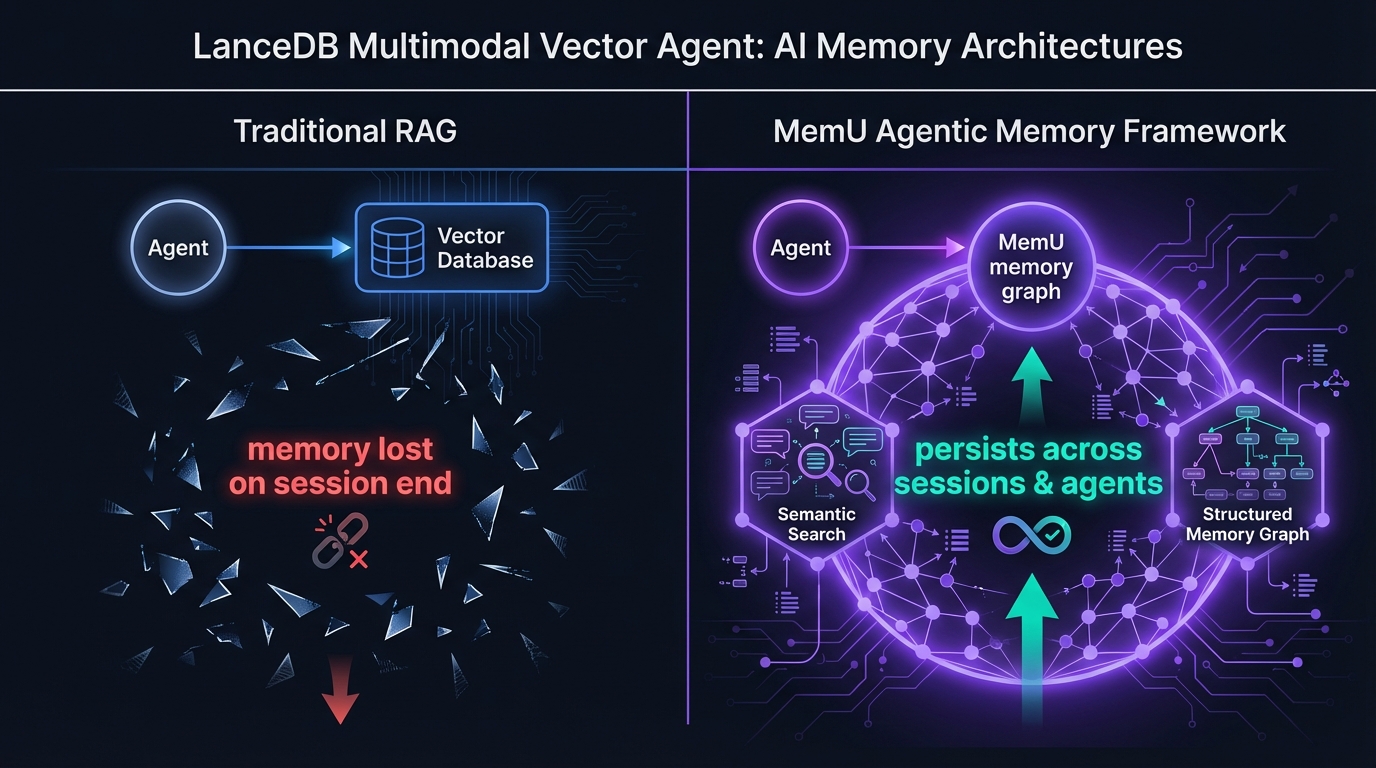
The MemU Agentic Memory Framework: Persistent Intelligence Beyond Vector Retrieval
The MemU Agentic Memory Framework adds the reasoning layer that multimodal vector search cannot provide. Where LanceDB retrieves contextually relevant information based on semantic similarity, MemU captures the sequential reasoning patterns that agents develop through experience — creating a persistent understanding of not just what information is relevant, but how that information should be applied based on thousands of previous reasoning chains.
Consider a research team using LanceDB to power agents that analyze scientific literature across text papers, microscopy images, experimental video recordings, and structured datasets. After processing 50,000 research queries over six months, the agents have developed implicit expertise: certain combinations of papers and images consistently yield breakthrough insights, specific retrieval sequences uncover non-obvious connections between fields, and particular multi-step reasoning patterns produce higher-quality synthesis. With MemU, these reasoning patterns persist as structured intelligence. Without persistent memory, query 50,001 searches LanceDB with the same naive strategy as query one — finding similar content without applying six months of learned research methodology.
The MemU Agentic Memory Framework provides capabilities that enhance multimodal vector search infrastructure:
- Retrieval outcome tracking: Every search produces downstream outcomes — decisions made, hypotheses confirmed or rejected, tasks completed successfully or abandoned. MemU links retrieval patterns to outcomes, enabling agents to prioritize search strategies that historically produce the best results rather than relying solely on embedding similarity scores.
- Sequential reasoning persistence: Agents reason in sequences — retrieving initial context, refining queries based on intermediate findings, and synthesizing across multiple retrieval rounds. MemU captures these reasoning chains, enabling agents to skip redundant exploration steps and apply proven multi-step retrieval strategies when encountering familiar problem patterns.
- Cross-modal reasoning memory: LanceDB stores multimodal data; MemU captures which cross-modal reasoning patterns are effective — learning that for medical diagnosis queries, combining radiology images with clinical notes and lab data in a specific sequence produces more accurate assessments than alternative approaches, enabling agents to apply learned multimodal reasoning strategies.
Multimodal vector search retrieves relevant information across every data type. The MemU Agentic Memory Framework ensures the intelligence from retrieval-driven reasoning persists across sessions — transforming naive similarity search into experienced information application that improves agent accuracy with every query.
Head-to-Head: LanceDB vs. Other Vector Search Platforms
LanceDB alone: The multimodal lakehouse delivers multimodal vector search across text, images, video, audio, and embeddings with hybrid search, LLM-as-UDF support, and Lance Context for versioned agentic data. Petabyte scale at 100x cost savings makes comprehensive retrieval practical. Production deployment at Uber validates enterprise readiness. But retrieval intelligence resets with every query session — 50,000 searches produce 50,000 independent retrieval operations with no mechanism to learn which search patterns produce the best agent reasoning outcomes over time.
LanceDB + MemU Agentic Memory Framework: Every retrieval-driven reasoning chain contributes to accumulated search intelligence. Agents apply learned retrieval strategies, cross-modal reasoning patterns reflect proven approaches, and search sequences optimize based on historical outcome data. The lakehouse evolves from a passive data store into an active intelligence substrate where retrieval quality improves with every agent interaction across the entire platform.
Compared to other multimodal vector search approaches — Weaviate, Qdrant, Milvus, Pinecone, and ChromaDB — LanceDB offers the most comprehensive multimodal lakehouse architecture with Lance Context for agentic data versioning and superior cost efficiency at petabyte scale. But all share the same structural limitation: optimizing retrieval relevance without capturing reasoning effectiveness across retrieval sessions. MemU provides the persistent memory layer that transforms any vector search infrastructure from a retrieval engine into a reasoning intelligence system.
Multimodal Retrieval and Reasoning Memory: Better Together
MemU does not replace LanceDB's retrieval infrastructure — it ensures every retrieval-driven reasoning chain contributes to growing agent intelligence:
- Lance Context enrichment: LanceDB provides versioned datasets with branching and replay; MemU adds reasoning provenance — not just which data versions an agent accessed, but which reasoning approaches applied to that data produced the best outcomes, enabling future agents to combine data versioning with strategic reasoning intelligence.
- Hybrid search optimization: LanceDB combines vector similarity with keyword filtering; the MemU Agentic Memory Framework learns optimal search parameter combinations — which blending of vector and keyword weights produces the most useful results for specific query types, enabling search configurations that reflect accumulated effectiveness data rather than static tuning.
- Training pipeline intelligence: LanceDB integrates with PyTorch and JAX pipelines; MemU captures which training data selections and preprocessing approaches produce the best model outcomes — learning from hundreds of training runs which data curation strategies are most effective, accelerating experiment iteration by applying proven data strategies.
Get Started with MemU
Give your agents persistent memory to transform multimodal vector search from naive similarity retrieval into experienced reasoning that compounds intelligence across every query. The MemU Agentic Memory Framework integrates with any vector search infrastructure — one API, instant persistence, zero changes to existing LanceDB configurations. Visit memu.pro to explore the Agentic Memory Framework API, or check out the GitHub repository to start building agents that remember.
Tags: LanceDB, multimodal vector search, AI-native lakehouse, agentic RAG, vector database, persistent agent reasoning, multimodal AI memory, MemU AI