LangChain Deep Agents Tackle Long-Horizon Tasks — But Within-Execution Persistence Without Cross-Deployment Memory Means Intelligence Resets Every Run

LangChain Deep Agents: What the Framework Gets Right and Where It Stops
LangChain Deep Agents arrived on March 11, 2026 as a purpose-built framework for long-horizon, multi-step tasks that demand sustained reasoning. Built on LangGraph, Deep Agents introduces a planning-first architecture where agents decompose complex goals into structured execution plans, delegate to subagents with isolated context windows, and persist intermediate artifacts in a virtual filesystem. The MIT-licensed open-source release hit 42.65% on Terminal Bench 2.0 — a benchmark that measures exactly the kind of extended, real-world terminal workflows that most agent frameworks fail at.
The framework's core innovation is the write_todos planning tool, which forces agents to formalize their execution strategy before acting. Rather than streaming tokens and hoping for coherence across dozens of steps, Deep Agents creates explicit task graphs. Each subagent receives its own sandboxed shell execution environment and an isolated context window, preventing the cross-contamination that plagues flat agent architectures. A virtual filesystem provides persistent storage within a single execution — files written in step three are available in step thirty.
Context compression with auto-summarization keeps the agent functional across sessions that would normally overflow context windows. When the working memory grows too large, Deep Agents compresses prior steps into summaries while preserving the virtual filesystem as ground truth. This means the agent can handle tasks that span hundreds of tool calls without losing coherence within a single run.
But there's a hard boundary: when that run ends, everything resets.
What Deep Agents Does With Memory Today
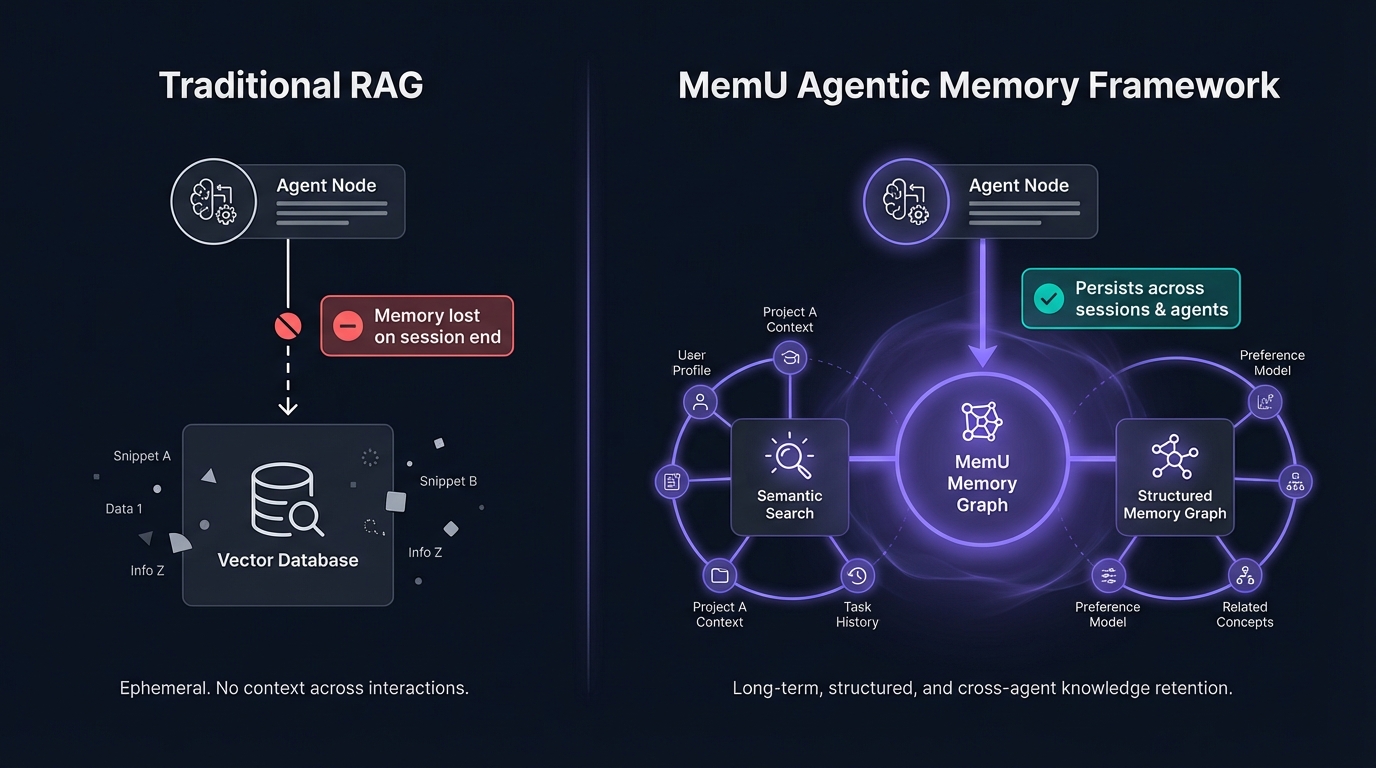
LangChain Deep Agents solves within-execution persistence elegantly. The virtual filesystem holds artifacts, the auto-summarization preserves reasoning history, and the todo-based planning creates a recoverable execution graph. Inside a single long-horizon task, these mechanisms work. An agent debugging a codebase across fifty shell commands maintains coherence because the filesystem anchors its state and the summaries preserve its reasoning chain.
What the framework does not solve is cross-deployment memory. When the task completes and the agent shuts down, the virtual filesystem is gone. The planning patterns the agent discovered — which decomposition strategies worked for which problem types — evaporate. The context compression summaries, which represent distilled intelligence about the task domain, disappear. Deep Agents builds impressive within-run persistence but treats every deployment as a clean slate.
This matters for teams using Deep Agents on recurring tasks. A DevOps team using the framework to debug production incidents re-teaches the agent their infrastructure patterns every time. A research team running multi-step data analysis pipelines loses every optimization the agent discovered in prior runs. The 42.65% Terminal Bench score represents the agent's capability on any single attempt — it never improves to 50% or 60% from accumulated experience because there is no accumulation mechanism.
The virtual filesystem is a local artifact store, not a memory system. It holds files, not knowledge. And the auto-summarization compresses for the current context window, not for future retrieval. Long-horizon execution without long-horizon learning means the agent handles complex tasks but never gets better at handling them.
The MemU Agentic Memory Framework: Persistence That Compounds
The MemU Agentic Memory Framework provides the cross-deployment memory layer that Deep Agents and similar long-horizon frameworks lack. Where Deep Agents manages within-execution state through virtual filesystems and context compression, MemU manages what persists and compounds across every execution.
Within-execution persistence keeps agents coherent during a task. Cross-deployment memory makes agents smarter across tasks. Long-horizon intelligence requires both — coherent execution and compounding knowledge.
Consider a Deep Agents workflow debugging a microservices deployment: the agent identifies that service A's timeout configuration conflicts with service B's retry policy. With the MemU Agentic Memory Framework, that architectural insight persists. The next debugging run starts with the knowledge that these two services have a known interaction pattern. The agent doesn't rediscover the conflict — it builds on prior understanding.
The MemU Agentic Memory Framework integrates via REST API alongside any LangGraph-based system, including Deep Agents. Key architectural properties:
- Execution-to-knowledge extraction: Virtual filesystem artifacts, planning patterns, and auto-summaries from Deep Agents runs feed into MemU's structured memory graph. Files become knowledge; task decompositions become reusable strategies.
- Cross-deployment retrieval: Before a new Deep Agents execution begins, MemU surfaces relevant prior experiences — similar tasks, successful decomposition patterns, domain-specific insights the agent previously discovered.
- Structured knowledge graph: Not just vector embeddings — entities, relationships, decisions, and outcomes link in a queryable graph. Agents ask "what debugging strategies worked for timeout issues" and get structured, actionable answers from past runs.
Head-to-Head: MemU vs. Deep Agents Alone
Deep Agents alone: Impressive within-execution persistence. The write_todos planner decomposes complex goals, subagents execute with isolated context, the virtual filesystem anchors state, and auto-summarization maintains coherence across hundreds of tool calls. The 42.65% Terminal Bench score demonstrates real capability on long-horizon tasks. But every deployment is stateless. No cross-project learning, no accumulated debugging patterns, no compounding intelligence. The thousandth run has the same starting knowledge as the first.
Deep Agents + MemU Agentic Memory Framework: The same long-horizon execution architecture, now backed by persistent cross-deployment memory. Every successful decomposition strategy gets preserved. Debugging patterns compound across incidents. The virtual filesystem's artifacts feed a knowledge graph that future runs draw from. Long-horizon agents transform from capable-but-amnesiac executors into systems that genuinely improve with experience. The hundredth debugging run benefits from ninety-nine prior runs' accumulated insights.
Empowering Deep Agents: Better Together
Combining Deep Agents' long-horizon execution with the MemU Agentic Memory Framework unlocks workflows neither system achieves alone:
- Adaptive task decomposition: The write_todos planner retrieves successful decomposition patterns from prior runs. Similar problems inherit proven strategies instead of planning from scratch every time.
- Cumulative infrastructure knowledge: DevOps agents remember past incidents, service interaction patterns, and configuration relationships. Each debugging session builds on prior discoveries rather than re-exploring the system.
- Cross-project intelligence transfer: Patterns learned debugging one codebase — testing conventions, common failure modes, architectural pitfalls — transfer to new projects via MemU's knowledge graph.
- Benchmark improvement over time: Instead of a static Terminal Bench score, agents with persistent memory can genuinely improve their pass rate as they accumulate task-specific strategies and domain knowledge.
Get Started with MemU
LangChain Deep Agents delivers the most sophisticated within-execution persistence in the open-source agent ecosystem. The virtual filesystem, planning tools, and context compression solve real problems for long-horizon tasks. What they don't solve is cross-deployment learning. The MemU Agentic Memory Framework adds that layer — one API call to persist, one to retrieve, any LangGraph-based framework supported.
Visit memu.pro to explore the Agentic Memory Framework API, or check out the GitHub repository to build long-horizon agents that compound intelligence across every run.
Tags: LangChain Deep Agents, long-horizon agents, agentic memory, AI agent memory, LangGraph, virtual filesystem, cross-deployment memory, MemU AI