LangChain and NVIDIA Unite for Enterprise Agentic AI — But Optimized Infrastructure Without Persistent Memory Means Intelligence Resets at Every Deployment

On March 16, 2026, LangChain announced a deep integration with NVIDIA's enterprise agentic AI platform, combining LangSmith observability, Deep Agents for long-horizon tasks, and LangGraph orchestration with NVIDIA's Nemotron models, NIM microservices, Dynamo runtime, and OpenShell sandboxing. The partnership delivers concrete performance gains: NIM delivers 2.6x higher throughput compared to standard serving frameworks, the AI-Q Blueprint ranks first on deep research benchmarks, and compile-time graph optimization enables parallel execution of independent nodes alongside speculative execution for conditional branches. LangChain has formally joined the Nemotron Coalition, signaling a commitment to building the definitive stack for enterprise agentic AI platform deployments at scale.
But infrastructure optimization solves only half the enterprise agent problem. Agents deployed on optimized platforms that lack persistent memory still discard every insight they generate — and for organizations investing in long-running, mission-critical agent workflows, that amnesia represents an escalating cost that faster inference alone cannot offset.
Enterprise Agentic AI Platforms: What the Partnership Gets Right (And Misses)
The LangChain-NVIDIA integration targets the three bottlenecks that have slowed enterprise agentic AI platform adoption: inference throughput, workflow orchestration complexity, and security. Addressing throughput, NIM microservices deliver 2.6x higher inference throughput than standard serving frameworks by optimizing GPU utilization through dynamic batching, request-level parallelism, and hardware-aware kernel selection. For enterprise teams running thousands of concurrent agent sessions, this throughput gain translates directly to lower latency per agent action and higher total system capacity on the same GPU fleet.
On orchestration, LangGraph's compile-time optimization is a meaningful architectural advance. Traditional agent frameworks execute graph nodes sequentially, waiting for each step to complete before evaluating the next. LangGraph's compiler analyzes the dependency structure of agent workflows and identifies nodes that can execute in parallel, launching them simultaneously. For conditional branches, speculative execution pre-computes likely paths before the branching decision resolves, eliminating wait times when the predicted path is correct. Combined with Deep Agents — LangChain's framework for multi-step, long-horizon tasks that require sustained reasoning across dozens or hundreds of tool calls — the enterprise agentic AI platform can handle genuinely complex workflows without the latency penalties that have historically made agentic approaches impractical for real-time enterprise applications.
Security comes through NVIDIA's OpenShell, which sandboxes agent execution within declarative YAML policy boundaries, and through NIM's enterprise-grade deployment model that supports VPC-isolated, SOC 2-compliant inference endpoints. For regulated industries, these guarantees are table stakes for production deployment.
What the partnership does not address is knowledge persistence across deployments. A Deep Agent that spent forty tool calls researching a market analysis retains none of that research when the next request arrives. LangGraph workflows that discovered optimal execution paths through production traffic do not carry those discoveries into subsequent deployments. LangSmith captures observability data — traces, latencies, error rates — but observability data is for human operators, not for agents themselves. The enterprise agentic AI platform optimizes every dimension of agent execution except the one that compounds over time: memory.
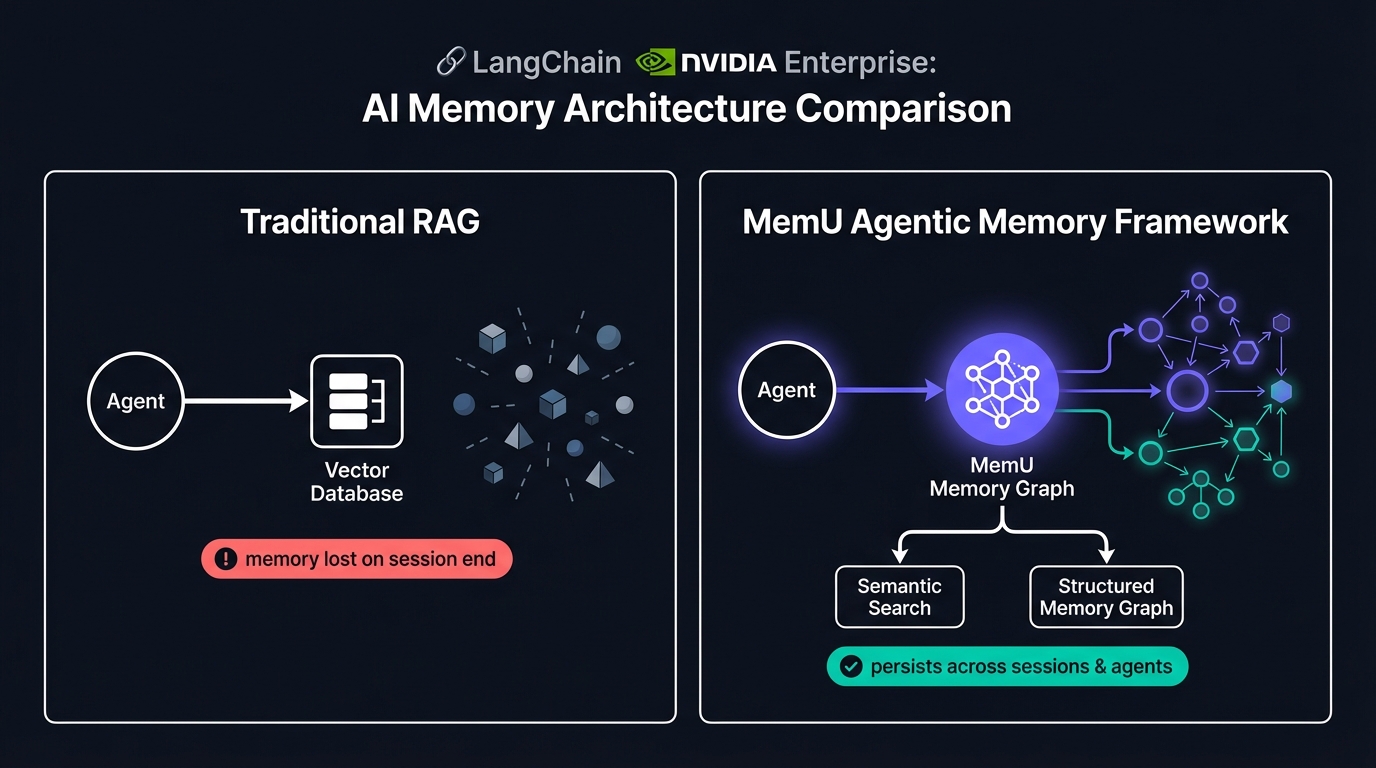
The MemU Agentic Memory Framework: Persistent Intelligence for Enterprise Agent Platforms
The MemU Agentic Memory Framework provides the persistence layer that turns optimized agent infrastructure into a learning system. Where NIM accelerates inference and LangGraph optimizes orchestration, MemU ensures that the intelligence generated through that optimized execution accumulates rather than evaporates — transforming each deployment from an isolated execution into a knowledge-building event.
Consider a Deep Agent handling competitive intelligence research for a strategy team. Over a sequence of thirty tool calls, it identifies key market signals, cross-references financial filings, and synthesizes a threat assessment. With MemU, the agent stores the research artifacts, source reliability assessments, and analytical frameworks it developed. When a follow-up request arrives next week, the agent retrieves that foundation and extends it rather than rebuilding it. Without persistent memory, the Deep Agent re-executes the entire research pipeline from scratch — burning the same tokens, calling the same APIs, and producing results that lack the longitudinal perspective only continuity can provide.
The MemU Agentic Memory Framework delivers capabilities specifically designed for enterprise agent deployments:
- Graph-aware memory: Memories integrate with LangGraph workflow structures, allowing agents to recall which execution paths produced optimal results for specific task types. Compile-time optimization handles static workflow structure; MemU handles dynamic optimization based on accumulated execution experience across hundreds of production runs.
- Cross-deployment persistence: When agents are redeployed with updated models, new NIM versions, or revised LangGraph configurations, accumulated memories persist intact. Intelligence survives infrastructure changes, preventing the costly knowledge loss that accompanies every model update or platform migration in conventional deployments.
- Throughput-aligned retrieval: Memory retrieval operates at sub-100ms latency, preserving the 2.6x throughput gains that NIM delivers. The enterprise agentic AI platform maintains its performance edge while adding persistent intelligence — no latency tradeoff required.
Enterprise agents need optimized infrastructure to perform. They need persistent memory to learn. The MemU Agentic Memory Framework delivers the second half of the equation — ensuring that every optimized execution builds on every prior one.
Head-to-Head: LangChain-NVIDIA Platform vs. Standalone Frameworks
LangChain + NVIDIA alone: Every deployment starts with optimized infrastructure but empty agent context. Deep Agents re-research topics they have analyzed before. LangGraph workflows re-discover execution patterns that prior production traffic already validated. LangSmith logs capture what happened, but agents themselves cannot access those logs to inform future decisions. The enterprise agentic AI platform is fast and secure, but fundamentally amnesiac between sessions.
LangChain + NVIDIA + MemU Agentic Memory Framework: Every deployment starts with optimized infrastructure and accumulated intelligence from all prior deployments. Deep Agents extend prior research rather than repeating it. LangGraph workflows leverage execution history to make better routing decisions from the first request. The platform becomes a compounding intelligence system where infrastructure optimization and knowledge persistence reinforce each other, producing measurably better outcomes with each deployment cycle.
Compared to alternative enterprise agentic AI platform stacks — Microsoft Semantic Kernel with Azure endpoints, AWS Bedrock Agents, Google Vertex AI Agent Builder — the LangChain-NVIDIA combination offers superior inference throughput and workflow optimization flexibility. But all enterprise stacks share the same persistence gap. Bridging that gap with persistent agent memory creates a unique competitive advantage: an enterprise agent platform that is not only fast and well-orchestrated but genuinely intelligent across time.
Empowering the Enterprise Stack: Better Together
MemU does not replace LangChain or NVIDIA infrastructure — it ensures that every dollar spent on optimized inference and orchestration generates lasting value:
- Deep research agents: Deep Agents handle sustained, multi-step research with precision; MemU persists research artifacts, source evaluations, and analytical frameworks — transforming one-time research into a reusable knowledge base that deepens with every engagement and eliminates redundant computation across similar queries.
- Workflow optimization: LangGraph's compile-time parallelism optimizes static workflow structure; MemU captures dynamic execution data — which paths are fastest for specific data types, which tool combinations produce highest-quality results — enabling runtime optimization that improves continuously beyond what static analysis can achieve alone.
- Enterprise governance: LangSmith provides observability for human operators; the MemU Agentic Memory Framework provides operational memory for agents themselves — enabling self-improving agents that learn from their own execution history while maintaining the audit trail that enterprise compliance requires.
Get Started with MemU
Give your LangChain and NVIDIA-powered agents the persistent memory they need to transform enterprise agentic AI platform deployments from stateless pipelines into learning systems. The MemU Agentic Memory Framework integrates with LangGraph, NIM, and any model serving framework — one API, instant persistence, enterprise-grade reliability. Visit memu.pro to explore the Agentic Memory Framework API, or check out the GitHub repository to start building enterprise agents that remember.
Tags: LangChain, NVIDIA, enterprise agentic AI platform, NIM microservices, LangGraph, Deep Agents, Nemotron Coalition, persistent agent memory, MemU AI