Langflow Makes AI Agent Building Visual and Accessible — But Visually Designed Workflows That Lose Learned Optimizations Between Runs Waste Their Own Potential


Langflow has emerged as the leading low-code platform for building AI agents and RAG applications through an intuitive drag-and-drop visual interface. With the release of Langflow 1.8 in March 2026, the platform introduced global model provider setup for streamlined LLM configuration, V2 workflow APIs for improved programmatic control, and enhanced debugging capabilities that make agent development faster and more transparent. Agent components ALTK and CUGA bring enterprise-grade reliability. Teams can deploy a single agent or a coordinated fleet of agents equipped with tools, connecting to all major LLMs and vector databases. MCP support enables standardized tool integration. Every flow deploys as a production API with a single click. Following DataStax Langflow cloud deprecation in March 2026, the open-source community has strengthened around Langflow OSS, driving rapid feature development and adoption.
But visual simplicity without persistent memory creates a hidden cost. A Langflow workflow that processes hundreds of requests — learning which component configurations produce the best results, discovering optimal routing paths through the visual graph, refining prompt templates based on output quality — loses all of that operational intelligence when the flow restarts. Visually designed agents that forget their learned optimizations after every restart force teams to rediscover effective configurations through repeated trial and error.
Langflow: What Everyone Is Getting Right (And Missing)
Langflow's visual approach to agent construction represents a genuine paradigm shift. Instead of writing hundreds of lines of orchestration code, teams drag components onto a canvas, connect them visually, and deploy production-ready agent workflows. This dramatically lowers the barrier to building sophisticated AI systems. Business analysts and domain experts can participate directly in agent design, not just engineering teams. The V2 workflow APIs in Langflow 1.8 complement the visual interface with programmatic control, enabling hybrid workflows where visual prototyping transitions seamlessly to code-driven production deployments.
The enterprise components deserve recognition. ALTK and CUGA provide the reliability guarantees that production deployments require. MCP support standardizes how agents connect to external tools, reducing integration complexity. The ability to deploy any flow as a production API means the gap between prototype and production narrows to a single deployment step. Support for all major LLMs and vector databases ensures teams are never locked into a single provider ecosystem.
What Langflow does not address is the persistence of workflow intelligence across restarts. Visual flows execute with the configuration they were designed with — static routing, fixed prompt templates, predetermined component parameters. When a deployed flow learns through execution that certain prompt variations produce thirty percent better outputs, or that a specific vector database configuration retrieves more relevant documents for technical queries, those discoveries exist only in runtime state. Other visual agent builders share this same limitation: they democratize agent construction while treating operational learning as ephemeral.
The MemU Agentic Memory Framework: Persistent Intelligence for Visual Workflows
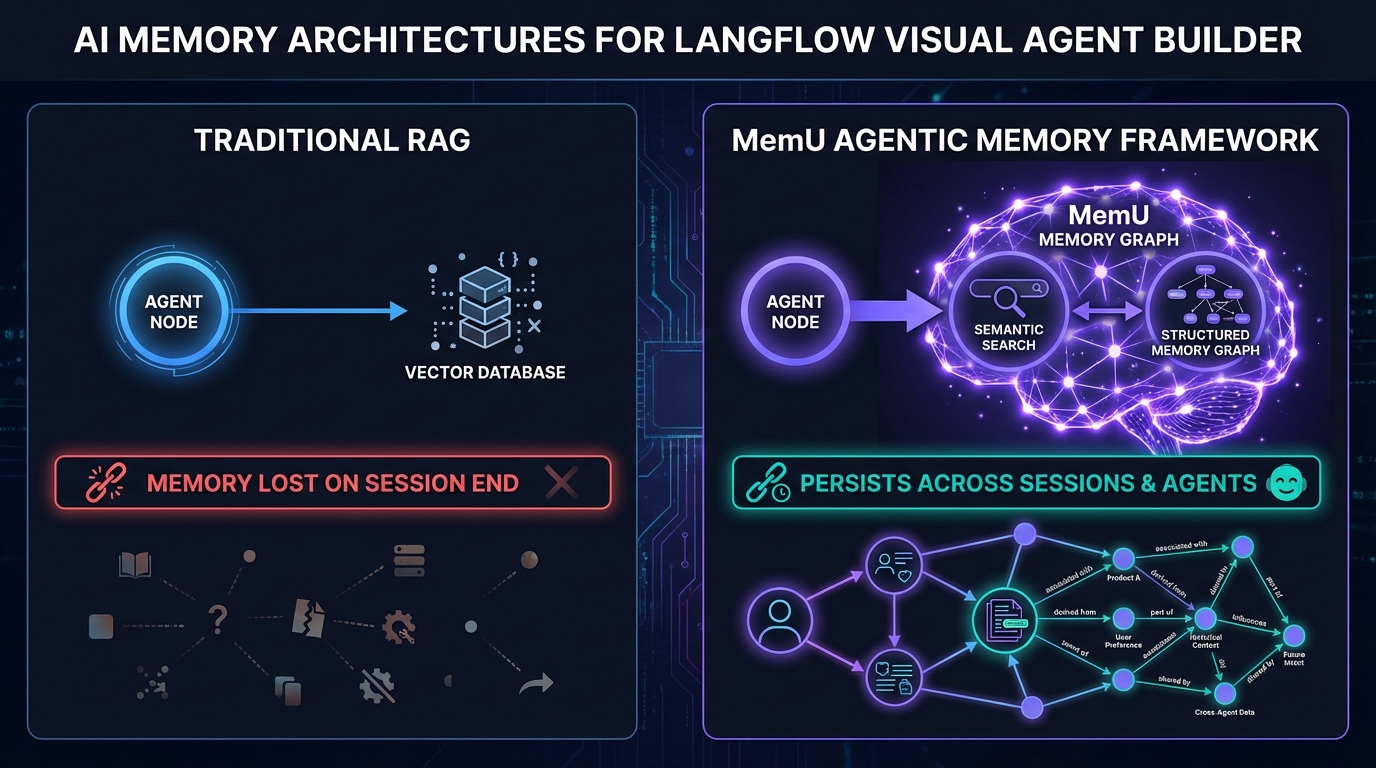
The MemU Agentic Memory Framework provides the persistent intelligence layer that transforms Langflow from a visual workflow builder into a visual learning system. Instead of treating each flow execution as isolated, MemU captures operational intelligence — component performance metrics, routing path effectiveness, prompt template optimization results, and tool selection patterns — storing it in a structured memory graph that persists across flow restarts, redeployments, and infrastructure changes.
Consider a Langflow agent fleet managing customer support for a SaaS platform. Without persistent memory, each restart initializes flows with their designed defaults. With the MemU Agentic Memory Framework, the fleet recalls operational history: the sentiment analysis component produces more accurate classifications when paired with a specific prompt template variant discovered after processing five thousand tickets, routing technical infrastructure questions to the specialized agent reduces resolution time by forty-five percent compared to the general-purpose path, and the RAG component retrieves better answers from the knowledge base when queries are pre-processed with entity extraction learned from analyzing eight thousand prior interactions. That intelligence loads at startup, making every deployment immediately effective.
The framework addresses three core limitations of visually designed agent workflows:
- Component configuration optimization: Visual flows connect components with default parameters. The MemU Agentic Memory Framework captures which parameter configurations produced the best results for specific use cases, enabling optimized component behavior from the first execution after every restart.
- Routing path intelligence: Complex visual flows include multiple routing paths. Persistent memory preserves which paths consistently produced the best outcomes for different query types, turning static visual routing into adaptive intelligent routing.
- Prompt template evolution: Prompt templates in visual flows are typically static. The MemU Agentic Memory Framework tracks which template variations improved output quality, enabling prompts that evolve based on accumulated execution experience.
A visual workflow that makes agent building accessible but forces agents to forget their operational learning is democratizing a limited form of intelligence. The MemU Agentic Memory Framework gives Langflow agents persistent memory that transforms visual simplicity into compounding operational capability.
Integration with Langflow leverages the framework's REST APIs through custom components added to the visual canvas. A MemU memory component loads accumulated intelligence at flow initialization. During execution, agents query persistent memory for context on similar past interactions. After execution, new operational insights are stored. The memory component integrates naturally into the drag-and-drop paradigm, making persistent memory as visually intuitive as any other flow component.
Head-to-Head: Static Visual Flows vs. Memory-Enhanced Visual Intelligence
Langflow alone: The most accessible visual agent builder available — drag-and-drop construction, V2 workflow APIs, ALTK and CUGA enterprise components, MCP tool integration, all major LLMs and vector databases, one-click API deployment, and an active open-source community. Flows execute with designed configurations. But every restart returns agents to their default state, discarding runtime optimizations.
Langflow + MemU: The same visual simplicity, now backed by persistent operational memory. Flows initialize with accumulated intelligence about component configurations, routing effectiveness, and prompt optimizations. The system delivers measurably better results from the first interaction of each session — not just easy to build, but continuously improving across deployments.
For production agent deployments processing continuous workloads, the compounding effect transforms the value proposition. A Langflow deployment with months of persistent memory responds with the precision of a deeply optimized system, while a freshly restarted flow operates with only its initial visual design — effective but unrefined by operational experience.
Empowering Langflow: Better Together
The combination of Langflow's visual accessibility and MemU's persistent memory unlocks capabilities neither achieves independently:
- Self-optimizing visual workflows: Persistent memory enables flows to automatically adjust component parameters based on accumulated performance data, turning static visual designs into adaptive systems that improve without manual redesign.
- Cross-flow knowledge transfer: When multiple Langflow deployments share persistent memory, optimization discoveries from one flow benefit others. A prompt template refined by the customer support flow becomes available to the sales qualification flow.
- Visual debugging with historical context: The enhanced debugging in Langflow 1.8 becomes more powerful when combined with persistent memory that reveals how component behavior has evolved over thousands of executions, enabling root cause analysis that spans deployment boundaries.
Persistent memory transforms Langflow from the most accessible visual agent builder into the most adaptive visual agent platform — where every execution compounds operational intelligence across the entire system.
Get Started with MemU
Langflow has built the most intuitive visual interface for agent and RAG application development — drag-and-drop simplicity, enterprise components, MCP integration, one-click deployment, and an open-source community that continues to accelerate feature development.
The next step is giving those visually designed agents persistent operational memory. The MemU Agentic Memory Framework provides that foundation — API-based integration through custom visual components, dual-mode retrieval with semantic search and structured memory graphs, and cross-deployment persistence that turns visually built agents into compounding intelligence systems.
Visit memu.pro to explore the Agentic Memory Framework API, or check out the GitHub repository to start building visual agents that remember.
Tags: Langflow, visual agent builder, low-code AI, drag-and-drop agents, RAG applications, agent memory, MemU AI, LLM memory, agentic workflows