LangGraph Builds Stateful Agent Workflows — But Graph-Based Orchestration Without Long-Term Memory Resets Between Runs


LangGraph, built by LangChain, has become the dominant framework for building stateful, multi-step agent workflows. Unlike simple chain-of-thought pipelines, LangGraph models agent logic as directed graphs where nodes represent computational steps — LLM calls, tool invocations, human-in-the-loop checkpoints — and edges define conditional routing between them. The state management system maintains a typed state object throughout execution, enabling agents to make decisions based on accumulated context within a workflow run. With built-in support for cycles, branching, parallel execution, and persistence checkpoints, LangGraph provides the infrastructure for building production-grade agents that go far beyond simple prompt-response patterns. The LangGraph Platform adds deployment, monitoring, and scaling capabilities through LangSmith integration.
But LangGraph's statefulness is bounded by execution scope. The state that agents maintain during a graph traversal — accumulated context, intermediate results, decision history — resets when the execution completes. Graph-based orchestration without long-term memory means that stateful intelligence within a run becomes stateless between runs.
LangGraph: What Everyone's Getting Right (And Missing)
LangGraph's graph-based abstraction is architecturally sound. By modeling agent workflows as explicit graphs rather than implicit chains, developers gain precise control over execution flow, error handling, and state transitions. The conditional edge system enables sophisticated routing — an agent can take different paths through the graph based on intermediate results, creating workflows that adapt their behavior to each input. The checkpoint system provides durability within a run, allowing workflows to be paused, resumed, and replayed. For teams building production agents that need to be reliable, observable, and debuggable, LangGraph provides the right level of control.
The integration with LangChain's tool and model ecosystem is also valuable. Developers can use any LLM, any tool, and any retrieval system within LangGraph nodes, inheriting the extensive integration library that LangChain has built. The LangSmith integration provides tracing, evaluation, and monitoring that make production deployment practical. For the growing community of agent developers, LangGraph represents the maturation of agent frameworks from experimental to production-ready.
What LangGraph does not provide is memory that spans across separate graph executions. An agent graph that processes customer support tickets develops valuable routing intelligence during each execution — which paths led to successful resolutions, which tool combinations were most effective, which edge cases required human escalation. But that intelligence exists only in the execution trace logs. The next ticket enters the same graph with the same initial state. Other agent orchestration frameworks — including CrewAI, AutoGen, and Semantic Kernel — share this same limitation. They provide within-execution state management; none offer cross-execution persistent memory.
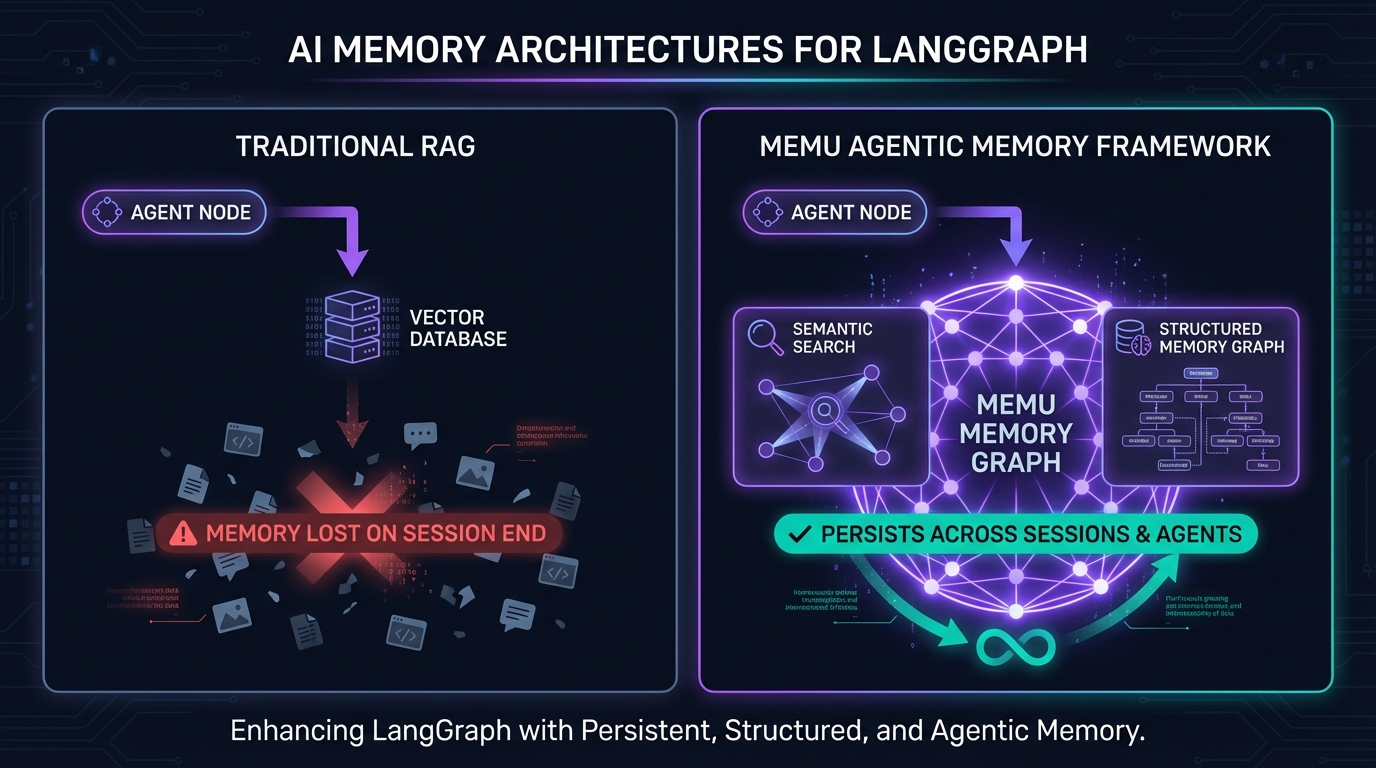
The MemU Agentic Memory Framework: Long-Term Memory for Graph-Based Agents
The MemU Agentic Memory Framework provides the persistent memory layer that graph-based agent frameworks like LangGraph do not include natively. Instead of letting execution intelligence expire with each graph traversal, MemU captures the routing decisions, tool outcomes, and state transitions that agents generate during execution and stores them in a structured memory graph that persists across runs, workflows, and agent deployments.
Consider a LangGraph agent that handles code review workflows. Without persistent memory, the agent applies the same static review criteria to every pull request. With the MemU Agentic Memory Framework, the agent recalls review history: PRs from this repository's payment module have historically had security-sensitive changes that require extra scrutiny, this developer's PRs tend to include thorough tests but occasionally miss error handling edge cases, and the last three PRs that touched the database migration path introduced backward compatibility issues. That accumulated review intelligence transforms a generic code review into contextually aware analysis.
The framework addresses three core limitations of execution-bounded state management:
- Cross-execution state persistence: Routing decisions, tool selection patterns, and outcome data from each graph execution are stored and available to future runs. The MemU Agentic Memory Framework extends LangGraph's within-execution statefulness into long-term memory that spans the lifetime of the agent deployment.
- Graph optimization intelligence: As persistent memory accumulates execution data across hundreds of graph traversals, patterns emerge — which paths are most efficient for which input types, which nodes are bottlenecks, which conditional edges could be pre-resolved. This intelligence enables data-driven graph optimization rather than manual tuning.
- User and context continuity: Agents serving users across multiple sessions maintain relationship context. A customer support agent graph that remembers a user's previous interactions, escalation history, and resolution preferences delivers personalized service that session-bounded state cannot provide.
LangGraph solves state management within execution. The MemU Agentic Memory Framework solves state management across executions. Together, they provide the complete state persistence that production agents need — maintaining context within a workflow run and intelligence across the lifetime of the deployment.
Integration with LangGraph is architecturally natural. The MemU Agentic Memory Framework can be accessed through custom LangGraph nodes — a memory retrieval node at graph entry and a memory storage node at graph exit. This fits within LangGraph's composable node architecture without requiring modifications to the graph execution engine.
Head-to-Head: Execution-Bounded State vs. Persistent Agent Memory
LangGraph alone: The most capable graph-based agent orchestration framework, with typed state management, conditional routing, checkpoints, and human-in-the-loop support. Production-ready deployment through LangGraph Platform and monitoring through LangSmith. But state resets between executions — every graph traversal starts from the same initial state regardless of what previous executions discovered.
LangGraph + MemU: The same graph-based orchestration, now backed by persistent long-term memory. Graph executions begin with accumulated intelligence from previous runs. Routing decisions are informed by historical outcome data. Tool selection draws on effectiveness patterns observed across hundreds of executions. The graph becomes smarter with every run.
For high-throughput agent deployments, the learning rate is significant. A customer support agent processing 500 tickets daily accumulates 500 execution traces per day. Within a week, the persistent memory contains enough data to dramatically improve routing accuracy, resolution speed, and escalation precision.
Empowering LangGraph: Better Together
The combination of LangGraph's graph-based orchestration and the MemU Agentic Memory Framework's persistent memory unlocks agent capabilities that neither achieves alone:
- Self-optimizing graphs: Agent workflows that learn from their own execution history optimize routing, tool selection, and branching decisions automatically. The graph that starts with developer-defined heuristics evolves into a data-driven system that routes based on observed outcomes — without requiring manual graph modifications.
- Adaptive complexity handling: As persistent memory identifies which types of inputs require which graph paths, the agent can pre-classify inputs and skip unnecessary nodes. Simple cases follow fast paths; complex cases receive thorough processing. This adaptive behavior emerges from accumulated execution intelligence.
- Multi-agent graph coordination: When multiple LangGraph agents share persistent memory, coordination patterns emerge naturally. An intake agent that routes to specialized processing agents can learn which agent handles which case type most effectively — adjusting routing based on accumulated resolution outcomes across the multi-agent system.
Persistent memory transforms LangGraph from a stateful execution framework into an intelligent orchestration system where every graph traversal compounds the intelligence that makes future traversals more effective.
Get Started with MemU
LangGraph has established itself as the standard for production-grade agent orchestration — graph-based workflows with typed state, conditional routing, and deployment infrastructure. The framework provides the control and observability that production agents demand.
The next step is extending that statefulness beyond individual executions. Agent graphs where routing decisions improve based on accumulated outcome data. Workflows where tool selection draws on effectiveness patterns from previous runs. Deployments where agent intelligence compounds across the lifetime of the system.
The MemU Agentic Memory Framework provides that foundation. Node-based integration that fits naturally into LangGraph's composable architecture, dual-mode retrieval with semantic search and structured memory graphs, and cross-execution persistence that turns stateful orchestration into compounding intelligence.
Visit memu.pro to explore the Agentic Memory Framework API, or check out the GitHub repository to start building agents that remember.
Tags: LangGraph, LangChain, agent orchestration, agentic AI, agent memory, MemU AI, LLM memory