LangGraph Makes Agents Stateful Within Workflows — But State Doesn't Equal Long-Term Memory

LangGraph solved the hardest problem in AI agent development: reliable state management. Part of the LangChain ecosystem (90 million monthly downloads, 100K+ GitHub stars), LangGraph provides graph-based agent orchestration where nodes represent processing steps, edges define transitions, and state flows through the graph with full persistence and checkpointing. For production-grade agents that need predictable, debuggable behavior with human-in-the-loop capabilities, LangGraph has become the framework of choice.
The graph-based approach enables fine-grained control that other frameworks can't match. Define exactly which paths an agent can take. Add conditional branching based on intermediate results. Insert human approval at critical decision points. Roll back to checkpoints when things go wrong. LangSmith provides full observability — every node execution, every state transition, every decision is traceable.
LangGraph makes agents stateful. But there's a distinction that matters for production systems: workflow state is not the same as long-term memory.
LangGraph: What Graph-Based State Management Achieves
The graph paradigm brings software engineering rigor to agent development. Traditional agent loops — "think, act, observe, repeat" — are unpredictable and hard to debug. LangGraph replaces that with explicit state machines where every possible path is defined, every transition is conditional, and every state is persistent and inspectable.
Checkpointing enables powerful patterns. Pause an agent workflow, get human approval, then resume. Roll back to a previous state when an agent takes a wrong turn. Fork a workflow to explore multiple approaches in parallel. These capabilities make LangGraph agents production-safe in ways that free-running agents aren't.
LangSmith integration provides the observability that enterprise deployments require. Trace every decision. Monitor agent behavior at scale. Identify where agents succeed and fail. Strategic forecasts predict 80% of production agent deployments will require integrated observability by 2027.
State management handles the current execution. LangGraph persists state within and across steps of a single workflow execution. Checkpoints let you resume interrupted workflows. But when a workflow completes, its state represents the record of that specific execution — not accumulated wisdom from all previous executions.
How LangGraph Handles State vs. Memory
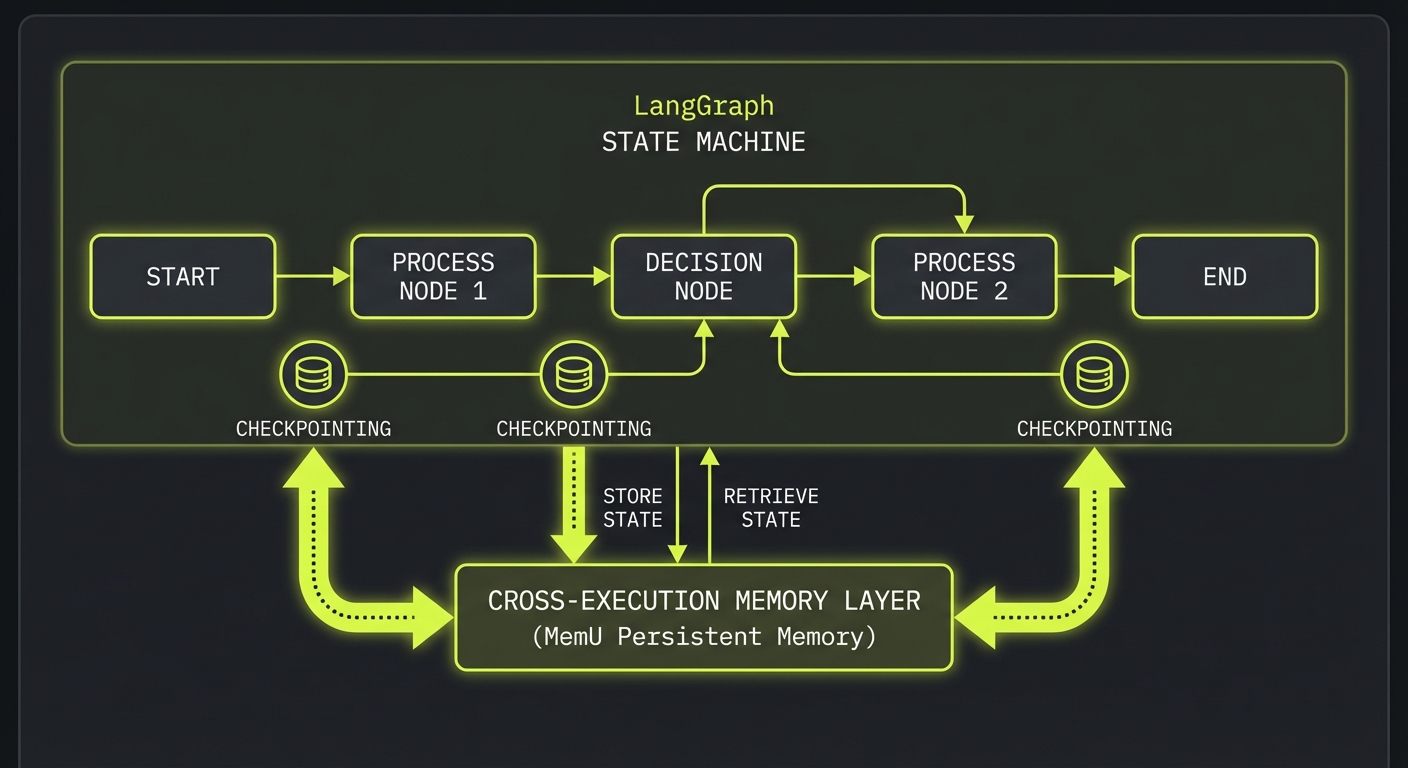
LangGraph's state management is genuinely sophisticated. State objects persist across graph nodes. Reducers control how state updates accumulate. Checkpointers serialize state for durability. The graph structure ensures state flows through well-defined paths with predictable transformations at each step.
For multi-step agent workflows — data analysis pipelines, customer service flows, content generation processes — this state management is essential. The agent can track intermediate results, maintain conversation context, and coordinate across nodes without losing information.
But state is execution-scoped, not knowledge-scoped. A customer service agent built on LangGraph perfectly tracks the state of a single support interaction — issue identified, troubleshooting attempted, resolution applied. When that interaction completes, the state represents what happened in that ticket. It doesn't contribute to a growing understanding of common issues, effective resolutions, or customer patterns.
The distinction: state tells you where you are in a process. Memory tells you what you've learned from doing that process many times.
The MemU Agentic Memory Framework: Long-Term Memory for Stateful Agents
The MemU Agentic Memory Framework provides the long-term memory layer that complements LangGraph's state management. While LangGraph handles workflow state within executions, MemU captures and retrieves knowledge across executions.
Consider a data analysis agent built on LangGraph. Each execution processes a dataset: ingest, clean, analyze, report. LangGraph ensures each step's state flows correctly. With the MemU Agentic Memory Framework, the agent also remembers what it learned — this data source frequently has null values in column X, that analysis technique works best for time-series data in this format, these visualization parameters produce the clearest reports. Each execution benefits from accumulated analytical intelligence.
The architecture complements LangGraph through three capabilities:
- Execution-to-memory pipeline: When LangGraph workflows complete, MemU captures the knowledge that emerged — not the raw state, but the synthesized insights and patterns worth preserving for future executions.
- Memory-informed routing: LangGraph's conditional edges can query MemU to make routing decisions based on historical knowledge. "Based on previous executions with similar data, take the alternative processing path" becomes a LangGraph conditional backed by MemU memory.
- Cross-workflow learning: Different LangGraph workflows operating on related tasks share memory. The preprocessing workflow's discoveries inform the analysis workflow's approach. Knowledge flows across workflow boundaries.
LangGraph manages where agents are. MemU remembers what agents have learned. Together: stateful agents with long-term memory.
Head-to-Head: Workflow State vs. Organizational Memory
LangGraph alone: Best-in-class workflow state management, checkpointing, observability, and human-in-the-loop control. Production-grade reliability for stateful agent workflows. But each execution is knowledge-independent — no accumulated intelligence, no cross-execution learning, no progressive improvement.
LangGraph + MemU: Same state management plus persistent organizational memory. Agents learn from every execution. State management handles the present; memory handles the past and informs the future. Sub-100ms memory retrieval integrates seamlessly with LangGraph's graph execution.
Get Started with MemU
LangGraph has set the standard for production-grade agent orchestration. The graph-based approach, checkpointing, and observability make it the natural choice for enterprise agent deployments.
The MemU Agentic Memory Framework provides the long-term memory that makes those deployments progressively more intelligent. State for the workflow. Memory for the knowledge. The complete agent infrastructure stack.
Visit memu.pro to explore the Agentic Memory Framework API, or check out the open-source repository on GitHub to start building long-term memory into your LangGraph agents today.