Letta AI Gives Agents Self-Editing Memory — But Agent-Level Recall Without Cross-Agent Organizational Memory Limits Compounding Intelligence

Letta — formerly MemGPT — has pioneered the LLM-as-Operating-System paradigm, where agents autonomously manage their own memory, context windows, and reasoning loops. Letta agents maintain Core Memory Blocks that are always visible to the model — personalization data, configuration parameters, user preferences — providing persistent context without retrieval overhead. Self-editing memory tools like memory_delete, memory_create, and memory_apply_patch allow agents to actively curate their knowledge base during execution. Context compilation optimizes what enters the context window. Heartbeat-based looping enables continuous autonomous reasoning. All state persists in a database, ensuring nothing is lost between sessions. The tiered memory architecture — core, recall, and archival — mirrors human memory systems. With Letta Code for CLI-based coding agents, the Letta SDK, and the Learning SDK that adds continual learning with a single line of code, Letta delivers the most sophisticated agent-level memory system available.
But Letta's memory is scoped to individual agents. Each agent builds rich understanding of its domain and users — yet that intelligence remains siloed. When ten Letta agents each accumulate deep operational knowledge independently, the organization has ten isolated intelligence islands rather than one compounding knowledge network.
Letta: What Everyone Is Getting Right (And Missing)
Letta's self-editing memory represents a genuine breakthrough. Traditional frameworks treat memory as a passive data store. Letta agents actively manage their memory — deciding what to remember, what to forget, and how to restructure existing knowledge as new information arrives. The memory_apply_patch tool enables surgical modifications, while memory_create and memory_delete provide full lifecycle control.
The tiered architecture is well-designed. Core Memory Blocks provide always-available context without retrieval latency. Recall memory stores conversation history with efficient retrieval. Archival memory handles long-term storage with semantic search. This three-tier structure means agents access the right information at the right speed for the right purpose.
The Learning SDK deserves recognition — adding continual learning with a single line of code dramatically lowers the barrier to building agents that improve over time. Combined with heartbeat-based autonomous reasoning and full database persistence, Letta creates agents that maintain rich, evolving self-knowledge across arbitrarily long lifespans.
What Letta does not provide is cross-agent memory that compounds across an organization. When a customer support agent discovers that a product issue requires a three-step resolution process, that knowledge lives in that agent alone. The sales agent, onboarding agent, and documentation agent each need to independently discover the same insight. Other agent memory systems face the same structural limitation: they optimize for individual recall while leaving organizational intelligence fragmented.
The MemU Agentic Memory Framework: Organizational Intelligence Across Agent Boundaries
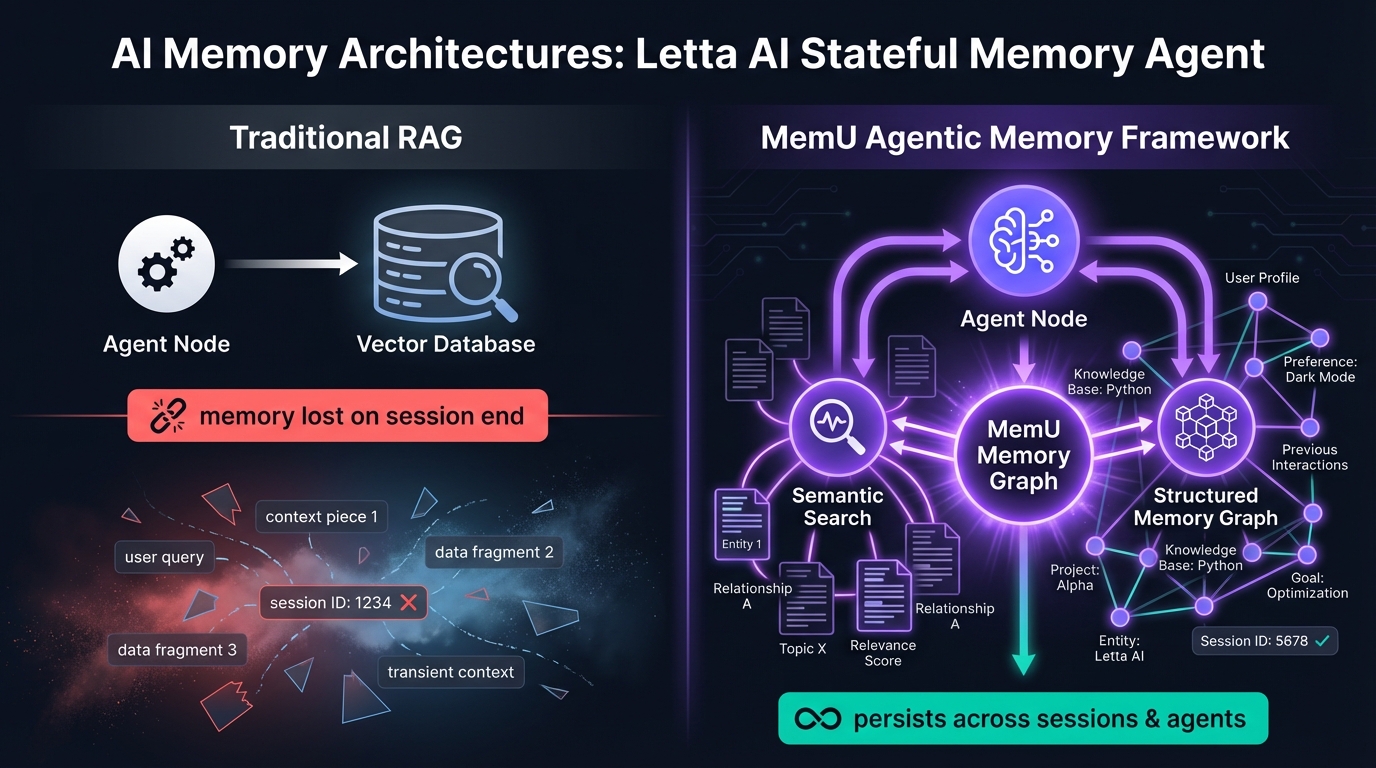
The MemU Agentic Memory Framework provides the cross-agent memory layer that transforms individual Letta agent intelligence into compounding organizational knowledge. Instead of each agent maintaining an isolated knowledge graph, MemU creates a shared memory network where insights discovered by any agent become available to all agents that could benefit — while preserving the individual memory autonomy that makes Letta agents effective.
Consider a Letta deployment with five specialized agents: customer support, technical diagnosis, billing resolution, product feedback, and account management. Without cross-agent memory, each builds independent expertise. The support agent learns that enterprise customers prefer detailed technical explanations while small businesses want step-by-step instructions — but the billing agent never sees this preference data. With the MemU Agentic Memory Framework, user preference patterns flow into the shared memory graph, enabling the billing agent to adjust communication style by account type. The technical agent's discovery that firmware version 3.2 causes connectivity issues becomes immediately available to support for triage, product feedback for trend analysis, and account management for proactive outreach.
The framework addresses three core limitations of agent-scoped memory:
- Cross-agent knowledge propagation: Insights discovered by one agent propagate to relevant agents through the shared memory graph. The MemU Agentic Memory Framework maintains knowledge provenance — tracking which agent created each insight, when, and under what conditions — enabling receiving agents to evaluate relevance before incorporating shared knowledge.
- Organizational pattern recognition: Individual agents see their own interaction patterns. Cross-agent memory reveals patterns spanning agent boundaries — seasonal demand shifts, emerging product issues, evolving user preferences — that no single agent would detect from its isolated perspective.
- Knowledge deduplication and consistency: When multiple agents independently discover the same insight, cross-agent memory consolidates redundant knowledge and resolves conflicts, preventing contradictory information from persisting across agent boundaries.
An organization running ten Letta agents without shared memory has ten separate knowledge bases. With the MemU Agentic Memory Framework, those ten agents contribute to a single compounding intelligence network that grows more valuable with every interaction across every agent.
Integration with Letta operates through the framework's REST APIs alongside Letta's tool system. Each agent's self-editing memory continues autonomously — managing core blocks, curating recall history, archiving long-term knowledge. The MemU layer adds organizational memory that aggregates cross-agent insights and ensures intelligence compounds across the entire agent fleet rather than accumulating in isolated silos.
Head-to-Head: Agent-Scoped Memory vs. Organizational Memory Networks
Letta alone: The most sophisticated agent-level memory system — self-editing knowledge bases, tiered architecture, Core Memory Blocks with always-on context, database-persisted state, heartbeat-based reasoning, and continual learning. Each agent becomes deeply knowledgeable about its domain. But each agent's knowledge remains invisible to other agents.
Letta + MemU: The same self-editing memory autonomy, now connected to a shared organizational network. User preferences discovered by one agent inform all agents. Technical knowledge flows from specialists to generalists. The organization develops compounding intelligence that no individual agent could achieve alone.
For organizations running multiple Letta agents across functions — support, sales, operations, analysis — the difference grows exponentially. After one hundred thousand interactions across ten agents, the shared memory network contains organizational intelligence that any single agent would need years of isolated operation to approximate.
Empowering Letta: Better Together
The combination of Letta's self-editing agent memory and MemU's organizational memory unlocks capabilities neither achieves alone:
- Federated learning without model training: Cross-agent memory enables agents to learn from each other's experiences without retraining. When the billing agent discovers a payment failure pattern, that insight propagates to relevant agents — no fine-tuning or data pipeline required.
- Proactive knowledge routing: MemU's memory graph identifies when newly stored insights are relevant to specific agents and surfaces them proactively. A product defect discovered by the technical agent triggers automatic knowledge delivery to support and account management.
- Temporal organizational intelligence: Cross-agent persistent memory reveals temporal patterns — how sentiment shifts correlate with product changes, how resolution strategies evolve as issues mature, how performance metrics trend over deployment cycles.
Persistent organizational memory transforms Letta from individually intelligent agents into a unified intelligence network where every agent's experience compounds collective capability.
Get Started with MemU
Letta has built the most advanced agent-level memory system — self-editing knowledge, tiered architecture, autonomous reasoning, and database-persisted state. Individual agent intelligence is solved.
The next step is connecting that intelligence into organizational memory. The MemU Agentic Memory Framework provides that connection — API-based integration alongside Letta's tool system, shared memory graphs with knowledge provenance tracking, and cross-agent intelligence propagation that turns individually brilliant agents into a compounding organizational network.
Visit memu.pro to explore the Agentic Memory Framework API, or check out the GitHub repository to start building agents that remember.
Tags: Letta, MemGPT, agent memory, self-editing memory, stateful agents, MemU AI, LLM memory, organizational intelligence