Lindy AI Builds No-Code AI Agents in 48 Hours — But Agents That Learn From Feedback Without Persistent Memory Reset When They Restart


Lindy AI has built one of the most accessible no-code AI agent platforms on the market. With over 5,000 customers and a drag-and-drop builder that lets teams deploy custom AI agents in as little as 48 hours, the platform eliminates the engineering bottleneck that keeps most organizations from leveraging agentic AI. Three core capabilities — Ask (search across connected tools), Act (book meetings, send files, update CRMs), and Anticipate (proactive alerts before users think to ask) — cover the full spectrum of workplace automation. Agents learn from user feedback, adjust to preferences, and operate 24/7 across any device. Hundreds of integrations span Gmail, Slack, CRM platforms, and more. Teams report saving 40+ hours per week per member, with custom development available from Lindy's implementation engineers for complex enterprise use cases.
But there is a structural limitation behind that impressive accessibility. The platform's agents learn from feedback within a session — and within that session, they genuinely improve. Session-level learning without persistent memory resets when agents restart or redeploy. Preferences learned through weeks of interaction evaporate. Contextual intelligence built through thousands of feedback signals dissolves between deployments.
Lindy AI: What No-Code Agents Get Right (And What Session-Level Learning Cannot Sustain)
The no-code builder genuinely democratizes agentic AI. Drag-and-drop workflow construction means product managers, operations leads, and customer success teams can build agents tailored to their processes without writing code or waiting in the engineering queue. The 48-hour deployment timeline is real — organizations routinely go from concept to production agent in two business days. For enterprise use cases that exceed the builder's scope, Lindy's implementation engineers provide custom development, bridging visual simplicity and production-grade complexity.
The three-function model captures the full agent lifecycle clearly. Ask handles information retrieval across every connected tool — pulling data from CRMs, searching email archives, querying knowledge bases. Act executes consequential actions: booking calendar slots, sending documents, updating records. Anticipate monitors conditions and fires proactive alerts — flagging deals at risk, deadlines approaching, or behavior patterns that warrant attention. These three functions cover the majority of workplace automation scenarios enterprise teams need.
What the platform does not address is what happens between sessions. Agents adjust to user preferences through feedback — but that adjustment lives in session state. When an agent restarts, redeploys, or scales to a new instance, learned preferences vanish. An agent that spent weeks learning an executive's scheduling preferences, communication style, and meeting priorities starts fresh after a platform update. Session-level learning creates agents that improve temporarily — persistent memory creates agents that improve permanently.
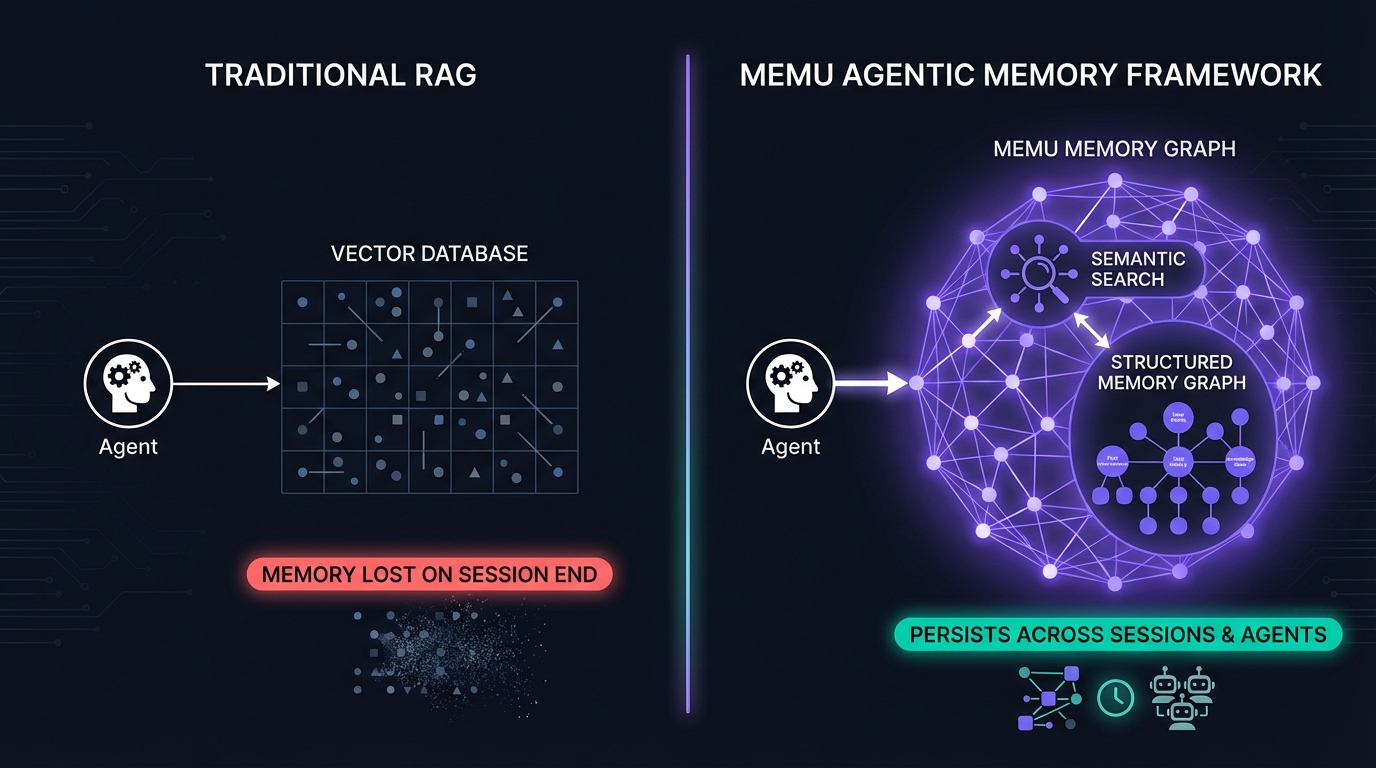
The MemU Agentic Memory Framework: Persistent Intelligence for No-Code Agents
The MemU Agentic Memory Framework provides the persistent memory layer that no-code agent platforms need to deliver on their promise of agents that truly learn. Instead of limiting learning to session-level feedback loops that evaporate on restart, MemU captures preferences, interaction patterns, task outcomes, and contextual intelligence in a structured memory graph that persists across sessions, restarts, and scaling events.
Consider a no-code agent managing an executive's calendar. Without persistent memory, the agent learns during a session that the executive prefers 30-minute meetings before noon, avoids Friday afternoons, and wants agendas attached to every invite — then forgets after a restart. With the MemU Agentic Memory Framework, those preferences survive platform updates, instance scaling, and deployment changes. The agent arrives at every new session already knowing what it learned across all previous interactions.
The framework addresses three critical limitations of session-level learning:
- Session continuity: Every feedback signal, preference adjustment, and behavioral pattern captured during operation is stored persistently — ensuring agents never repeat the learning curve after restarts or redeployments.
- Cross-agent knowledge sharing: Organizations deploying multiple agents across departments need insights from one agent to inform all others. The MemU Agentic Memory Framework enables a shared organizational memory graph accessible to every agent in the workforce.
- Accumulated intelligence: When an agent discovers that a customer responds better to concise updates or that a specific workflow sequence resolves issues faster, that insight persists for all future interactions — building intelligence that grows with usage.
No-code agent builders solve the creation problem — getting agents deployed quickly. The MemU Agentic Memory Framework solves the retention problem — ensuring those agents keep getting smarter rather than resetting with every restart.
Integration with Lindy AI workflows uses MemU's REST APIs. Before executing a task, the agent queries persistent memory for user preferences and learned patterns from prior sessions. After completion, outcomes and new preferences are stored. The MemU Agentic Memory Framework supports both semantic search and structured graph queries for flexible context retrieval.
Head-to-Head: Session-Level Learning vs. Persistent Agent Memory
Lindy AI alone: Outstanding no-code agent builder with 48-hour deployment, hundreds of integrations, and a three-function model covering Ask, Act, and Anticipate. Agents learn from feedback within sessions and teams save 40+ hours per week. But session-level learning resets on restart — agents that adjust to preferences lose those adjustments when redeployed or scaled.
Lindy AI + MemU: The same accessible platform with persistent intelligence underneath. Agents remember preferences across restarts, accumulate operational intelligence across thousands of interactions, and share contextual knowledge across instances and departments. No-code deployment delivers agents that learn permanently from every feedback signal.
For organizations already achieving significant time savings, persistent memory ensures those savings compound rather than plateau — each week's interactions make next week's agents measurably smarter.
Lindy AI + MemU: Better Together
The combination of no-code agent creation and persistent memory unlocks capabilities neither achieves alone:
- Permanent preference learning: Agents retain every preference adjustment and behavioral pattern permanently — surviving restarts, platform updates, and scaling events that would normally reset session-level learning to a blank baseline.
- Multi-agent organizational intelligence: Teams running agents across sales, support, HR, and operations build a shared memory graph where insights from one agent inform all others — creating institutional knowledge that grows with every interaction across the workforce.
- Accelerated agent onboarding: New agents inherit the accumulated memory of their predecessors — bypassing months of learning and delivering experienced-level performance from day one.
Persistent memory transforms the platform from a no-code agent builder into a no-code intelligent workforce platform — where every agent contributes to and benefits from accumulated organizational intelligence.
Get Started with MemU
Lindy AI has made agentic AI accessible to every team — eliminating the engineering bottleneck with a builder that delivers production agents in 48 hours. As workplace automation scales from individual agents to multi-agent workforces, persistent memory becomes the differentiator between agents that work and agents that learn.
The MemU Agentic Memory Framework provides that foundation. Drop-in API integration with any agent workflow, dual-mode retrieval combining semantic search and structured memory graphs, and cross-session persistence that ensures no-code agents retain every insight they discover.
Visit memu.pro to explore the Agentic Memory Framework API, or check out the GitHub repository to start building agents that remember everything they learn.
Tags: Lindy AI, no-code AI agents, AI agent memory, agentic AI, MemU AI, workplace automation, agent learning, persistent memory