LiteLLM Unifies 100+ LLM Providers Behind a Single Gateway — But Routing Without Memory Means Agents Never Learn Which Model Works Best


LiteLLM has become the definitive open-source LLM gateway proxy, providing a unified OpenAI-format API across more than 100 LLM providers. The platform standardizes endpoints for chat completions, embeddings, image generation, audio processing, batch operations, reranking, and agent-to-agent communication through a single integration layer. High availability with automatic fallback ensures production reliability, handling over 1,500 requests per second at peak throughput. Virtual keys with per-key, per-team, and per-user budgets provide granular cost governance. Centralized logging, configurable guardrails, and intelligent caching reduce operational overhead while the admin UI delivers real-time visibility. The platform achieves zero vendor lock-in through its Python SDK, Docker deployment, and comprehensive provider abstraction that spans OpenAI, Anthropic, Google, AWS Bedrock, Azure, and dozens more.
But unified routing is essential infrastructure — not intelligence. An LLM gateway ensures agents can reach any model through a consistent interface with reliable fallback. That same gateway cannot learn which model performs best for which task type over time, which providers deliver optimal latency for specific workloads, or which fallback sequences produce the highest quality results. Routing decisions remain static configurations rather than learned optimizations.
Unified LLM Gateway Routing: What LiteLLM Gets Right (And What It Misses)
LiteLLM addresses a critical pain point in multi-model AI architectures: the proliferation of provider-specific APIs, authentication schemes, and response formats that force developers to maintain separate integration code for each LLM they use. The LLM gateway abstracts this complexity behind a single OpenAI-compatible interface, meaning any application built against the OpenAI SDK can instantly access Claude, Gemini, Llama, Mistral, and a hundred other models with zero code changes. This abstraction is not merely convenient — it is architecturally necessary for production systems that need provider diversity for resilience, cost optimization, and capability coverage.
The budget and access control system demonstrates production maturity. Virtual keys enable organizations to allocate LLM spending across teams, projects, and individual users with hard limits that prevent cost overruns. Combined with centralized logging, every request is auditable — which team called which model, at what cost, and with what outcome. For enterprises managing dozens of AI-powered applications, this governance layer transforms the proxy from a technical convenience into a compliance requirement.
The A2A agent support represents forward-thinking architecture. As agent ecosystems grow more complex, agents need to communicate with other agents across different frameworks — LangGraph agents talking to Vertex agents, Bedrock agents coordinating with Pydantic AI agents. LiteLLM's A2A endpoints provide this interoperability through the same unified proxy interface, extending the abstraction from model-level to agent-level communication.
The limitation is that routing intelligence remains static. LiteLLM routes requests based on configured rules — model preferences, fallback sequences, load balancing weights. These configurations are set by humans and remain fixed until manually updated. After routing millions of requests, the LLM gateway has accumulated no knowledge about which routing decisions produced the best outcomes, which models excel at specific task categories, or which fallback patterns resolve failures most effectively. Every routing decision applies the same static logic regardless of accumulated operational history.
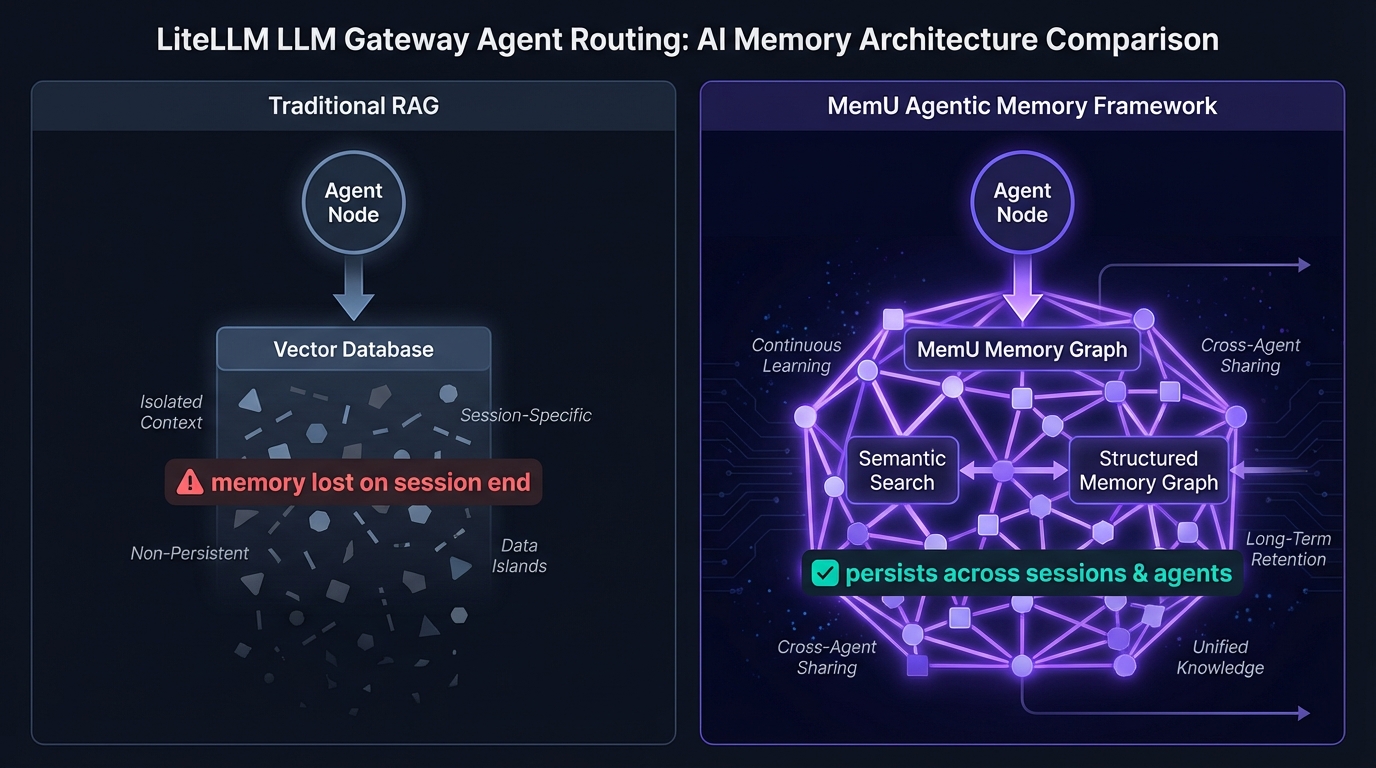
The MemU Agentic Memory Framework: Learned Routing Intelligence Across Gateway Operations
The MemU Agentic Memory Framework extends LLM gateway infrastructure from static routing to learned routing intelligence. Where LiteLLM ensures any request reaches an appropriate model through configured rules, MemU ensures routing decisions improve continuously based on measured outcomes — creating a compounding layer where every routed request contributes to smarter routing for all future requests.
Consider an enterprise running hundreds of AI agents through a centralized gateway — coding assistants, document analyzers, customer service bots, and research agents all sharing the same routing infrastructure. LiteLLM handles the routing reliably, applying fallback rules and budget limits uniformly. After processing five million requests over six months, the gateway has implicitly generated massive intelligence about provider performance: Claude excels at structured analysis tasks but has higher latency for simple completions, GPT-4 handles creative generation superbly but costs more than needed for classification, and Llama delivers excellent value for routine summarization. With MemU, this intelligence becomes actionable routing knowledge. Without persistent memory, request five million and one is routed with the same static rules as request one.
The MemU Agentic Memory Framework provides capabilities that enhance gateway routing:
- Outcome-aware routing: Every routed request generates performance data about response quality, latency, cost, and task completion. MemU captures this as structured intelligence that future routing decisions reference — enabling the gateway to learn optimal model selection for specific task types rather than relying on static priority lists.
- Fallback pattern learning: LiteLLM implements automatic fallback across providers; MemU tracks which fallback sequences produce the best recovery outcomes for different failure modes — building intelligence about provider reliability patterns, degradation signals, and optimal failover strategies based on real operational data.
- Cross-agent routing optimization: Different agents have different model affinities; MemU learns which models perform best for which agent types and task categories — enabling personalized routing that serves each agent's specific needs while maintaining the unified gateway abstraction.
Unified gateway routing ensures agents reach the right model reliably. The MemU Agentic Memory Framework ensures routing decisions improve with every request — transforming static model selection into intelligent LLM gateway optimization that compounds knowledge across millions of operations.
Head-to-Head: LiteLLM vs. Other LLM Gateway Solutions
LiteLLM alone: The open-source platform provides unified access to 100+ providers, automatic fallback, budget governance, A2A agent support, and production-grade throughput at 1,500+ requests per second. But routing decisions remain static configurations — millions of requests generate millions of data points about model performance that are logged but never synthesized into routing intelligence for future decisions.
LiteLLM + MemU Agentic Memory Framework: Every request contributes to accumulated routing intelligence. Model selection adapts based on measured performance across task categories, fallback strategies evolve based on observed recovery patterns, and cost optimization improves as the system learns which models deliver the best value for specific workloads. The platform transforms from a routing layer into a learning layer that continuously optimizes how agents interact with the model ecosystem.
Compared to other gateway solutions — Portkey, OpenRouter, AWS Bedrock Gateway — LiteLLM offers the broadest open-source provider coverage with the most complete feature set. But all share the same fundamental limitation: static routing without learned intelligence. MemU provides the persistent memory layer that transforms any gateway proxy from a reliable router into an intelligent optimizer.
Routed and Intelligent: Better Together
MemU does not replace LiteLLM's gateway infrastructure — it ensures every routed request contributes to growing routing intelligence:
- Budget optimization: LiteLLM enforces spending limits per key and team; MemU tracks cost-performance ratios across models and task types — learning where premium models justify their cost and where efficient alternatives deliver equivalent results, enabling intelligent budget allocation that maximizes output quality within financial constraints.
- Provider health intelligence: LiteLLM logs request metrics centrally; MemU synthesizes these metrics into provider reliability profiles over time — detecting gradual degradation, seasonal performance patterns, and emerging issues before they trigger fallback cascades, enabling proactive routing adjustments rather than reactive failover.
- Agent-specific learning: LiteLLM users route requests from diverse agent populations; MemU enables the gateway to learn each agent type's optimal model configuration — building routing profiles that match specific agent workloads to their ideal providers, transforming uniform routing into personalized intelligence.
Get Started with MemU
Give your LLM gateway persistent memory to transform static routing into intelligent model selection that improves with every request across every agent. The MemU Agentic Memory Framework integrates with any gateway infrastructure — one API, instant persistence, zero changes to existing LiteLLM configurations. Visit memu.pro to explore the Agentic Memory Framework API, or check out the GitHub repository to start building agents that remember.
Tags: LiteLLM, LLM gateway, agent routing, multi-model proxy, agentic AI infrastructure, intelligent routing, provider abstraction, MemU AI